Data Lineage Tracking in AI Agent Pipelines

Traditional lineage was built on a few sensible premises: a human sat somewhere in the loop and could ask follow-up questions; queries were discrete events tied to a named person; data flows were stable enough between runs that a snapshot captured something meaningful. Those premises held when the consumer of data was an analyst at a BI tool. They collapse when the consumer is an autonomous agent.
Agents do not query data once and wait for a person to review the result. They chain tool calls, invoke sub-agents, update metadata, and loop back through retrieval, sometimes dozens of times inside a single task. Each step produces derived data that immediately becomes the input to the next step. Lineage has to follow that chain continuously. And unlike an analyst who notices when a metric definition feels different from last quarter, an agent carries no institutional memory, no capacity for clarification, no instinct that something is off.
That is where things get quietly catastrophic. When column names change or upstream tables are renamed, an agent operating on a bare schema produces wrong outputs without triggering a single error. A stale answer looks exactly as confident as a correct one. Nothing inside the agent registers the difference, and nothing in a traditional lineage implementation is watching for it either.
Multi-agent architectures compound this in a specific way that I think gets underexplained. When an orchestrating agent delegates sub-tasks to specialized agents, each one in the chain resolves metric definitions independently unless they share grounded semantic context. That divergence does not surface as an error state. It surfaces as inconsistent outputs that no single audit log connects back to a cause. You spend hours in post-mortem territory trying to reconstruct something that should have been captured in the first place.
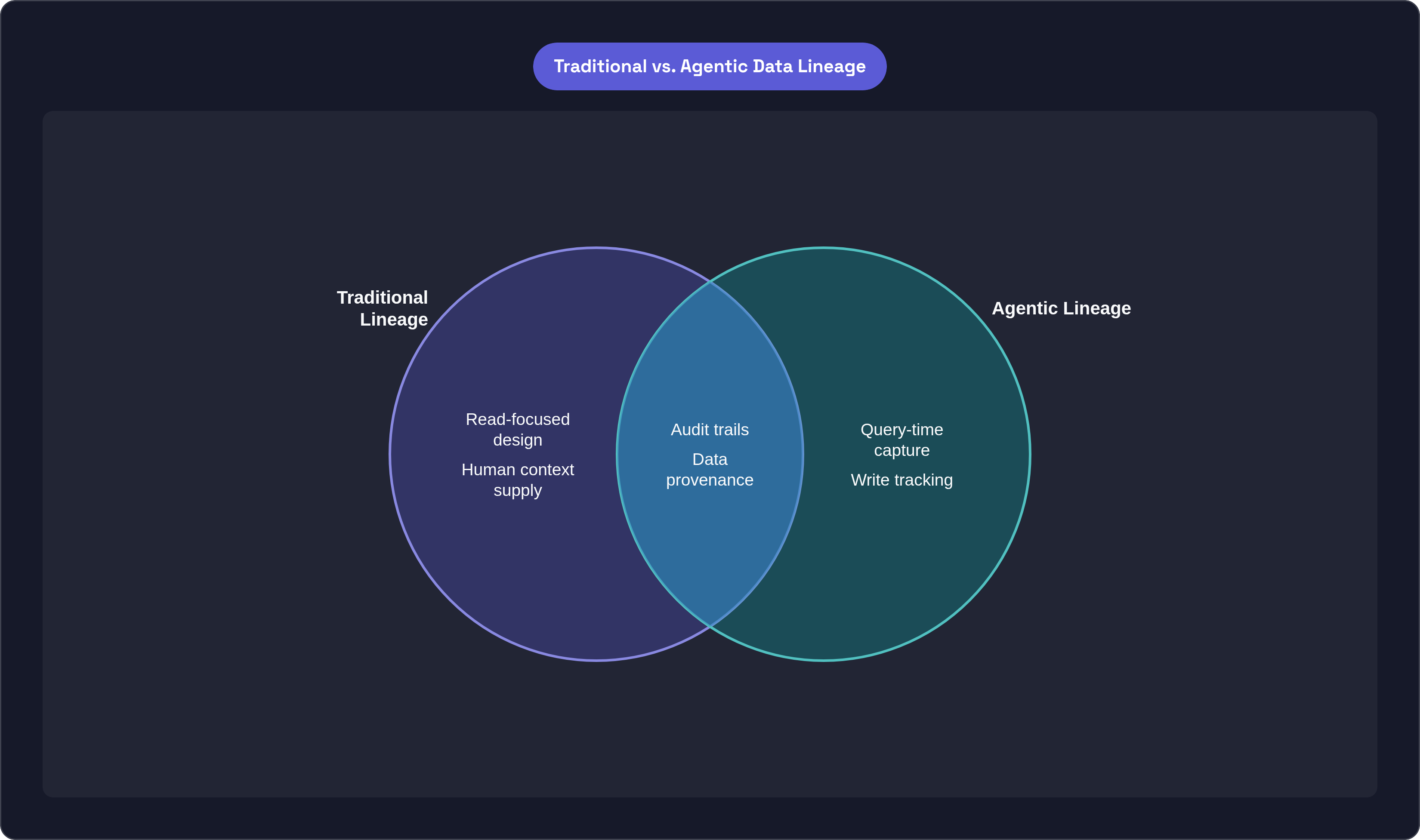
Then there is the write problem. Traditional lineage was largely built around reads, which makes sense given that analysts were the primary consumers. Agents act on data: updating metadata, routing alerts, proposing schema migrations, writing results back into operational systems. A misconfigured agent can propagate bad data downstream before any human notices. That is a fundamentally different risk profile, and the lineage infrastructure most enterprises inherited was not designed to handle it.
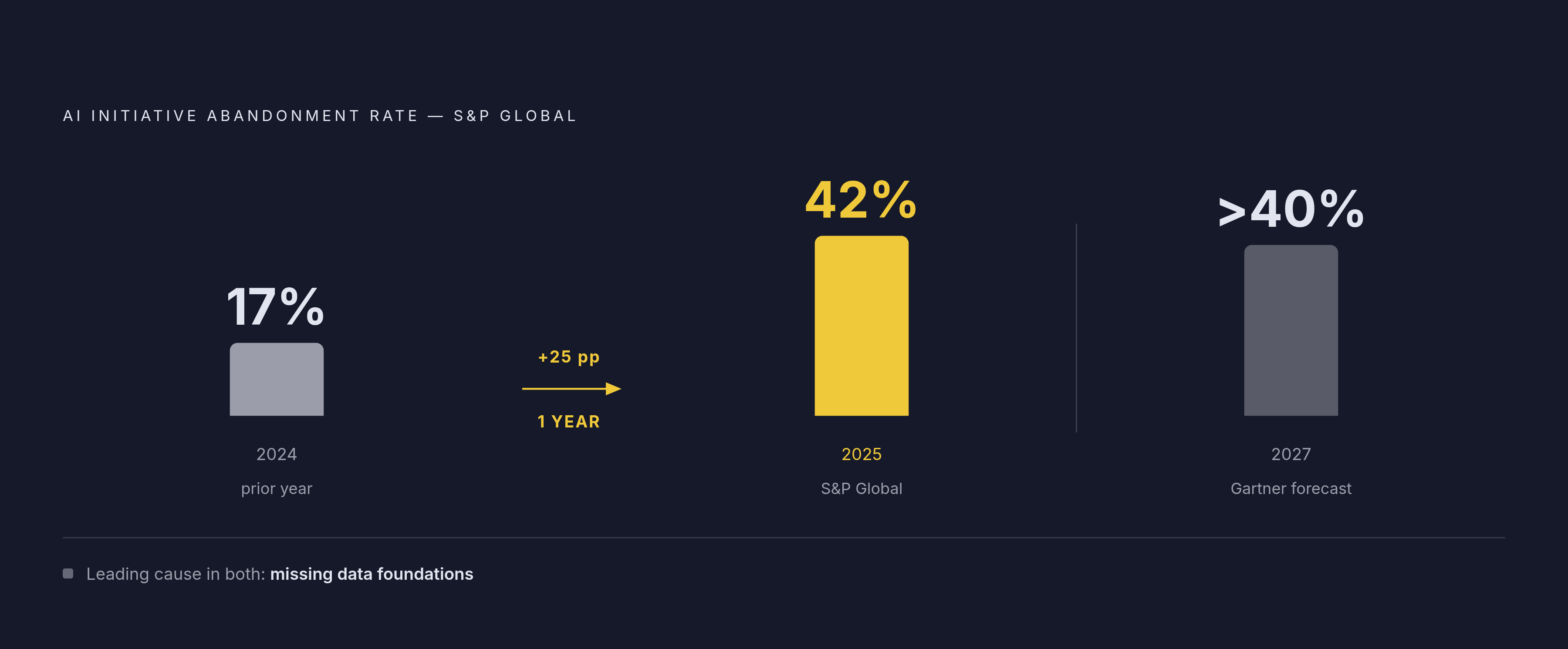
Gartner forecasts more than 40% of agentic AI projects will be cancelled by the end of 2027, with missing data foundations cited as the primary cause. That number reflects what happens when you deploy autonomous systems on top of infrastructure designed for a different era.
What Lineage Actually Needs to Capture in an Agentic Pipeline
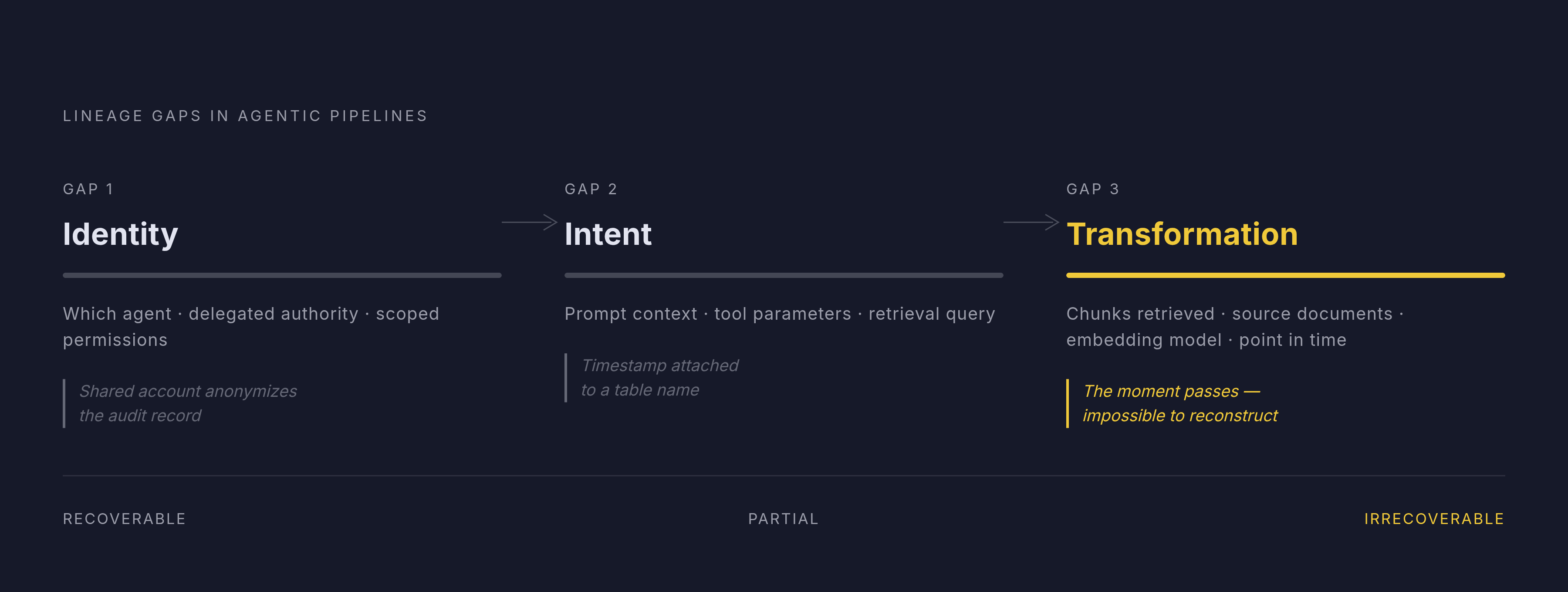
Most lineage implementations today record what moved and where it went. That was sufficient when the consumer was a person who could supply missing context from their own knowledge of the business. Agents cannot supply that context. So the lineage record has to carry it instead.
Identity is the first gap, and it is worth being specific. Knowing which agent, or which human acting through an agent, issued a query, under whose delegated authority, and with what scoped permissions, is not optional. A shared service account is not an identity. It is an anonymization layer that renders audit records useless at the exact moment you need them most. I have watched debugging sessions stall for hours because a query was attributed to a generic service account that four different workloads were sharing. The log existed. It told us nothing.
Intent is the second gap. The prompt context, the tool call parameters, the retrieval query, these explain the purpose behind an access event. Without them, an audit record is a timestamp attached to a table name. It cannot tell you whether the agent was executing a legitimate task or had drifted outside its intended scope. That distinction matters to regulators. It matters more to the engineer trying to understand why production behaved the way it did at 2 a.m.
Transformation is the third, and retrieval-augmented generation pipelines make this particularly demanding. Which chunks were retrieved, from which source documents, using which embedding model, at what point in time, all of that is part of the provenance chain of any output the agent produces. Lineage capture has to happen at query time because reconstructing it afterward is often impossible. Source schemas drift. Retrieval contexts are not preserved. The moment passes.
There is also a sensitivity problem that only shows up at combination time. An agent joining two individually innocuous fields can produce a composite that is sensitive in ways neither field's classification would flag alone. Lineage that evaluates sensitivity at the individual field level is missing a significant portion of the actual risk surface, and it is not an edge case. It is a routine occurrence in any pipeline doing meaningful enrichment.
Why Semantic Context Is a Prerequisite for Meaningful Lineage
You can build a perfect record of every data movement across a pipeline and still have lineage that cannot tell you whether the agent used the data correctly. This took me longer to fully internalize than I would like to admit, partly because the traditional mental model frames lineage as a tracking problem, and tracking problems feel solved once the tracker is working. Movement without meaning is incomplete provenance. The tracker working is not the same as the tracker being useful.
A semantic layer maps raw fields and schemas to business definitions, metric logic, entity relationships, the calculation rules that transform a column of numbers into a figure that actually means something to the business. Without that mapping, lineage traces a field from source to output but cannot confirm whether the agent resolved it against the right definition. You know the data traveled. You do not know whether it arrived as the right thing. That distinction is what separates a compliance-grade audit trail from a log file.
Gartner elevated the semantic layer to essential infrastructure in its 2025 Hype Cycle for BI and Analytics, projecting that by 2030, universal semantic layers will be treated as critical infrastructure for enterprise AI. The framing matters because it signals where investment is heading, not where it would be nice to go eventually.
In agentic pipelines, semantic context does two jobs simultaneously. At query time, it gives the agent the table descriptions, metric definitions, and relationships it needs to generate answers that are actually correct rather than syntactically valid. In the lineage graph, it records which definition the agent resolved against, so an audit can confirm not only that the agent read a column but that it read it with the right meaning attached.
The propagation implications are significant and often underappreciated. Classify a column as PII once, and lineage propagates that classification to every downstream asset automatically. Agents inherit those classifications without additional configuration. When a quality check fails upstream, the lineage graph surfaces every downstream dashboard, pipeline, and agent affected. Notification before an agent acts on stale data, rather than discovery after the consequences have already traveled downstream.
The Open Semantic Interchange, launched in 2025 with collaboration from dbt Labs, Snowflake, and Salesforce, uses MetricFlow as a vendor-neutral declarative specification. The premise is defining metrics once so they are consumed consistently by every tool and agent in the chain. Without that shared grounding, sub-agents return results using different metric logic than the orchestrator expects. Lineage records the divergence. It cannot prevent the divergence if definitions were never standardized in the first place.
What a Query-Time Lineage System Looks Like in Practice
The architecture that is actually working in production today starts with continuous replication. Change data capture feeds a stream processing layer that validates and transforms operational data in real time, routing governed data to AI destinations: feature stores, vector databases, agents via protocols like MCP. The distinguishing characteristic is not the replication. It is where lineage capture happens, at the query layer, not reconstructed afterward from whatever logs happened to survive.
Every query is logged with the real user identity, not a service account. The agent workload identifier is recorded. The semantic context resolved at the time of the query is preserved alongside the permission state at that exact moment. Crucially, the permissions enforcement and the lineage record share the same event. They are not two separate systems that need to be correlated after the fact by someone who is already stressed about a production incident and working from incomplete information.
Agent workload isolation matters here more than most architects initially budget for. Revoking one agent's access cannot cascade into breaking every downstream process that shares the same service account. That kind of tight scoping is only achievable if lineage and access control were designed together from the start, not bolted onto each other six months after the agents were already running in production. I have seen the latter approach, and the remediation work is genuinely painful.
Freshness requirements are use-case-specific, and the lineage record has to reflect that explicitly. A snapshot acceptable for a quarterly dashboard is already stale for an agent making an operational routing decision. The lineage artifact needs to include the timestamp of the data state the agent acted on, not just the timestamp of the query. Those are not the same thing, and conflating them produces audits that are technically complete and practically misleading.
Structured lineage also needs to be queryable as a first-class system. Reconstructing an agent's exact join path or metric resolution from vector embeddings of log text is not reliable enough to satisfy an auditor. The artifact needs to support structured queries, not interpretation. That requirement tends to get underestimated until the first serious debugging session or compliance request, at which point it becomes obvious.
The viable path for most enterprises is a governed query layer on top of existing warehouses and operational systems, exposing a single interface with lineage and semantic context built into every query from the start. This does not require ripping out existing warehouse infrastructure.
The Governance Pressure That Makes Query-Time Lineage Unavoidable
The EU AI Act, GDPR, CCPA, and HIPAA each require audit-ready documentation of data usage, transformation tracking, and lawful basis validation throughout the AI lifecycle. That is the current legal baseline across several major jurisdictions, and the sectoral regulations layering on top are multiplying.
IDC's "Trust Before Autonomy" data from IDC Directions Boston 2026 found AI-ready data architecture at 45.7% as the top AI adoption priority, overtaking AI business strategy and AI infrastructure. AI governance rose to 38.5% in the same dataset. A study from Drexel University and Precisely found 62% of organizations cite lack of data governance as the primary barrier to successful AI initiatives. Not model quality. Not compute. Not talent.
Audit logs in agentic systems must capture identity, intent, and lineage together. At agent-level query volumes, a log that records only what was accessed is functionally useless for compliance and nearly as useless for debugging. Regulators are also beginning to treat agent-initiated writes differently from reads, which is a meaningful distinction that most current lineage implementations do not make. A lineage system that treats them equivalently will fail to satisfy a regulator who wants to know exactly what an agent changed and under whose authority the change was made.
Gartner projects the global AI governance software market past $5 billion by 2027. That number reflects enterprises recognizing that the compliance pressure is structural, not a temporary condition they can defer until after they have figured out the interesting parts of building with agents.
What the Lineage Gap Costs When Agentic Pipelines Operate Without It
Only 29% of technology leaders strongly agree their enterprise data meets the quality, accessibility, and security standards needed to scale generative AI, according to the 2024 IBM Institute for Business Value survey. That gap is felt most acutely when agents are the consumer, because agents have no tolerance for ambiguity and no internal mechanism for surfacing when something has gone wrong.
Silent failure is the defining risk. An agent without lineage backing produces a wrong answer that looks identical to a correct one. No error state, no flag, no rollback trigger. The failure is invisible until its consequences materialize downstream, often far removed from the original point of failure, often after several other agents have already acted on the bad output as though it were trusted. By the time anyone notices something is wrong, tracing the contamination back to its source is an exercise in forensic archaeology.
Without query-time lineage, debugging an agent failure means trying to reconstruct the data state the agent saw at the moment it made a decision. That reconstruction is frequently impossible. Source schemas drift. Retrieval contexts are not preserved. Intermediate derivations were never captured. You are left inferring what happened from the output, which is precisely the kind of guesswork that lineage exists to eliminate. I have been in that position, and the experience has a way of clarifying priorities.
The compliance exposure is concrete. If a regulator asks which training data contributed to a specific inference decision and lineage does not connect training provenance to runtime decisions, the answer is "we don't know." That is not a defensible position under the EU AI Act, and it is worth internalizing that "we don't know" is not just a compliance failure. It is an engineering failure.
S&P Global's 2025 Voice of the Enterprise survey found 42% of companies abandoned most of their AI initiatives, up from 17% the prior year, with data foundation failures as the leading cause. In multi-agent systems the compounding dynamic is particularly punishing: one agent's bad output, untracked, becomes the next agent's trusted input. The error propagates through the chain carrying the same confidence signal as correct information, and nothing in the architecture flags the contamination until consequences are already distributed across several downstream systems.
Lineage is not a post-launch audit tool for agentic pipelines. It is a prerequisite for the pipeline operating correctly at all. Organizations treating it as a compliance checkbox are learning that lesson in the most expensive way available.