Data Governance Policy Templates for AI Initiatives
AI-driven systems fail due to data governance gaps, not flawed models.

Most AI initiatives don't fail because the model was wrong. They fail because the data layer had no policy governing what the agent could see, how fresh the data needed to be, or what a field actually meant. Standard data governance policy templates were built for a world where humans were the primary data consumers, and that assumption is now the single biggest structural liability in enterprise AI programs. The policy components AI initiatives actually need don't exist as addenda to existing templates; they require a different architecture from the ground up.
What the failure statistics actually point to as the root cause
The numbers are striking enough to demand explanation. According to RAND Corporation research, more than 80% of AI projects fail to reach meaningful production deployment, roughly twice the failure rate of traditional IT projects. Of the $684 billion invested globally in AI initiatives in 2025, over $547 billion failed to deliver intended results. S&P Global's 2025 survey found that 42% of companies abandoned most of their AI initiatives that year, up from 17% the year prior, with the average organization scrapping 46% of AI proof-of-concepts before production.
The instinct is to blame the model. That instinct is wrong.
Gartner's 2025 research attributes 84% of AI project failures to data issues, unviable business cases, lost executive sponsorship, and infeasible technical approaches. Data issues alone account for 38%, dwarfing every other category. Only 7% of organizations describe their data as completely ready for AI. The mechanism plays out the same way, repeatedly: an agent receives stale, context-free, or improperly scoped data, produces a confidently wrong answer, erodes stakeholder trust, and the initiative stalls.
The gap between AI adoption and AI governance is where this happens. Economist Impact's research shows 88% of companies use AI in at least one function, yet only 8% maintain a comprehensive AI governance framework.
This is a governance failure. It is addressable. It starts with understanding what standard templates were never designed to do.
What makes an AI governance policy template structurally different from a standard data governance policy
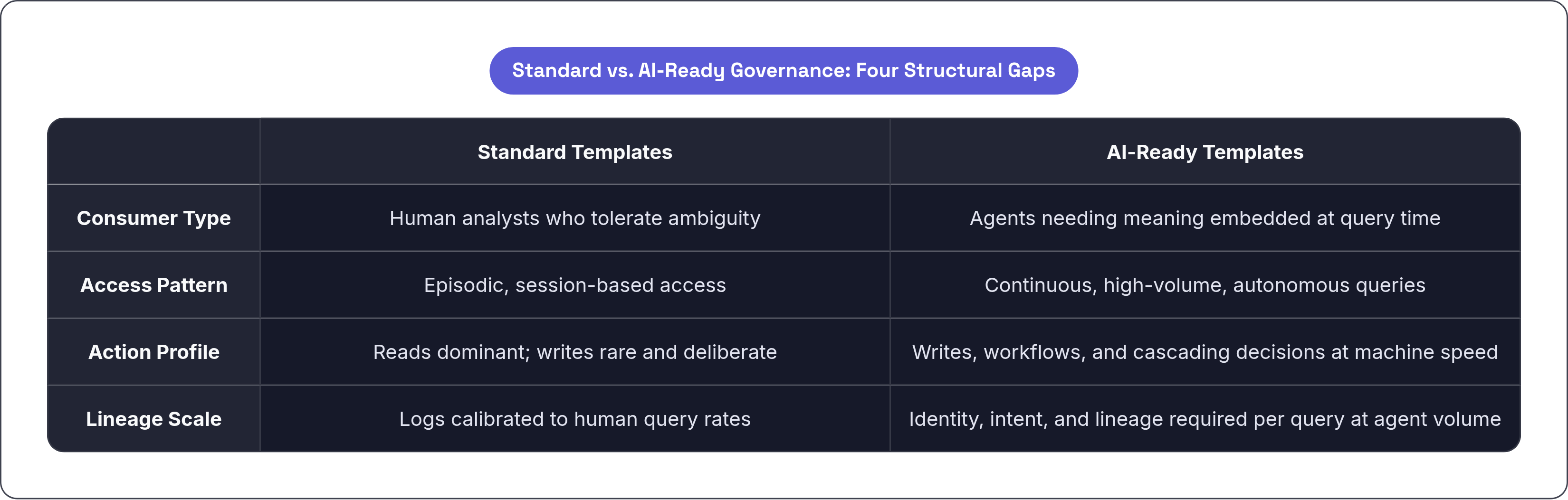
Adding an "AI section" to an existing policy template is the wrong move. The issue isn't a missing appendix; it's that the foundational assumptions embedded in every component of a standard template no longer hold. You can't patch assumptions. You have to replace them.
Four structural differences define the gap.
The first is consumer type. Human analysts tolerate ambiguity. They ask follow-up questions, apply judgment, and recognize when something looks off. AI agents cannot do any of that. They need meaning embedded in the data itself, at query time, every time.
The second is access pattern. Humans access data episodically: they open a dashboard, run a report, close the session. Agents query continuously, at volume, and often autonomously. Per-session access controls were designed around human rhythms and break immediately under agentic workloads.
The third is action profile. Human-centric governance treated reads as the dominant action because humans were doing the reading. Agents increasingly write, trigger workflows, and cascade decisions downstream, at machine speed, without human review at each step. Read and write governance are no longer equivalent risk categories, but most templates still treat them that way.
The fourth is lineage scale. Audit logs designed for human query rates become functionally unreadable when agents issue queries continuously. Without identity, intent, and lineage captured together per query, the log is noise.
The downstream implication is this: every standard template component, scope, roles, data classification, access control, and audit, needs a parallel AI-specific formulation. Not an addendum. A parallel structure. Deloitte research indicates that 74% of organizations plan to adopt agentic AI within two years, while only 21% currently have a mature governance model for AI agents. Most will reach for existing templates and apply them unchanged. That choice is where the next wave of failures gets seeded.
Scope and purpose: defining what the policy covers and what it doesn't
Standard templates define scope by system boundary or user role. "All data in the enterprise data warehouse." "Users with analyst permissions." Neither formulation captures an autonomous agent, a training pipeline, or an automated decision system, because none of those existed as primary actors when the templates were written.
An AI-ready scope statement must explicitly enumerate what it governs. Autonomous agents, including third-party agents with delegated access. AI pipelines that move or transform data as part of model training or inference. Automated decision systems that act on query results without human review. Orchestrators that coordinate multi-agent workflows and, critically, inherit permissions across steps.
The purpose clause requires the same precision. "Data quality" and "data access" aren't sufficient anymore. The purpose must specify what the policy governs at the intersection of AI and data: semantic accuracy, runtime permission enforcement, and agent-level auditability. Those three things don't appear in standard purpose clauses because they weren't operational concerns when the templates were drafted.
Risk classification by AI use case matters here too, not just by data sensitivity. A read-only analytics agent and a write-capable decision agent operating on the same dataset require different scope treatment. The policy must reflect that distinction explicitly, or the scope will be applied uniformly where differential treatment is required.
Finally, explicitly carving out what the policy does not cover prevents conflation that creates enforcement gaps. Model training governance is a different domain from data access governance. Conflating them doesn't create coverage; it creates confusion about who is accountable for what.
Roles and accountability in a world where the data consumer may not be a person
The RACI model that underpins most standard data governance templates assumes humans at every node: data owner, data steward, data consumer. It's a clean model for a world where humans are the actors. That world is gone for most AI programs.
AI governance templates must define accountability for non-human consumers without abandoning human accountability for their behavior.
Every AI workload needs a named human owner. Not a service account. Not a team alias. A named, accountable person or specifically designated group responsible for that agent's behavior and data access. Call the role what you want, AI workload owner is a reasonable designation, but the principle is non-negotiable: every non-human actor in the data environment must trace back to a human who is responsible for what it does.
The semantic layer needs a dedicated steward too. Agents rely on certified metric definitions, table descriptions, and relationship mappings to function correctly. Someone must own those artifacts, maintain them, and certify their accuracy. This role doesn't exist in most standard templates because human analysts could compensate for metadata gaps by applying judgment. Agents cannot.
Pipeline accountability is the third gap. When an automated pipeline produces data that an agent acts on incorrectly, standard RACI frameworks produce ambiguity about who is responsible. The template must specify this explicitly.
Multi-agent orchestration creates a chain-of-accountability problem that deserves direct attention. When agent A calls agent B, which queries data and triggers a write, accountability can evaporate entirely if the template doesn't specify how it propagates. The practical requirement: every AI workload registered in the governance system must have a named human owner, a defined access scope, and a revocation path that is independent of other workloads. Access tied to a shared service account, where revoking it breaks everything downstream, is a governance anti-pattern that templates should explicitly prohibit.
Data classification for AI: why sensitivity must be evaluated where data is combined, not where it originates
Standard data classification labels fields or datasets at the source. A column gets a tag: PII, confidential, restricted. The label travels with the column. That model made sense when humans were querying data in relatively bounded ways. It breaks under agentic workloads.
AI agents routinely join datasets across sources in ways no human analyst would assemble manually, and the sensitivity of the combination can exceed the sensitivity of any individual field by an order of magnitude. Consider a straightforward example: a name column with low individual sensitivity, joined to a psychiatric diagnosis column and a location column, produces a re-identifying record of high sensitivity. None of the three source-level labels reflects that. The combination is what the agent sees.
The template requirement is direct: classification policy must specify that sensitivity is evaluated at the point where data is combined. Join-time and query-time classification, not only ingestion-time labeling.
AI pipelines compound the issue further. An agent may traverse multiple data sources in a single inference step, assembling a composite record that no human ever reviewed for sensitivity classification. The template needs to address this with combination rules: which field types, when joined, automatically escalate the composite record's sensitivity classification. It must also require query-time classification checks, not just column-level tags. And it must log the combined output's effective sensitivity alongside the query, not just the inputs used to generate it.
This is one of the larger structural gaps between standard templates and what AI workloads require. Most organizations will need to develop the combination rules themselves; there is no established standard to inherit.
Semantic context as a policy requirement, not an optional metadata practice
When a large language model agent encounters a raw field labeled something like custsegcd, it has no way to infer what that means in the business context. It guesses. A wrong guess produces an answer that looks valid and is factually incorrect. The model doesn't know it guessed wrong, and neither does the end user until the damage is visible.
Research on governed semantic layers shows that a significant majority of organizations report conflicting metric definitions across teams, which reduces trust and slows decision-making. Agents inherit this inconsistency and amplify it at whatever speed they operate.
The semantic layer is not a metadata nicety. It is the mechanism by which agents receive certified definitions, enforced relationships, and unambiguous metric logic at query time. Gartner elevated the semantic layer to essential infrastructure in its 2025 Hype Cycle for BI and Analytics, and that designation reflects what practitioners have been learning the hard way: agents operating without a governed semantic layer are operating on guesswork, not knowledge.
What the AI governance policy template must require in its semantic context component is specific. Mandatory table and column descriptions: no dataset may be exposed to an AI agent without human-reviewed, version-controlled definitions attached to every queryable object. Certified metric definitions: terms like "revenue," "active customer," and "churn rate" must have a single governed definition registered in the semantic layer, so any AI query referencing those terms resolves to the certified definition, not to whatever SQL the agent constructs. Relationship documentation: foreign key relationships, temporal validity of joins, and hierarchical relationships must be explicitly declared, not inferred. Freshness SLAs per metric: every exposed metric must carry a documented freshness requirement tied to its specific use case, because a snapshot acceptable for a monthly board report may be dangerously stale for an agent making a real-time pricing decision.
McKinsey's 2025 State of AI found that while 88% of companies use AI in at least one function, roughly only a third have successfully scaled it, with inconsistent business logic cited as a major barrier. The semantic layer is the structural fix that template policy must mandate, not suggest.
Query-time access control: why provisioning-time permissions are insufficient for AI workloads
Standard access control templates were built around a simple model: a human authenticates, receives a role, and that role governs everything downstream in the session. The permission check happens once, at provisioning or login. For a human analyst who accesses data as themselves, for their own purposes, this model is adequate.
AI agents don't work that way. A single agent may act on behalf of dozens of different end users within the same session. The data it may appropriately return to user A is not the same data it may appropriately return to user B. If the agent is authenticated under a broad service account, it inherits the account's maximum permissions and passes those along to every end user, regardless of whether that user has the right to see what the account can see. This is the service account anti-pattern, and it is pervasive. The template must explicitly prohibit it.
The required shift is to permissions evaluated at query time, scoped to the actual end user's identity, not the agent's service identity. Row-level and column-level security must be enforced at the data layer, not at the model or prompt layer. Relying on the model to self-censor data it was never supposed to receive is not a governance control; it is a hope. The EU AI Act's structure for high-risk AI systems supports this directly: it requires demonstrable access controls that can be verified per deployment, and provisioning-time grants don't produce the evidence trail that verification requires.
The template also needs workload-scoped revocation. Revoking one agent's access must not cascade to other workloads sharing infrastructure, which means permissions cannot be structured around shared accounts or shared roles. Time-bounded access grants are required for elevated access scenarios: agents that need elevated permissions for a specific task receive them for a defined window, not permanently. Permanent elevated access is an audit finding waiting to happen.
Write governance: the policy component that barely exists in standard templates
Human-centric governance templates treat reads as the primary access pattern and writes as a privileged variant requiring explicit approval. The risk differential between the two was manageable because humans authored writes deliberately, one at a time, with at least some cognitive overhead applied to each action.
Agentic AI has changed the calculus entirely. Agents increasingly write to databases, update records, trigger downstream workflows, and initiate transactions, at machine speed, without human review at each step. A stale read produces a bad answer. An incorrect agent write can propagate errors across every downstream system consuming that record before anyone detects the problem. The blast radius of a write error is not bounded by the agent; it extends to everything downstream.
Standard templates are almost entirely silent on this. Most organizations building agentic AI programs will need to draft the write governance component from scratch rather than adapt existing language.
What that component must cover: an explicit enumeration of which agents are permitted to write, to which tables or systems, under what conditions. Write access is not a default capability implied by read authorization; it must be separately and explicitly granted. Human-in-the-loop thresholds: the template must define the conditions above which an agent write requires human confirmation before execution. Those conditions should address record count, financial magnitude, and irreversibility of action. Write rollback and audit requirements: every agent write must be logged with the agent identity, end-user identity, the specific records modified, and a documented rollback path. And cascade impact assessment: agents operating in environments where their writes feed downstream systems must carry documented assessments of the potential blast radius of an incorrect write.
None of this is exotic. All of it is missing from standard templates.
Audit and lineage at agent-level volume
Standard audit templates log who accessed what data and when. That design was calibrated for human query rates, where a few hundred queries per day per user represents significant activity. It functions adequately at that scale.
AI agents can issue thousands of queries per minute. A log that captures the same fields at that volume becomes computationally expensive to store, nearly impossible to audit manually, and useless for incident investigation if it doesn't capture intent and lineage alongside identity.
An AI audit log must capture three things together, not separately. Identity: the end-user identity on whose behalf the agent acted, not just the agent or service account identifier. Without end-user identity, the log records that something happened but cannot attribute it to a human actor, which means it satisfies no accountability requirement. Intent: the prompt or task context that triggered the query. Without intent, a log entry showing that a sensitive table was accessed at 2:47 a.m. carries no actionable information; it cannot distinguish a legitimate automated process from a security event. Lineage: the full chain of data movement and transformation that produced the output, including every intermediate step in a multi-agent workflow. When an agent's output is wrong and downstream systems have already consumed it, lineage is the only mechanism for understanding what happened and containing the damage.
The practical implication is that AI audit infrastructure requires different design than human audit infrastructure. Sampling strategies for high-volume logging, graph-based lineage capture rather than flat log tables, and automated anomaly detection to surface events worth human review: these are architectural choices that the policy must mandate, because they won't emerge from applying human-analytics audit templates at scale. The policy must specify what the audit system is required to capture, at what fidelity, and what constitutes a reviewable event, because at agent-level volume, no one can review everything. The template's job is to ensure that the right things are never missed.