Dynamic Data Masking for AI Workloads
Dynamic masking evaluates sensitivity at query time, not copy time.

Start with the basic mechanics, because the distinction matters more than most practitioners give it credit for.
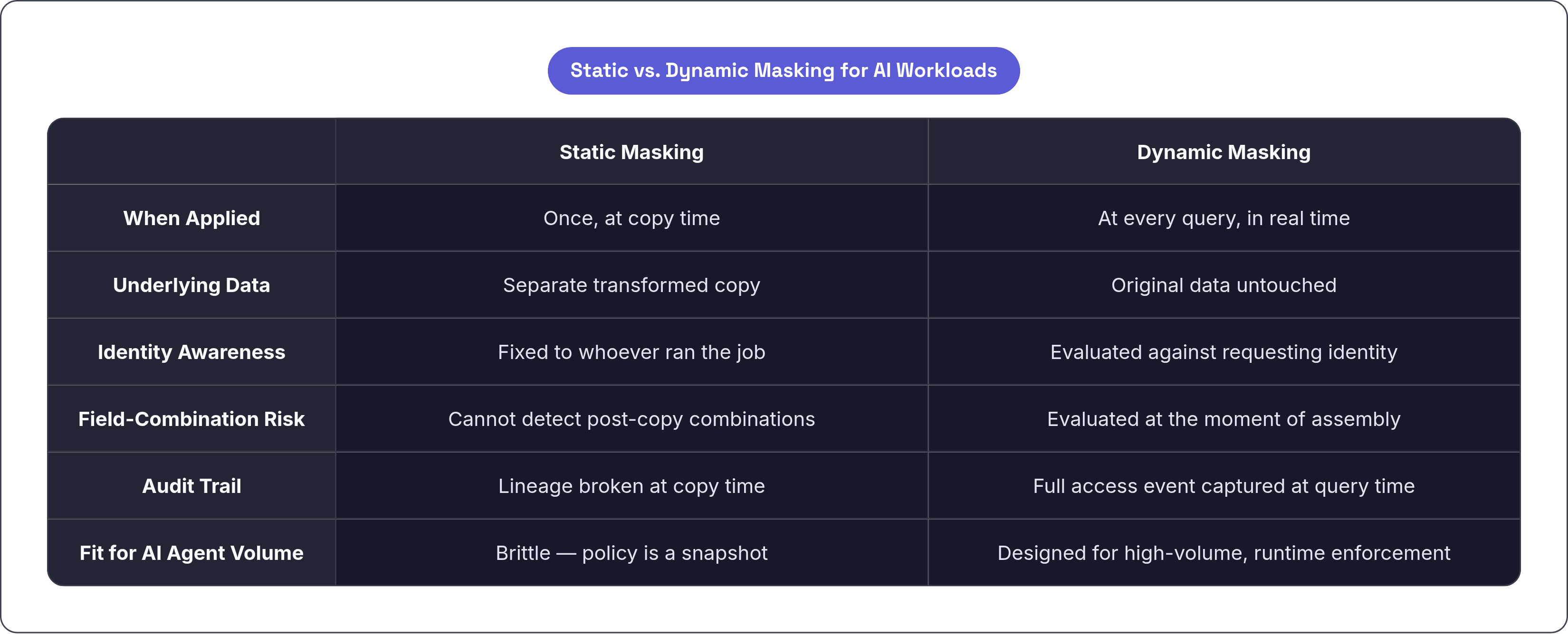
Static masking produces a transformed copy of the data. A test database, a masked export, a staging environment. Sensitivity is resolved once, at copy time, by whoever ran the masking job. From that point forward, the copy is fixed, reflecting the world as it existed when the job ran. That is already a problem before an AI agent ever touches it.
Dynamic masking works differently. It intercepts the query at runtime, rewrites the result set before it reaches the requester, and leaves the underlying data completely intact. The same physical table returns different results depending on who is asking. A compliance officer sees a full SSN; a customer service agent sees four masked digits; an AI agent sees a token, or nothing at all. The masking policy is evaluated at query time, against the requesting identity, not against whoever originally classified the dataset.
Here is where it gets interesting, and where I have watched a lot of well-intentioned architectures quietly fall apart. A static masked copy carries a fixed point-in-time sensitivity classification. By the time an agent queries it, the classification may already be wrong, the data stale, and the particular combination of fields that query assembles may produce a sensitivity level none of the individual fields carried on their own. The copy cannot know that. Static masking is a snapshot pretending to be a policy — like a photograph of a locked door standing in for the lock itself.
The dynamic masking market was estimated at USD 0.48 billion in 2025 and is projected to exceed USD 1.0 billion by 2030, per Mordor Intelligence. That growth is being driven by operational analytics and API-access scenarios, which is exactly the pattern AI workloads represent, not by test data management.
How AI Agents Query Data Differently from Human Analysts, and Why That Changes the Risk Surface
A human analyst making a privacy-sensitive query usually knows they are doing it. They slow down. They check with someone. Or, at minimum, there is a moment of institutional hesitation before they proceed. An AI agent does not experience that moment. It resolves ambiguity probabilistically from column names and schema patterns, and it proceeds. The analyst has a conscience; the agent just has a connection string.
The field combination problem is where static masking breaks down fastest. A query joining name, employer, ZIP code, and a health-status flag does not trip a single-field masking rule. Each field, individually, passes a naive policy check. But the combination is re-identifiable. Sensitivity must be evaluated at the point where fields are combined, not at the individual field level, and a masked copy made before that combination was ever contemplated cannot make that evaluation retroactively.
Volume accelerates everything. Agents do not run five queries per session; they run hundreds or thousands, each with a slightly different join or filter. A masking system evaluated at ingestion time cannot anticipate a combinatorial space it never encountered.
Multi-agent chains introduce a second compounding problem. Agentic workflows pass results from one agent to the next, and a masking decision made against agent one's credential does not automatically carry forward to agent two unless identity is explicitly threaded through the entire chain. Most architectures today do not thread it. The result is a masking policy correctly applied to the first retrieval and then quietly dissolved as the result moves downstream. Call it a relay race where the baton gets handed off but the rules of the race do not.
There is also the inference surface to reckon with, which is distinct from the retrieval surface. Models trained on enterprise data carry a risk that query-time masking on the retrieval path does not fully address: models can memorize and reproduce portions of training data in their outputs. Masking at query time applies to live inference, not to training pipelines. These are different enforcement surfaces, and conflating them creates blind spots that neither architecture alone covers.
Gartner predicts 40% of enterprise applications will integrate AI agents by end of 2026, up from less than 5% in 2025. Most enterprises are scaling agent access before they have masking architectures designed for that access pattern.
Why Enforcing Masking Under the Actual Requesting Identity Is the Load-Bearing Requirement
Most enterprise AI systems today connect to data via a shared service account with broad permissions. Every agent query runs under that identity, regardless of which user or workflow triggered it. It is an understandable infrastructure shortcut; it keeps deployment simple. It is also where the governance architecture collapses.
The first consequence is forensic. Audit logs record the service account, not the human or agent that actually initiated the query. At agent-level query volume, those logs become noise. There is no practical way to reconstruct which workflow triggered which access, which user authorized which agent, or which combination of fields was exposed to which downstream system.
The second consequence is policy. Masking rules scoped to the service account apply the same transformation to every query, whether a low-clearance agent or a privileged analyst is asking. The identity dimension that makes masking meaningful is absent entirely.
Identity passthrough resolves both problems simultaneously. The authenticated identity of the actual requester, whether a human user, a named agent, or a specific workload, is carried into the database with the query. Masking policy is evaluated against the right principal. Permissions become revocable at the workload level; if one agent is compromised or a workflow is retired, its access can be pulled without disrupting the shared account every other agent depends on.
Traditional access control frameworks were not built to evaluate context-dependent decisions at agent query volume. They cannot simultaneously factor in user role, data sensitivity, the specific combination of fields being joined, and regulatory jurisdiction. Query-time enforcement is the only point in the pipeline where all four variables are present at once: who is asking, what they are requesting, what the result will contain, and what policy requires. Anywhere else, at least one of those variables is missing.
What Governance Data Shows About Enterprises Operating Without This Architecture Today
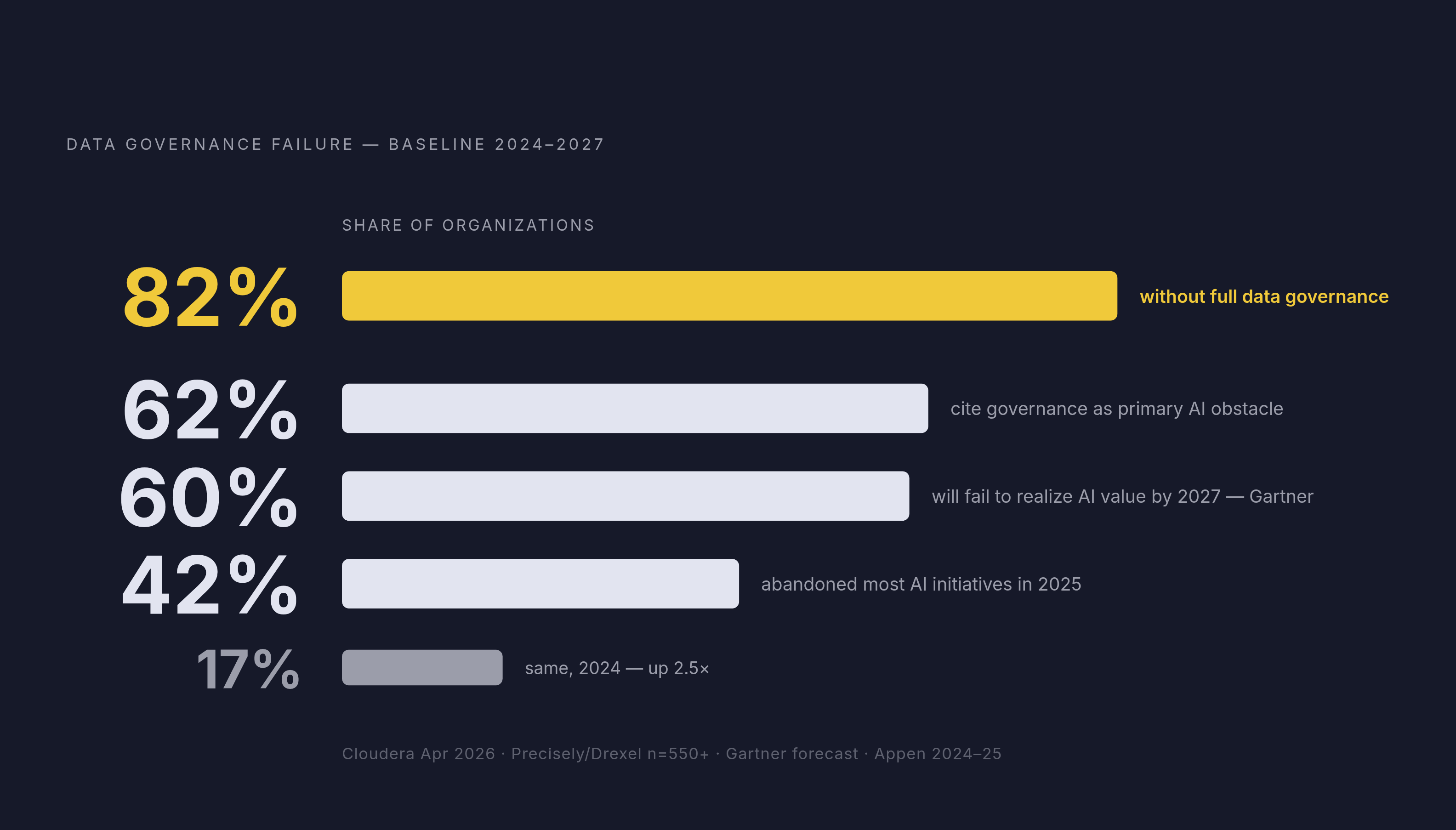
The governance gap is not a projection. It is the current baseline, and the numbers are uncomfortable.
Only 18% of respondents told Cloudera, in research published April 2026, that their data was fully governed. The other 82% are deploying AI agents into a data environment where masking, lineage, and access controls are, at best, partial. A survey of more than 550 professionals conducted by Precisely and Drexel University found that lack of data governance is the primary data challenge inhibiting AI initiatives, cited by 62% of organizations. Only 12% report their data is of sufficient quality and accessibility for effective AI implementation. Nearly nine in ten organizations have already identified the problem and have not resolved it.
The production consequences are measurable. S&P Global's 2025 survey found 42% of companies abandoned most AI initiatives that year, up from 17% in 2024. The average organization scrapped 46% of AI proof-of-concepts before reaching production. These are not model failures. The research consistently points to the same cluster: fragmented data, inconsistent definitions, missing governance frameworks.
Gartner's standing prediction is that 60% of organizations will fail to realize anticipated value from AI use cases by 2027, specifically because of incohesive data governance. That describes the architectural choices most enterprises are making right now.
The masking problem is one instance of that same root cause. Treating it as an isolated technical configuration misses what it actually is: a symptom of a broader governance posture. The enterprises that close the gap will be the ones that recognize masking as a governance decision, not a pipeline configuration task.
The Role of a Semantic Layer in Making Query-Time Masking Decisions Accurate
A masking rule that says "mask fields tagged PII" cannot evaluate a join that produces re-identifiable output from fields that are, individually, non-PII. It needs to understand what the combined result means. That is the work a semantic layer does, and it is work that most data architectures have underinvested in.
A semantic layer documents what entities, metrics, and relationships mean in business terms: which fields represent the same concept across different source systems, how a metric is calculated, what constitutes a sensitive combination. Without it, an AI agent resolves ambiguity from column names and schema patterns. It correctly infers that "custaddrzip" and "zip_code" are related, but it does not know they are the same field from two separate systems that, when joined, produce a re-identifiable record. The roads are all there in the schema; the semantic layer is what tells you which ones lead somewhere dangerous.
The failure mode is concrete. Gross margin is not a single field. It involves cost allocation, returns processing, promotional discounts, shipping adjustments, and the specific formula varies by business unit. An agent querying without semantic context produces a number that looks correct but uses the wrong logic for that context. Multiply that by the combinatorial query space agents operate in, and the error surface becomes substantial very quickly.
For masking specifically, the semantic layer is where sensitivity classifications can attach to business concepts rather than just physical columns. A masking rule travels with the meaning, not just the field name, across every system that surfaces that concept. Certified metric definitions and access policies defined once in the semantic layer and evaluated at every query produce consistent masking decisions across agents, users, and systems. The alternative is recalculating policy differently in each pipeline that touches the data, which is precisely how inconsistencies compound into exposures.
What a Query-Time DDM Architecture Looks Like in Practice for AI Workloads
The structural requirement is clear, even when the implementation is not. Queries from AI agents route through a governed query interface rather than directly to the database, so every request passes through a policy evaluation layer before any data is returned.
That interface carries the requesting identity. The authenticated principal, whether a human user, a named agent, or a specific workload, is threaded through the query rather than replaced by a service account at the connection layer. That threading is what makes everything downstream meaningful. Without it, you are back to a shared account and all the forensic problems that follow.
Masking rules are evaluated against that identity at the moment the result set is assembled, before results are returned, not applied to a static copy in advance. The evaluation is context-aware: who is asking, what the agent is doing, what the data contains, whether the combination of fields in the result crosses a sensitivity threshold. This is not a simple role-based access control lookup; it is runtime policy resolution with all relevant variables simultaneously present.
Every query is logged with the requesting identity, the query itself, the masking decisions applied, and the lineage of what data was touched. That combination is the only way to reconstruct what an agent actually saw and what it was permitted to see.
Routing through a single governed interface also produces a practical operational benefit worth naming. An agent needing data from multiple source systems makes one request and receives governed results. Federation is handled at the infrastructure level, and masking is applied consistently regardless of which source system the data originated from.
Write actions deserve separate treatment. An agent that can both query and act on results needs stricter masking and approval controls on the write path. A wrong unmasking decision at read time is contained; a wrong decision that triggers a write action is not recoverable in the same way. The risk profile shifts when retrieval connects to action, and the architecture has to reflect that shift explicitly.
Where DDM Enforcement Breaks Down When It Is Left to the Model or Prompt Layer
A prompt instruction like "do not return PII" is a request. The model follows it or does not. Compliance is probabilistic, not architectural. That single distinction is the entire problem.
Model-layer filters operate after the data has already been retrieved. The sensitive field reached the model's context window. The filter is attempting to strip it from the output after the fact. For regulatory purposes, retrieval is disclosure. The exposure has already occurred before the filter ever runs, and there is no architectural mechanism to undo it. Trying to redact data at the prompt layer after retrieval is like trying to un-ring a bell.
At agent-level query volume, prompt-layer governance is not auditable in any meaningful sense. There is no log showing which fields were present in the context window before the filter ran, what the filter decided in each case, or whether its behavior was consistent across similar queries. The audit trail that regulators require does not exist at the prompt layer, because the prompt layer was never designed to produce one.
Prompt injection and jailbreak patterns are specifically engineered to override model-layer instructions. This is not a theoretical edge case; it is an active attack category with a growing body of documented techniques. A data-layer control that never sends the sensitive field to the model cannot be overridden by a prompt, because the prompt never had access to the field in the first place.
Multi-agent chains make this structural. A system prompt on agent one has no bearing on what agent two does with the result it receives. If the data arrived unmasked at the first retrieval, it travels unmasked through every subsequent step in the chain.
If a field should not be visible to a given identity, it should never reach that identity's context. Query-time masking is the only point at which that guarantee can be made architecturally rather than probabilistically. IBM's 2025 Cost of a Data Breach Report found 13% of organizations reported breaches involving AI models or applications. That figure will grow as agent deployments scale, and prompt-layer controls are not structurally positioned to contain it.
The Audit and Compliance Requirements That Query-Time Enforcement Uniquely Satisfies
The EU AI Act entered into force in August 2024, with substantive obligations phasing in from February 2025. Among those obligations is traceability of data used in AI systems. Static masked copies cannot satisfy that requirement; the lineage between the copy and the source is broken at copy time. A regulator asking what data your agent accessed and when cannot be answered by pointing to a masked export that existed somewhere in the pipeline. The access event itself must be recorded.
Regulators in financial services, healthcare, and open banking increasingly require that access logs show who accessed what, when, and under what authorization, with enough context to reconstruct the event. That standard requires a log of the actual access, tied to an actual identity, capturing what was returned and what was withheld. Query-time enforcement produces logs that meet it. The requesting identity, the specific query, the masking transformation applied, and the lineage of the data touched are all captured at the moment of access, the only moment where all of those variables are simultaneously available and attributable to a single event.
At agent-level query volume, a log without identity and lineage is forensically useless. Reconstructing what an agent actually saw requires all three: who asked, what was asked, and what the result contained after masking. Any log capturing only one or two of those dimensions cannot support a meaningful investigation, let alone a regulatory response.
Data governance ranked as the top priority for 51% of chief data officers in 2025, per Deloitte. Gartner's 2024 research found 61% of organizations are evolving their data and analytics operating models specifically in response to AI-driven governance demands.
The audit requirement and the masking requirement point to the same answer: a governed query interface that enforces policy at runtime, logs every access with full context, and never allows sensitive data to reach an unauthorized identity. Organizations that treat governance as a compliance exercise applied after the fact will discover their audit trail starts too late to be useful.