Data Freshness Requirements for AI Agent Decision Making
Agents need fresher data than dashboards because they act without human judgment to catch staleness.

What Data Freshness Means in an Agentic Context Versus a BI Context
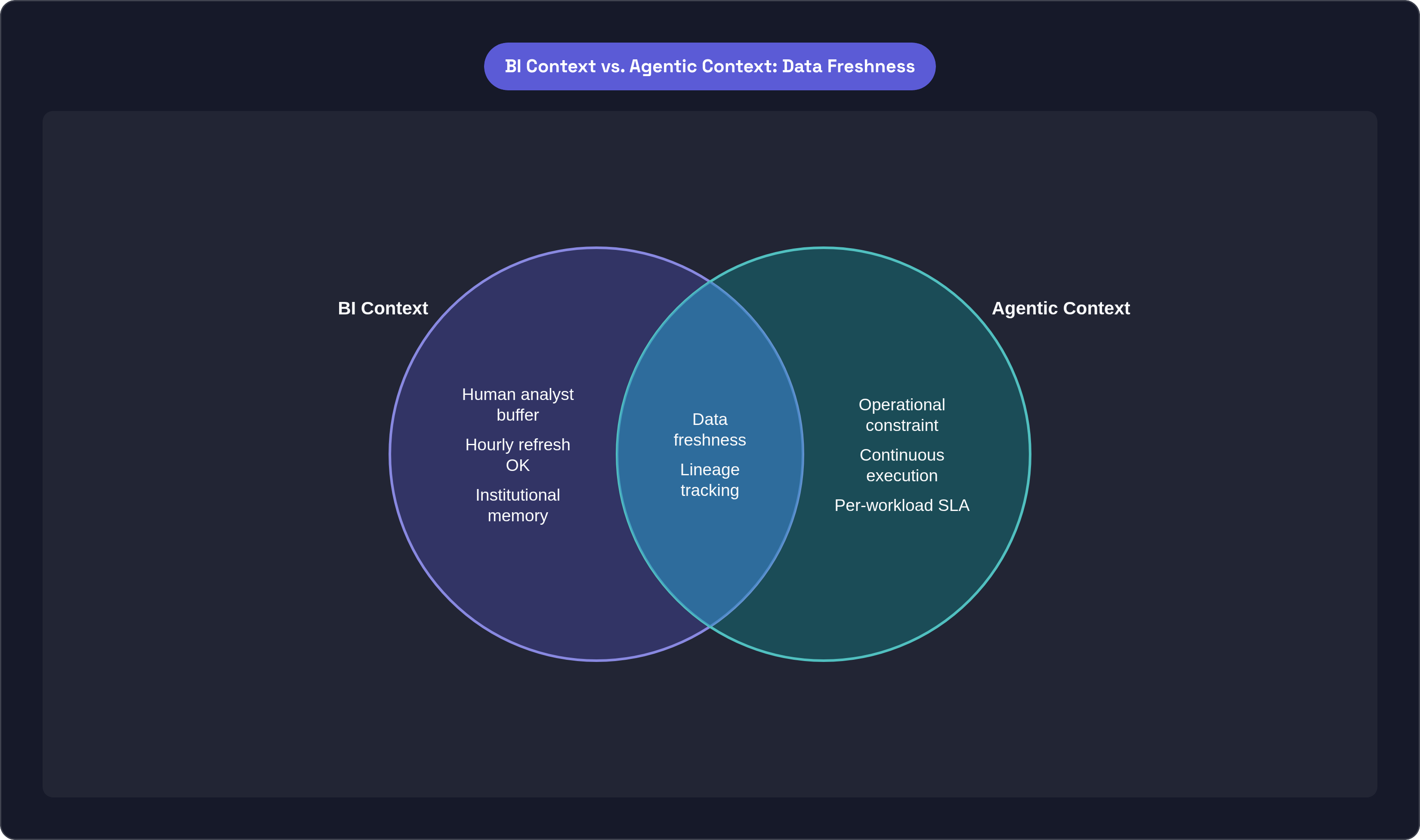
In a BI context, freshness is a preference. A dashboard that refreshes every hour is fine because a human analyst receives the output, interprets it, and applies judgment before anything consequential happens. The analyst is a buffer. She notices when a number looks suspicious, asks a follow-up question, remembers that last quarter's definition of "active customer" was different. That institutional memory is doing real work, quietly, and most organizations have never had to account for it explicitly because it was always just there.
An agent has none of that. In an agentic context, freshness is an operational constraint. The agent acts on data directly, without a human reviewing the timestamp, without the ability to sense when something feels off. Every query is a potential decision. Agents run continuously, not on a schedule someone chose.
BI-ready data and AI-ready data are not the same thing. AI requires time-awareness, lineage, real-time access, and semantic context. Traditional data infrastructure was built for analysts who run reports, not for agents that route support tickets, adjust prices, or approve transactions in real time.
The batch ETL (Extract, Transform, Load) assumption is the specific mechanism of failure. A warehouse built around 24-hour refresh cycles was architected for a world where humans consumed the output. When agents consume it instead, that architectural assumption becomes a liability. The same underlying fact can be fresh enough for one agent and dangerously stale for another. Freshness is not a global setting. It is a property that has to be defined per workload, which is a different and more demanding way of operating than most data teams are currently set up for.
How the Type of Decision an Agent Makes Determines Its Freshness Requirement
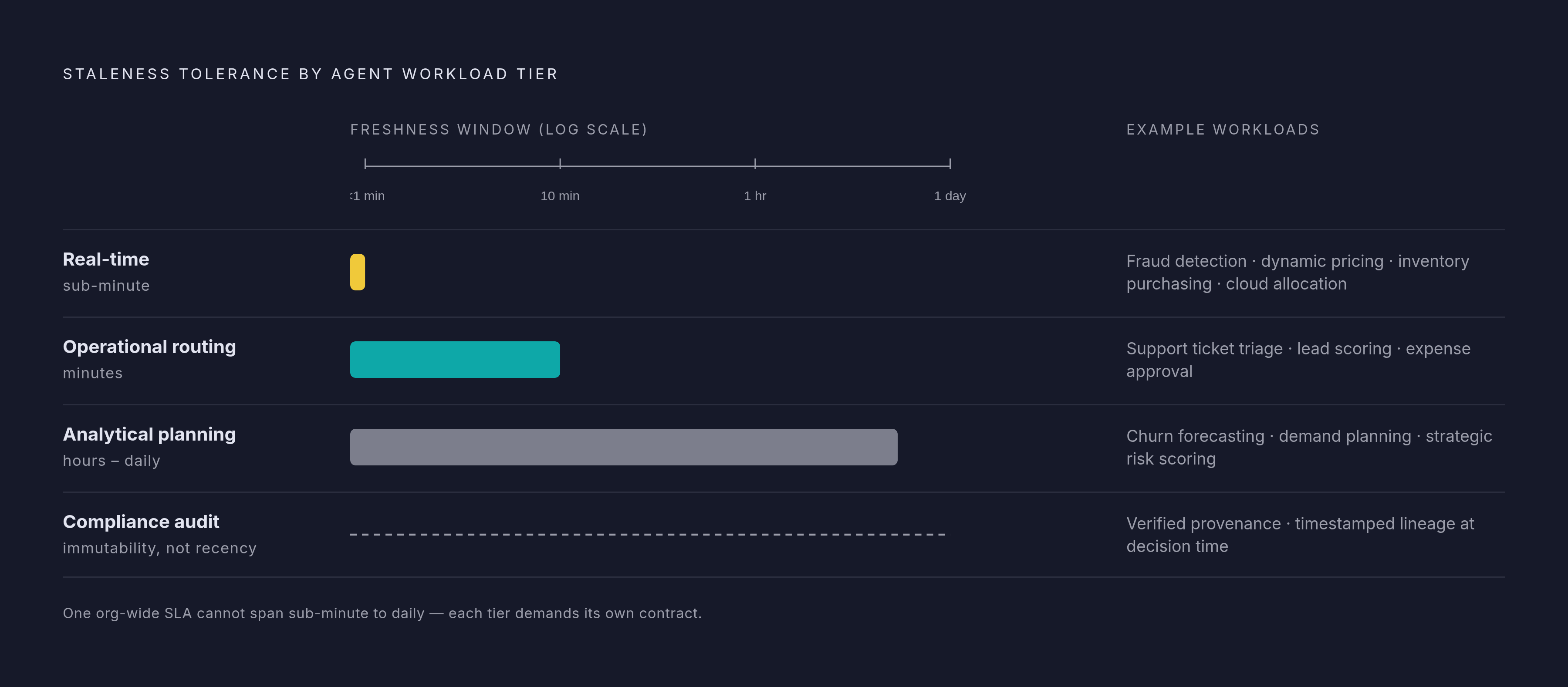
The classification starts with a single question: what is the cost if the agent acts on data that is N minutes old? The answer defines the tolerable window, and those windows vary enormously.
At the unforgiving end: fraud detection, dynamic pricing, inventory purchasing, cloud resource allocation. A six-hour-old inventory figure is not a data quality problem in the abstract. It is a financial loss that has already been set in motion. For these workloads, meaningful latency between data generation and agent availability is a structural risk.
Operational routing sits in the middle. Support ticket triage, lead scoring, expense approval. These can tolerate minutes before staleness causes real harm. The damage is downstream rework rather than immediate financial exposure, which makes it easy to underestimate. It accumulates quietly, and then someone has to explain why a hundred tickets were misrouted.
Analytical and planning decisions occupy the other end. Churn forecasting, demand planning, strategic risk scoring. Hourly or daily snapshots are often sufficient because the signal being detected is structural rather than transactional. A churn model does not need to know what a customer did in the last four minutes.
Compliance and audit workloads follow a different logic entirely. Their freshness requirement is less about recency and more about immutability and lineage. The agent needs a verified, timestamped record whose provenance can be demonstrated, not necessarily the most current version of a fact. Regulators care about what was true at decision time.
The practical output of this classification is a data contract for each workload: a written, machine-readable specification of the acceptable freshness window, derived from the consequence of violating it. That contract belongs in the enforcement layer, not in a wiki page that nobody reads after the kickoff meeting.
Why Agents Cannot Self-Correct for Staleness the Way Human Analysts Can
The inability of agents to self-correct for staleness is not a model limitation waiting to be solved in the next release. It is a structural absence of information. An agent querying a column called "revenue" has no way to know whether the definition changed last quarter, whether the timestamp on the record reflects when the event occurred or when it was ingested, or whether the table it is reading from has fallen outside its refresh window. No amount of reasoning capability closes that gap if the metadata was never provided.
Human analysts catch these things not because they are smarter but because they carry context accumulated over months and years. They have seen the quarterly cadence. They know revenue recognition changed after the acquisition. They will not catch everything, but they bring a calibration that is real, one that most organizations have been subsidizing for years without recognizing it as infrastructure.
The compounding problem is what makes this treacherous in multi-step agentic workflows. Agent A feeds stale output into agent B's context. Agent B feeds that into agent C's decision. By the time the error surfaces, tracing it back is expensive and corrective action is complicated by downstream state that already exists. A stale answer looks exactly as confident as a correct one at every step of the chain. There is no natural signal prompting anyone to distrust it.
This is why freshness cannot be treated as a monitoring concern to address after the fact. By the time a stale-data error is logged, the decision has already executed.
The Infrastructure Choices That Determine Whether Freshness Requirements Can Actually Be Met
Batch ETL is the primary architectural mismatch, and it is not a performance gap you close by tuning. It is a category error. Pipelines designed to move data once a day cannot serve agents that need sub-five-minute freshness for operational decisions. You can optimize those pipelines indefinitely and still not arrive at the thing you actually need.
Change Data Capture (CDC) is the replacement pattern. CDC streams changes from transaction systems continuously, so the governed data estate reflects current state rather than last night's export. Paired with event streaming infrastructure, it enables the freshness windows that high-velocity agent decisions actually require. The organizations achieving this in production are doing it through combinations of CDC, edge caching, and automated schema evolution, none of which is glamorous work, but all of which is necessary.
The federated query principle matters here more than it initially appears. Agents should be able to query data where it lives rather than waiting for it to be moved into a central store. Movement introduces latency. It also introduces governance surface area. Every copy of a dataset is another place where access policies, freshness metadata, and lineage information can fall out of sync. The administrative burden of keeping those copies synchronized is easy to underestimate until you are managing dozens of workloads simultaneously.
Open table formats, Apache Iceberg being where the industry has largely landed, matter for a related reason. Proprietary formats create a ceiling on what agents can reach and what governance tooling can enforce. The convergence on Iceberg over the past couple of years was driven by organizations building agentic workloads that needed a format governance infrastructure could reason about uniformly, regardless of which system originated the data.
The practical goal is an agent that needs data from five systems, makes one request to one governed interface, and gets consistent, freshness-verified results back, without five separate engineering integrations and without the maintenance burden of five separate access policies. Organizations that have moved past pilots are already operating this way.
What the Semantic Layer Contributes to Freshness Enforcement Specifically
An agent querying raw schema sees a value. It cannot tell, from the value itself, whether a field was last updated three minutes ago or three days ago. It cannot infer from column names whether a timestamp represents when the event occurred or when it was ingested. Better prompting does not fix this. It is a structural gap between the agent and the information it needs to govern its own behavior.
The semantic layer is where that gap closes. It is the place where freshness metadata lives alongside metric definitions, table descriptions, access policies, and business context. An agent querying through a well-constructed semantic layer can learn that a particular field carries a sub-60-second freshness SLA, that "revenue" in this context means recognized revenue not booked revenue, and that the data contract specifies what to do if the freshness window is breached. That information is not incidental. It is what makes the agent capable of self-governing on freshness rather than requiring every integration to encode those constraints separately.
Without a semantic layer, freshness constraints live in prompts or in individual pipeline configurations. Both approaches break the moment a schema changes, a metric definition is updated, or a new agent workload is added. The failure mode is silent: the constraint disappears and nobody notices until the agent starts behaving incorrectly, sometimes for weeks. Gartner elevated the semantic layer to essential AI infrastructure in the 2025 Hype Cycle for Business Intelligence and Analytics, and that shift reflects what organizations have learned by actually deploying agents and watching what breaks.
One thing worth naming directly: vector search alone does not solve this. It addresses semantic similarity for retrieval, which is useful, but it carries no freshness guarantees and it degrades on enterprise queries requiring multi-hop reasoning, precise metric definitions, or transactional accuracy. Organizations routing all agent queries through vector retrieval without a semantic layer are solving the meaning problem while leaving the freshness problem completely unaddressed.
How to Map Freshness Requirements to Agent Workloads in Practice
Start with the decision, not the data. For each agent workload, write down what decision the agent makes and what the cost would be if it acted on data that was N minutes old. That exercise surfaces the tolerable window. It also forces a conversation most organizations skip because they are focused on the pipeline rather than the decision consequence, and those two conversations involve different people with genuinely different mental models.
Once you have the window, classify the workload: sub-minute for high-consequence real-time decisions, minutes-range for operational routing, hourly or daily for analytical and planning work. Use that classification to select the appropriate data delivery pattern. Streaming CDC for the first tier, micro-batch for the second, scheduled batch for the third.
Encode the freshness requirement as a data contract property. Not documentation, a machine-readable constraint attached to the dataset that the query layer verifies at runtime. Documentation decays. Data contracts are enforced.
Add a freshness timestamp as a mandatory metadata field on every dataset an agent can reach. An agent without access to "when was this last updated" cannot self-govern on freshness, regardless of what model is running underneath. This is infrastructure work, not a model behavior question.
Define what the agent should do when the freshness SLA is breached: halt and escalate, return the last known value with a staleness flag, or query an alternative source. Make that decision in advance and encode it in the contract. Leaving it to the model is not a governance strategy; it is a gap dressed up as flexibility.
Avoid the universal-freshness trap. A single organization-wide freshness SLA treats a fraud detection agent and a weekly demand planning agent identically, which either wastes infrastructure on low-stakes workloads or systematically under-serves high-stakes ones. Readiness is always relative to the specific workload consuming the data, and any framework that obscures that fact will eventually produce failures that feel surprising but were entirely predictable.
Governance Considerations That Freshness Enforcement Surfaces
A freshness constraint is only enforceable if every query is evaluated against it at runtime. A static pipeline that assumes stable schemas cannot do this. The enforcement mechanism has to be dynamic, aware of the requesting workload, and capable of rejecting or flagging queries against data that has fallen outside its SLA window. Most current data governance tooling was not built this way, which is part of why organizations that underinvest in this layer discover the problem at the worst possible moment.
Audit logs need to capture more than who queried what. They need to capture the data's freshness state at the moment of the query. A log that records the query but not the timestamp of the underlying data is structurally incomplete for compliance purposes. If a regulator asks whether an agent was acting on current information at the time of a particular decision, "we have a log of the query" is not a sufficient answer.
Permissions and freshness interact in ways most access control systems were not designed to handle. A dataset within its freshness window for one agent workload operates under a different access policy than the same dataset accessed an hour later by a different workload. Both constraints have to be evaluated at query time, under the actual requesting identity, not assumed to be static properties of the dataset.
Write actions sharpen the stakes considerably. An agent that reads stale data and then acts on it, placing an order, updating a record, filing a compliance report, creates downstream state that has to be corrected. The governance failure is not the read. It is the write that followed. Preventing that write requires freshness to be evaluated before the action is taken, not after the damage is visible.
IDC found that 44% of organizations identified security limitations of existing data platforms as the leading challenge limiting agentic AI implementation. Freshness enforcement is inseparable from that broader trust architecture. An agent that cannot be trusted to act on current information cannot be trusted to act autonomously, and the two problems share the same infrastructure dependencies.
Lineage closes the loop. When an agent's decision is audited, reviewers need to trace not just what data was used, but whether that data met its freshness SLA at decision time. Without lineage that captures both the query and the freshness state of the underlying data, the audit is incomplete. For any agent operating in a regulated environment or making decisions with material financial consequences, that completeness is the baseline, not a stretch goal.