AI Agent Read vs Write Permission Asymmetry
Agents are provisioned with ten times the access they actually need.

The growth of AI agent activity in enterprise environments caught most security teams flat-footed, and the numbers that came out of 2025 explain why. Across one major security firm's customer network, nearly 40% of agents carried medium-to-critical risk factors. The average enterprise contained over 800 risky agents. And per Cisco's 2025 AI Security report, agents were being granted roughly ten times more access than their actual tasks required.
That last figure is the one worth sitting with. Ten times. Not a rounding error. A misconfiguration caught in QA would look different. It reflects how provisioning decisions actually get made when the person making them is focused on enabling a task rather than mapping the data surface they are opening.
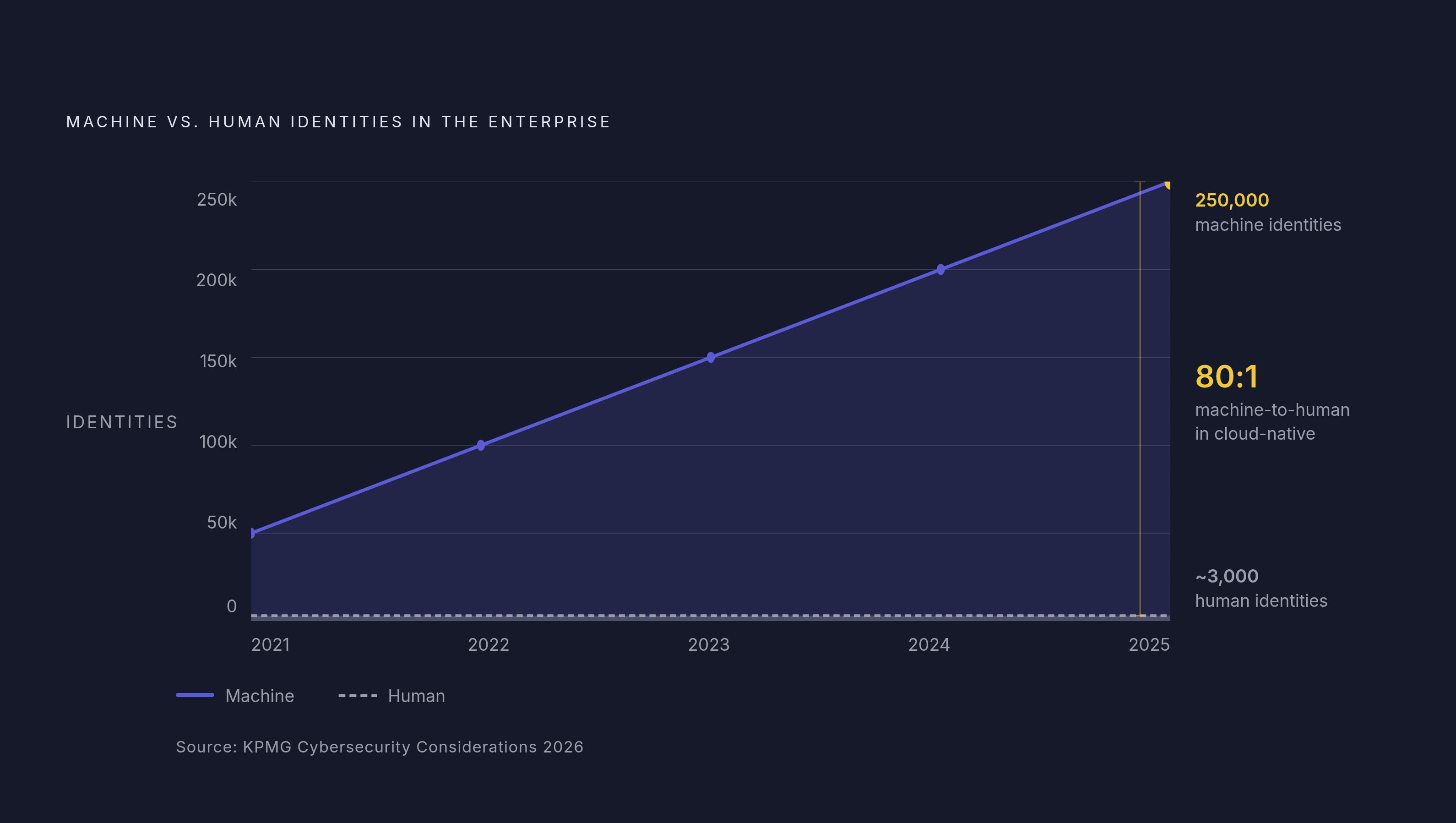
The 2026 NHI Reality Report sharpened this: 97% of non-human identities carry excessive privileges beyond what their function requires. Meanwhile, KPMG's Cybersecurity Considerations 2026 report documented machine identities growing from roughly 50,000 to 250,000 in the average enterprise between 2021 and 2025, with machine-to-human ratios exceeding 80:1 in cloud-native environments. The identity governance frameworks enterprises built for human employees simply were not designed for that ratio, and no amount of good intention at the individual provisioning level compensates for a framework mismatch at that scale.
The provisioning failure has a concrete, almost mundane shape. A payroll agent built to answer one salary question gets provisioned with broad read access to compensation data. That access is then available to answer any salary question the agent receives, including those about other employees. Nobody made a malicious decision. The person doing the setup was thinking about the task, not the aperture they were creating. Multiply that across hundreds of agents and the exposure compounds faster than any audit cycle can track it.
WEF research from 2025 found that 51% of organizations reported no clear ownership of AI identities, only 44% had implemented any policies governing their agents, and 92% agreed that governance was critical. Ninety-two percent said it mattered. Only forty-four percent did anything about it. That gap is the actual state of enterprise AI governance, not the stated one, and it is precisely where the write access problem begins.
What the 2025 Vulnerability Pattern Reveals About Where Authorization Actually Fails
Between June and October of 2025, four critical-severity vulnerabilities scored between 9.3 and 9.4 on the CVSS scale, affecting platforms from Anthropic, Microsoft, ServiceNow, and Salesforce. The specific platforms matter less than what the four cases share: in each instance, the authorization check happened at retrieval time, and the failure happened at output time. Data was retrieved by an authorized agent and then disclosed to people who had no business seeing it. The governance framework had already left the picture before any harm occurred.
Here is the mechanism. A CFO's Slack agent retrieves executive compensation data, legitimately, under its provisioned permissions. It then posts a summary to a shared channel where junior analysts are active. The retrieval was authorized. The disclosure was not. The authorization model never checked the second step because it was built to check the first one, and nobody building it had stopped to ask where the agent's output would ultimately land.
OAuth, the protocol underlying most enterprise authorization today, was designed for one user, one application, one permission set. Agentic systems operating in shared contexts break that model structurally. The agent is not one user. It is a service acting on behalf of multiple principals, sometimes simultaneously, in environments where the output's destination matters as much as the input's origin. OAuth has no native concept for that situation, and patching OAuth is not the answer because the problem is not in the protocol's implementation.
Memory compounds the exposure in ways that resist straightforward remediation. Agents retain context across sessions, which means a permissions failure in one session does not stay contained. It propagates into future reasoning and outputs, because the agent is acting on retained information from a retrieval it should never have made. Fixing it requires wiping agent memory, a categorically different kind of intervention from what most security teams are currently equipped to execute.
Stanford's 2025 AI Index Report documented a 56.4% increase in AI incidents in a single year: 233 reported cases in 2024 spanning data breaches to algorithmic failures, alongside a measurable decline in public trust in AI companies to protect personal data. What erodes that trust is not the existence of agents. It is the visible gap between what those agents are authorized to do and what they demonstrably do.
Why Write Actions Specifically Must Be Scoped, Time-Bounded, and Revocable
Many agents need only read access to do everything their stated purpose requires. That observation alone should shift the default provisioning posture. Write permissions should require explicit, affirmative justification, rather than being quietly inherited from a service account that accumulated access over months of incremental expansion. The burden of proof is inverted in most enterprises today, and correcting that inversion is the first practical step.
OWASP's Top 10 for Agentic Applications, published in 2026, introduces "Least Agency" as the agentic equivalent of least privilege: minimum autonomy, minimum tool access, minimum credential scope. It is framed as a design requirement, not a corrective measure applied after deployment. That distinction matters enormously in practice. Retrofitting scope constraints onto agents already running in production is far harder than building those constraints in at the start. Most organizations learn this the wrong way, after something has already happened.
Least privilege for agents also cannot be static. An agent switches tasks throughout its operational life. It interacts with systems that were not contemplated when its permissions were provisioned, acts on prompts nobody anticipated. Write access granted for a specific task should expire when that task ends, because an agent carrying write scope across task boundaries is, by definition, holding more authority than any single task justifies. The time dimension of authorization is one that most current frameworks simply do not model.
Revocability must be granular enough to actually function. If write access is tied to a shared service account, revoking it breaks every downstream agent using that account. Permissions need to be specific enough that access can be pulled from one agent without collateral damage to others. That level of granularity is operationally expensive to build, and it is also not optional if write governance is the actual objective rather than the stated one.
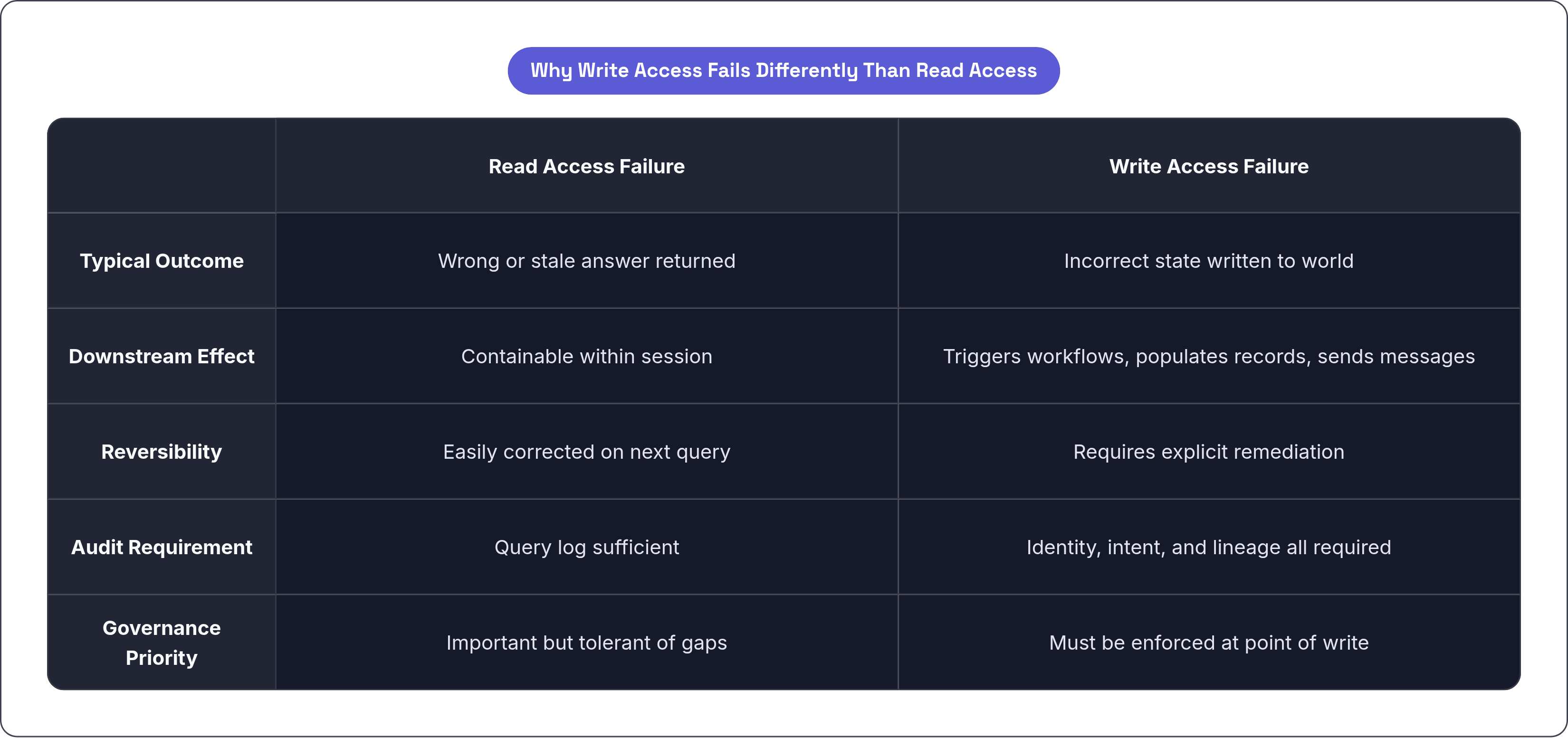
The asymmetry of failure modes settles the argument. A stale read produces a wrong answer. A stale write modifies state in the world: populates a record with incorrect data, triggers a downstream workflow, sends a message to an unintended recipient. Those two failure modes are not equivalent in consequence or reversibility, and governing them with identical instruments produces exposure that typically does not surface until something has already gone wrong.
NIST's NCCoE AI Agent Standards Initiative, released in February 2026, identifies four minimum architecture requirements for agentic systems: identification, authorization, access delegation, and logging. All four bear directly on writes. A write without verified identity is ungovernable. A write without logged lineage cannot be explained or reversed after the fact. These are the floor below which write-capable agents should not be deployed.
How Sensitivity at the Combination Point Changes the Write Risk Calculation
A salary figure in isolation is sensitive. A department is not. Tenure is benign. A performance rating, depending on context, may or may not be sensitive. But when an agent synthesizes salary, department, tenure, and performance rating into a single report, the combination creates re-identification risk that no individual field classification would have flagged. This is not a flaw in how those classification frameworks were designed. They were built for human analysts, who exercise judgment about what to include. The frameworks are simply incompatible with how agents operate, because agents do not exercise that judgment.
AvePoint's 2025 survey of 775 business leaders found that 75% of organizations experienced at least one AI-related breach in the past year, primarily from oversharing sensitive employee or customer data. Oversharing is not a field-level problem. It is a combination problem. The individual permissions were technically correct. The synthesis was not. That distinction is not subtle, but most governance frameworks still have no mechanism for evaluating it.
The same survey found that while 90% of organizations claimed an information management framework, only 30% said it classified and protected data effectively. That gap is widest exactly where agents work: at the intersection of multiple sources, synthesizing across HR, financial, and communications data simultaneously. The framework exists; the coverage does not.
Write outputs are where combination sensitivity stops being theoretical and becomes irreversible. An agent that reads across sources and produces a flawed analysis is a read problem, containable and correctable. An agent that writes that synthesis into a CRM field, a shared report, or an outbound message has instantiated the combined exposure in a durable, shareable artifact. Governance that checks permissions only at retrieval cannot catch what the synthesis produces. The evaluation has to happen at the point of write, which is architecturally a different requirement from what most current systems are built to satisfy.
What a Data Layer Designed Around Write Governance Actually Looks Like
The governance failure in most enterprises is positional: controls sit at the perimeter or at the model layer, not in the path of every query and every write. Moving governance into the data layer means it cannot be circumvented by any consumer, because every query travels through the same enforcement point regardless of which system or agent is issuing it. That positioning is the difference between governance that functions and governance that can be routed around by any sufficiently determined integration.
Permissions enforced at query time under the real user's identity, rather than assumed from a service account, mean the agent inherits exactly the access its principal is entitled to. No more. That scope holds whether the agent is reading or writing, because the enforcement point distinguishes by identity and entitlement, which is the correct distinction, not by consumer type.
Row-level security, column masking, and access controls defined once on governed virtual datasets propagate automatically to every consumer. A new agent connects and immediately operates within the same constraints as every other consumer, no additional configuration required. This matters at scale because the alternative, configuring permissions separately for each agent, does not survive enterprise environments where agents are added faster than security teams can review them.
A semantic layer embedded in this architecture does more than translate schema. It prevents agents from generating write operations based on misunderstood metrics. An agent that calculates gross margin incorrectly in a read will propagate that error into every write it produces based on that calculation, including financial records and customer-facing outputs. The semantic layer is a correctness constraint on what agents are permitted to write, not a convenience for how they read. That distinction gets lost in most discussions of semantic layers, which tend to frame them as a developer productivity feature rather than a governance mechanism.
Full lineage on every query means a write can be traced to the data it derived from, the identity that authorized it, and the logic that produced it. Without that traceability, post-incident review is guesswork at the query volumes agents generate. The architecture must also sit on top of existing infrastructure, because replacing warehouses and pipelines is not a realistic remediation path for most enterprises. Governance that requires migration will not be deployed before agents cause harm.
Why Audit Logs Must Capture Identity, Intent, and Lineage Together to Govern Writes
A log that records only what data was queried is insufficient for write governance. Three things must be present: who authorized the action, what the agent was attempting to accomplish, and what data the output was derived from. Missing any one of them leaves the log inadequate for attribution, reversal, or regulatory scrutiny. This is not a counsel of perfection. It is the minimum bar for a log that can actually do the work a write-governance audit requires.
At human-analyst query volumes, incomplete logs were survivable. Investigators could reconstruct context from adjacent signals, interview the analyst, piece together what happened. At agent-level volumes, that reconstruction is not realistic. The log must be complete at the moment it is written, because there is no credible path to reconstituting it afterward and no staff-hours sufficient to attempt it.
IBM's Cost of a Data Breach Report 2025 found that breaches involving employees' unauthorized use of AI tools cost organizations an average of $4.63 million. That figure reflects not just the breach itself but the investigation and remediation costs that accumulate precisely because adequate logging was absent. The log is not overhead. It is what makes a write explainable and reversible after the fact.
Regulatory pressure is now tied to specific timelines. The EU AI Act, with broad enforcement beginning August 2, 2026, and SOC 2 audits increasingly scrutinizing AI agent access patterns, are beginning to require identity-plus-lineage logging that most current agent deployments do not produce.
Memory persistence adds a dimension most logging designs miss entirely. A write's provenance extends across multiple sessions, because the agent is acting on context retained from a prior retrieval. A log that captures only the immediate query misses that ancestry entirely, which means post-incident reconstruction is incomplete even when the log itself is intact. Every write action must be logged with enough fidelity to be explained, reversed, or attributed. That is the prerequisite for deploying write-capable agents at enterprise scale, and organizations that treat it as optional will eventually learn otherwise.
Where the Governance Gap Is Stalling AI Initiatives That Could Otherwise Move Forward
The delay is not about model capability. That is the convenient explanation. It is also wrong. According to the Transcend/UserEvidence CIO Data Readiness Report from 2026, 81% of enterprises have delayed, scaled back, or abandoned at least one AI initiative in the past 12 months. AvePoint's 2025 research found that 86% of organizations delayed deployments by up to a year due to security and data quality concerns. The bottleneck is trust in the infrastructure agents operate on, and the write governance gap is specifically where that trust breaks down.
MIND's 2026 AI Data Security Report found that 65% of CISOs lack confidence in their data security controls, and only 20% of AI initiatives meet their intended KPIs. Gartner predicted at least 30% of generative AI projects would be abandoned after proof of concept by end of 2025, citing poor data quality and inadequate risk controls. These are not coincident problems. Write governance failures are actively contributing to that abandonment rate.
The initiatives that move from proof of concept to production share a recognizable pattern. Governance was built into the data layer before agents were granted write access, not retrofitted after an incident, not added when an auditor raised a concern. A 2026 CDO survey found that 76% of data leaders acknowledge governance has not kept pace with AI. Acknowledgment is nearly universal. Architectural response is not.
Restricting agents to read-only access by default would eliminate most of the business value that makes them worth deploying in the first place. The answer is building data layer controls that make write access governable, so that the organizations willing to do that architectural work can deploy agents that actually change business outcomes. The alternative is cycling indefinitely through proofs of concept that governance concerns will not allow to advance, which is precisely where most enterprises are stuck right now.