What a Semantic Layer Is in a Data Warehouse

What a Semantic Layer Actually Is
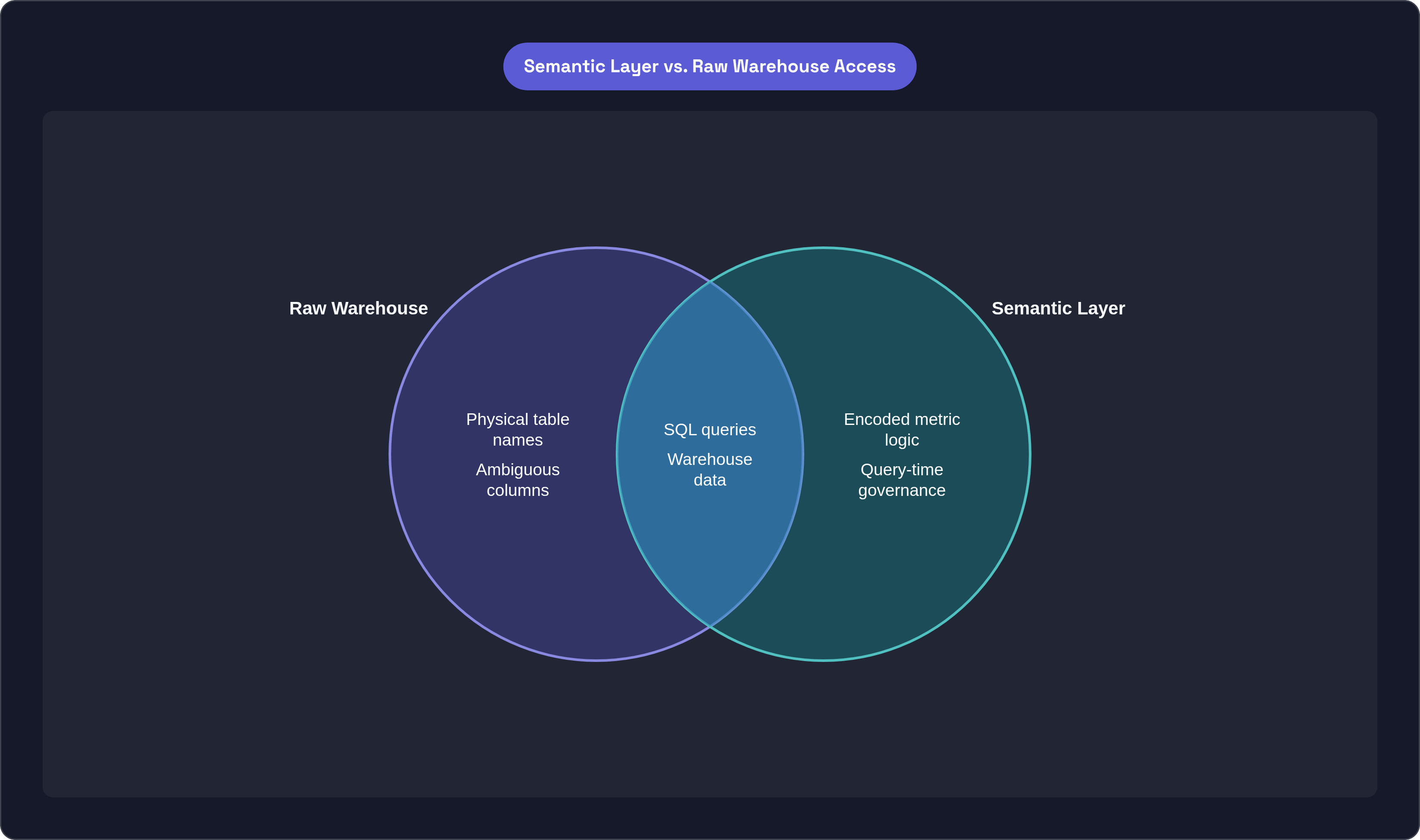
Your warehouse stores physical reality. Column names like txnamtusd. Table names like fact_orders. Join keys that made perfect sense to the engineer who built the schema three years ago and mean nothing to anyone hired since. Any tool with credentials can query this structure and return a number. The number will look confident. It can be completely wrong.
Here is the failure mode I have watched play out in nearly every data organization at some point. Two analysts independently query "revenue." One filters on order_status = 'completed'. The other doesn't. Both queries are syntactically valid. Both return different numbers. Neither analyst is wrong about the SQL. They are wrong about the agreement that was never made explicit anywhere in the system. Nobody wrote it down. Nobody encoded it. It lived in one person's head, and then it stopped living there. This kind of invisible divergence is not an edge case; it is the default state of most warehouses operating without a semantic layer.
A semantic layer is a software layer that sits between the warehouse and every tool that consumes it, exposing business concepts instead of physical tables. It is a virtual interface, not a migration. It does not move data or duplicate it. It translates queries against business concepts into the physical schema at runtime.
The central job is deceptively straightforward: map txnamtusd in fact_orders to "Total Revenue," and encode in that mapping every filter condition, grain specification, and time-logic rule that makes the mapping trustworthy. That definition lives in one place. It applies equally to a Tableau dashboard, a Power BI report, a Python notebook, and an AI agent's query. One definition, every consumer, no divergence.
"Semantic" is the operative word. The layer carries meaning, not just structure. It is the difference between a filing cabinet that stores documents and a contract that specifies what the documents mean.
The Four Components That Make a Semantic Layer Functional
Four components. Each necessary, none sufficient on its own.
Entities and Relationships
These are the logical business objects: Customer, Order, Subscription, Store. They map to fact and dimension tables without surfacing that structure to the consumer. A business analyst querying "customers with at least two completed orders in the last 90 days" should not need to know which tables are involved or how they join. The semantic layer handles that translation. The consumer reasons at the level of the business, not the schema, which is how it should have worked from the beginning.
Metrics and Time Logic
Named calculations with explicit grain, explicit filters, and explicit time semantics. Revenue is not just sum(orderamount). It is sum(orderamount) where order_status = 'completed', measured at order-level grain, with defined behavior for year-to-date, month-to-date, rolling windows, and cohort comparisons. The metric definition encodes all of that. When it is missing, every downstream consumer must re-implement it independently, and they will not all implement it identically. That is not a hypothetical risk; it is the default outcome.
Governance and Policies
Row-level security, column-level permissions, masking rules, all enforced here, at the semantic layer, consistently, rather than delegated to individual tools to handle however they choose. Governance at the semantic layer is not a setting. It is a guarantee that follows every query regardless of origin.
Synonyms and Natural-Language Metadata
Human-language descriptors that let language models and search interfaces translate natural-language questions into semantic queries. This is the component that makes the layer addressable by AI. You can have perfect metric logic and zero AI accessibility if you skip this one. Without natural-language metadata, the semantic layer is structurally invisible to any system that reasons in language rather than schema.
The four components are interdependent in ways that actually matter. Metrics without governance create access violations. Governance without natural-language metadata becomes invisible to AI agents. Entities without metric logic produce ambiguous aggregations. Remove one and the others degrade, sometimes in ways that are not obvious until something breaks in production.
How the Semantic Layer Sits Inside the Broader Warehouse Architecture
The typical flow: raw data lands in the warehouse, a transformation layer produces analytics-ready tables, the semantic layer adds business meaning, and then BI tools, agents, and APIs consume through the semantic interface. Each layer has a distinct job. Conflating them is one of the more common mistakes teams make when moving fast.
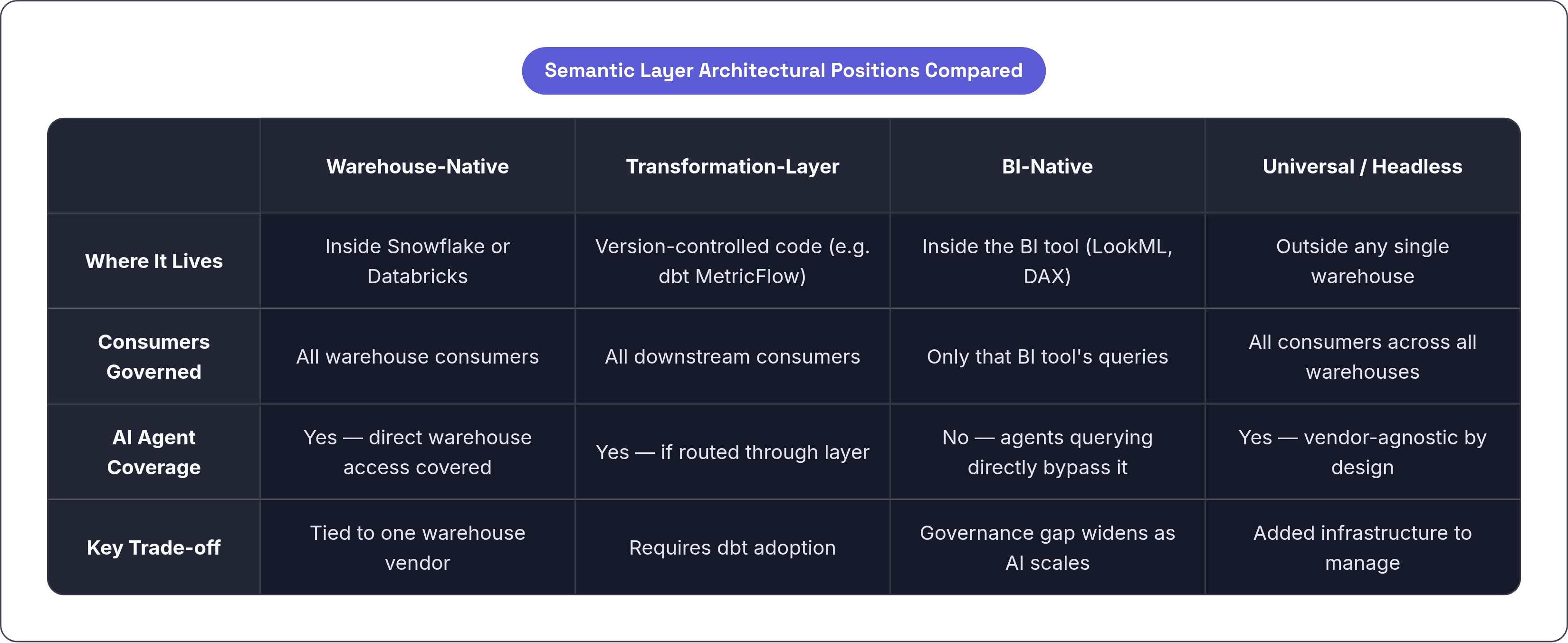
Between roughly 2020 and 2025, three distinct architectural positions emerged. Warehouse-native semantics store metadata as objects inside platforms like Snowflake or Databricks. Transformation-layer semantics live as version-controlled code, with dbt's MetricFlow reaching general availability in late 2024 as the most prominent example. BI-native semantics live inside the BI tool itself: LookML in Looker, DAX in Power BI, semantic models in ThoughtSpot.
Universal or headless platforms take a different approach entirely, sitting outside any single warehouse and connecting across Snowflake, BigQuery, Databricks, and Redshift simultaneously. The semantic layer becomes vendor-agnostic infrastructure rather than a feature of any one system.
The architectural choice carries a consequence organizations consistently underestimate: BI-native semantics govern only the queries that pass through that specific BI tool. An AI agent querying the warehouse directly falls outside their reach. So does an API call. Warehouse-native and headless approaches govern all consumers, which is the only model that holds as AI consumption scales.
No single pattern dominates, and anyone who tells you otherwise is selling something. The right choice depends on where your team already lives and which consumers you need to govern. But that choice is not cosmetic. It determines the actual reach of every policy you write.
Why the Industry Is Pushing Toward Open Standards for Semantic Definitions
The fragmentation problem is not abstract. A metric defined in LookML does not travel to Power BI. A metric defined in dbt MetricFlow is invisible to a Snowflake Cortex query. Organizations end up maintaining parallel definitions across multiple systems, and those definitions drift. "Revenue" in the BI tool and "revenue" in the data science environment are nominally the same concept and practically different calculations. I have been in the room when two senior leaders argued about a number for thirty minutes before anyone paused to ask whether they were even querying the same definition. Both were right about their numbers. Nobody was right about the business.
In 2025, dbt Labs, Snowflake, and Salesforce launched the Open Semantic Interchange initiative, aiming to standardize semantic layer definitions in a vendor-neutral YAML format using MetricFlow as the declarative specification. The goal is a single metric definition that any compliant tool can read. Defined once, consumed everywhere.
The pressure toward standardization is partly AI-driven, and the logic is not subtle. When multiple AI agents query data simultaneously, inconsistent metric definitions across tools produce inconsistent agent outputs. One agent returns a number derived from one definition of revenue. Another returns a number derived from a slightly different one. Both outputs look authoritative. Neither flags the discrepancy. The stakes for fragmentation rise considerably when the consumers are autonomous systems rather than analysts who can compare notes.
What Happens When AI Queries a Warehouse Without a Semantic Layer
AI agents have no institutional memory. They cannot ask a colleague what a column name means. They cannot know which of three "revenue" columns the finance team trusts, which one is deprecated, or which one is only valid for North American reporting. When the schema is ambiguous, agents resolve the ambiguity probabilistically, inferring meaning from column names, table structures, and naming conventions.
This produces confident-looking answers that are wrong in ways that are structurally invisible. A miscalculated answer carries exactly the same surface presentation as a correct one. There is no signal in the output that the agent used the wrong definition. It just returns a number.
Take gross margin. The actual formula involves cost allocation logic, returns processing, promotional discounts, and shipping adjustments, and that formula frequently varies by business unit and product line. An agent tasked with "gross margin by region" cannot infer the correct formula from a governance document it cannot access. It needs the logic encoded in the infrastructure it queries. Without that encoding, it will produce an answer, and the answer will be wrong, and the agent will have no mechanism for knowing that.
Internal testing at Google found that grounding generative AI queries in LookML's semantic definitions reduced data errors by roughly two-thirds compared to raw schema access. That is not a marginal improvement. That is the difference between a system that can function in a business context and one that produces clean-looking garbage on demand.
The semantic layer addresses this not through better prompting or improved model reasoning, but through structured, queryable definitions that replace probabilistic inference with authoritative answers. "Active customer count in Europe last quarter" resolves against the certified definition, with filters and grain logic already encoded, not against whatever pattern in the schema looks most plausible to the model.
How Protocols Like MCP Connect AI Agents to Semantic Definitions at Runtime
The semantic layer addresses what definitions should be. Model Context Protocol addresses how AI agents access those definitions at runtime.
MCP created a standardized interface for giving language models access to governed business logic rather than raw, uncontextualized schema. The agent queries semantic definitions through a governed interface. Every query is traceable. Every output is auditable. Every result is derived from the same definitions that govern every other consumer.
Large enterprises have begun standardizing MCP across multiple language models simultaneously, so that Claude, GPT, and internal fine-tuned models all share the same semantic foundation regardless of which model drives a given query. The model changes. The business logic does not. That separation is the point.
Multi-agent workflows surface a compounding version of this problem. In chains where one agent delegates sub-tasks to specialized agents, each agent in the chain needs to resolve metrics using the same definitions. Without shared grounding, sub-agents return results calculated against different logic than the orchestrating agent expects, and the orchestrating agent has no mechanism for detecting the discrepancy. Google's A2A protocol, released in April 2025, defines how agents communicate task requirements; semantic layers that expose definitions through standardized APIs integrate naturally into this architecture, ensuring every agent in the chain resolves metrics consistently.
What was designed to make dashboards consistent is now the mechanism that makes autonomous systems trustworthy. That is not a metaphor; it is the actual architectural function.
Why Governance Enforced at the Semantic Layer Is Structurally Different from Governance Applied Elsewhere
Governance enforced at the semantic layer is categorically stronger than governance applied at the tool or model layer, because it applies to every consumer without exception. Row-level security enforced at the semantic layer applies to every consumer simultaneously. A Looker dashboard, a ThoughtSpot query, a Cube.dev API call, and an AI agent all pass through the same policies. There is no path around it.
This is the structural guarantee that matters: governance stays at the data layer regardless of which AI model drives the query. Whether the request originates from GPT-4, Claude, Gemini, or an open-source model running on-premise, the policies are enforced by the engine, not by the model's own judgment. Trusting a language model to self-enforce data access policies is misplaced trust. Governance applied at the prompt or model layer is a filter that an agent can inadvertently bypass, and the agent will not know when it has done so.
Sensitivity also has to be evaluated at the point where data is combined, not only at the individual field level. Two columns, each innocuous in isolation, can create regulatory exposure when joined. A semantic layer enforcing policies at query time catches that combination. A policy applied field-by-field, before the join, does not. This distinction has real consequences in environments subject to HIPAA, GDPR, or financial reporting requirements.
Lineage extends this governance into the dimension of time. Tracking the full journey of every metric, from source system through transformation layer through semantic definition to AI output, converts the semantic layer from a black box into an auditable system. When a regulator asks how a number was derived, the answer needs to be traceable, not reconstructed from memory.
As of 2025, 52% of organizations identify compliance and regulatory readiness as their primary AI adoption challenge. Frameworks like the EU AI Act and NIST's AI Risk Management Framework require organizations to demonstrate transparency and auditability, not simply assert them. Governance at the semantic layer is one of the few architectural choices that makes that demonstration structurally possible rather than aspirationally claimed.
How Widespread the Data Readiness Gap Actually Is, and What It Costs
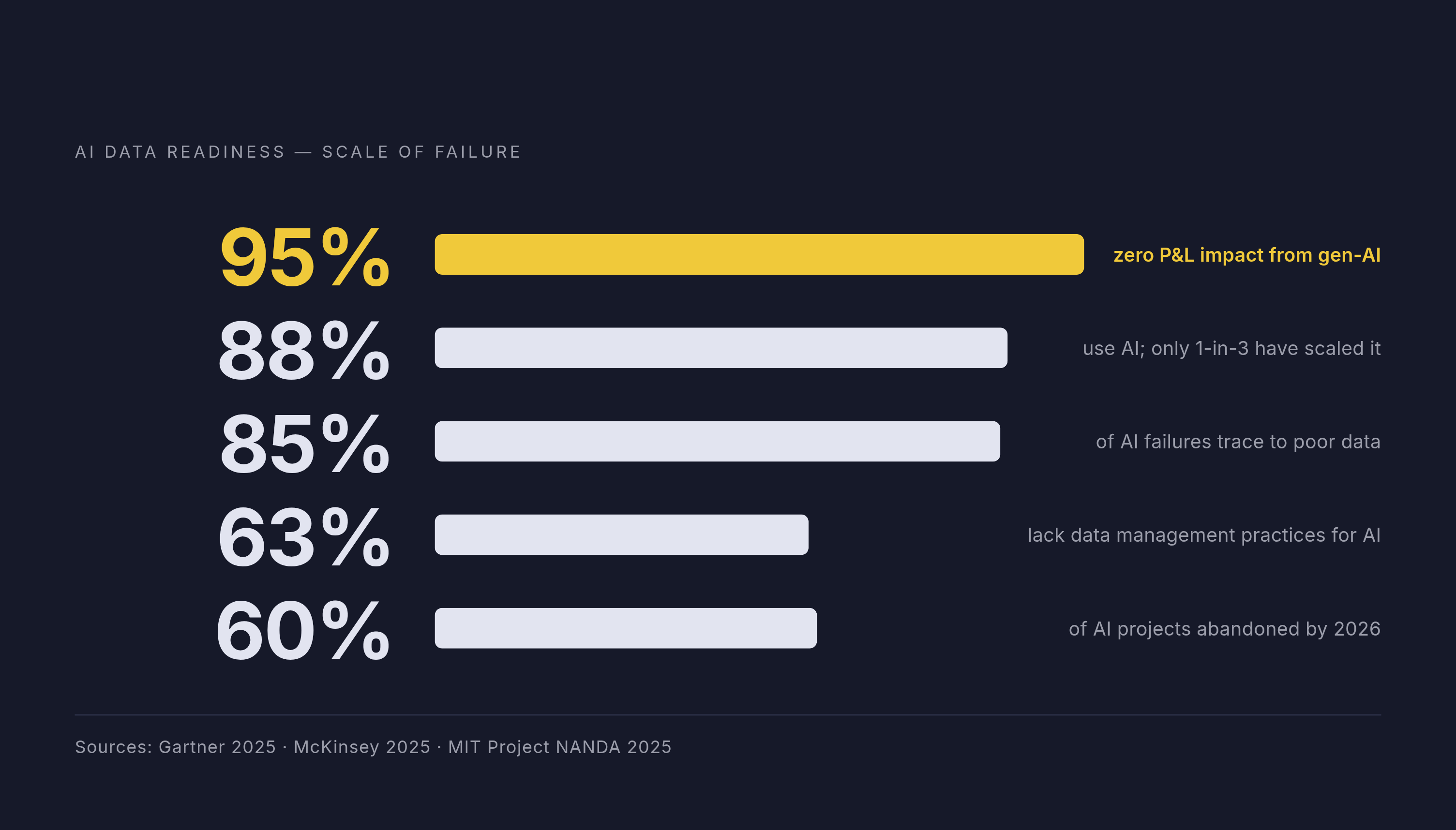
The numbers are clarifying in the way that uncomfortable numbers tend to be.
Gartner, in 2025, found that 63% of organizations either do not have or are unsure whether they have the right data management practices for AI. The same analysis predicted that through 2026, organizations will abandon 60% of AI projects unsupported by AI-ready data. Not deprioritize. Abandon.
MIT Project NANDA, also in 2025, found that 95% of organizations deploying generative AI saw zero measurable P&L impact. The most expensive AI infrastructure in those organizations produced no measurable business result.
McKinsey's 2025 State of AI found that while 88% of companies use AI in at least one function, only one-third have successfully scaled it, and inconsistent business logic is named explicitly as a contributing factor.
A Cloudera report from 2026 found that 96% of organizations report integrating AI into core business processes, while nearly 80% simultaneously admit their AI and data initiatives are constrained by limited data access across environments. The gap between those two figures is what the AI readiness illusion looks like in practice: reported adoption that quietly outpaces actual capability. Organizations are announcing AI strategies while running into the same wall, again.
IBM's Institute for Business Value estimated that over a quarter of organizations lose more than five million dollars annually due to poor data quality, with seven percent reporting losses of twenty-five million or more.
The root cause across these studies is consistent. Between 70% and 85% of AI failures trace back to poor data foundations, not algorithmic shortcomings. The model is rarely the problem. What it is reasoning against usually is.
What "AI-Ready Data" Actually Requires That Traditional Data Management Doesn't Provide
Traditional data quality standards were designed for human analysts who bring context to every query. They know which table finance trusts. They know which columns are deprecated. They know what "active" means in their business unit because someone explained it in an onboarding meeting three years ago and it stuck. That institutional knowledge lives in people, not systems, and it worked well enough when people were the primary consumers.
AI agents cannot supply that context. They need it made explicit, machine-readable, and embedded in the infrastructure itself. This is a genuine shift in what "clean data" means, not an incremental improvement on existing standards but a categorically different standard.
Four things AI-ready data requires that traditionally clean data does not guarantee: explicit metric definitions with grain and filter logic encoded at the infrastructure level; natural-language metadata and synonyms that make those definitions addressable by language models; governance enforced at query time under the real user's identity rather than a service account's broad, undifferentiated access; and data freshness calibrated to the actual use case, because a daily snapshot perfectly adequate for a Monday morning dashboard is already stale for an agent making a real-time decision.
Structured questions, "what was revenue last quarter by region," must be answered through structured, queryable semantic definitions. Routing those questions through a vector database built for unstructured content retrieval is a category error. Vector retrieval is appropriate for documents, support tickets, research notes. It is not a substitute for authoritative metric definitions, and conflating the two is an expensive mistake to make at scale.
The semantic layer closes all four gaps. It encodes definitions, carries natural-language metadata, enforces governance, and exposes live query access rather than static snapshots.
What most organizations resist, even after understanding all of this, is that AI readiness is an architectural decision made early, not a cleanup project applied to existing systems. Data cannot inherit the standards that made it adequate for human consumption. Organizations that treat this as a matter of improving what they already have will keep running the same experiment and getting the same result. The foundation has to be designed for AI consumption from the start, and that design work does not retrofit cleanly after the fact.