AI Governance Frameworks for Enterprise Data Teams
Enterprises are abandoning AI projects due to data governance gaps, not model failures.

The numbers make the diagnosis easy. S&P Global surveyed more than 1,000 enterprises and found that 42% abandoned most of their AI initiatives in 2025, up from 17% the year before. Nearly half of all proofs of concept, scrapped before they reached production. When leaders were asked why, 40% cited insufficient data quality or availability, 36% cited inconsistent governance across tools and regions, and 31% cited limited visibility into how data can be used across platforms. All three answers point to the same layer. Not the model. The data underneath it.
The EY Responsible AI Pulse Survey, covering 975 C-suite leaders, found that 99% of organizations reported financial losses from AI-related risks, with 64% losing more than $1 million and average losses reaching $4.4 million. Enterprise data infrastructure was built for reporting cadences, not for systems that make decisions continuously, and that gap is what governance must close. Closing it requires something more specific than a governance charter: enforcement at the data layer, the one place where controls actually have teeth.
Existing data governance was designed around human analysts working on batch cycles. A stable schema. A dashboard that refreshes nightly. A query that a person reviews before acting on. It was designed, in other words, for a world where the consumer of data carries institutional memory, tolerates ambiguity, and flags something that looks wrong.
AI agents break every assumption in that model. They query continuously, not on a schedule. They have no institutional memory, so they cannot ask what a vague column means. A stale or partial answer looks exactly as confident as a correct one. They combine fields across sources in ways no individual data owner anticipated when they approved the original access request. Think of it like handing a new intern a master key to every filing cabinet in the building and assuming they'll only open the drawers they're supposed to — except this intern never sleeps, never second-guesses itself, and runs a hundred queries before lunch.
The maturity gap shows up clearly. Cisco's 2026 Data and Privacy Benchmark Study found that 75% of organizations report having a dedicated AI governance process, but only 12% describe their efforts as mature. A separate Gartner survey of 360 IT application leaders found just 13% felt their governance structures were actually equipped to manage AI agents. Most organizations have governance programs that exist on paper and fall apart in practice. They don't fail dramatically, either. Access that was "good enough" for a human analyst becomes systematically over-permissioned for an agent running hundreds of queries per hour. The exposure compounds quietly, and by the time it's visible, the blast radius is large.
AI governance is not an extension of data governance. The regulatory window for treating this as optional is also narrowing: most EU AI Act provisions became binding in August 2026, introducing documentation, logging, and human oversight requirements for high-risk AI systems. The pressure is structural now, not just reputational.
The Four Things a Data-Layer Governance Framework Must Actually Address
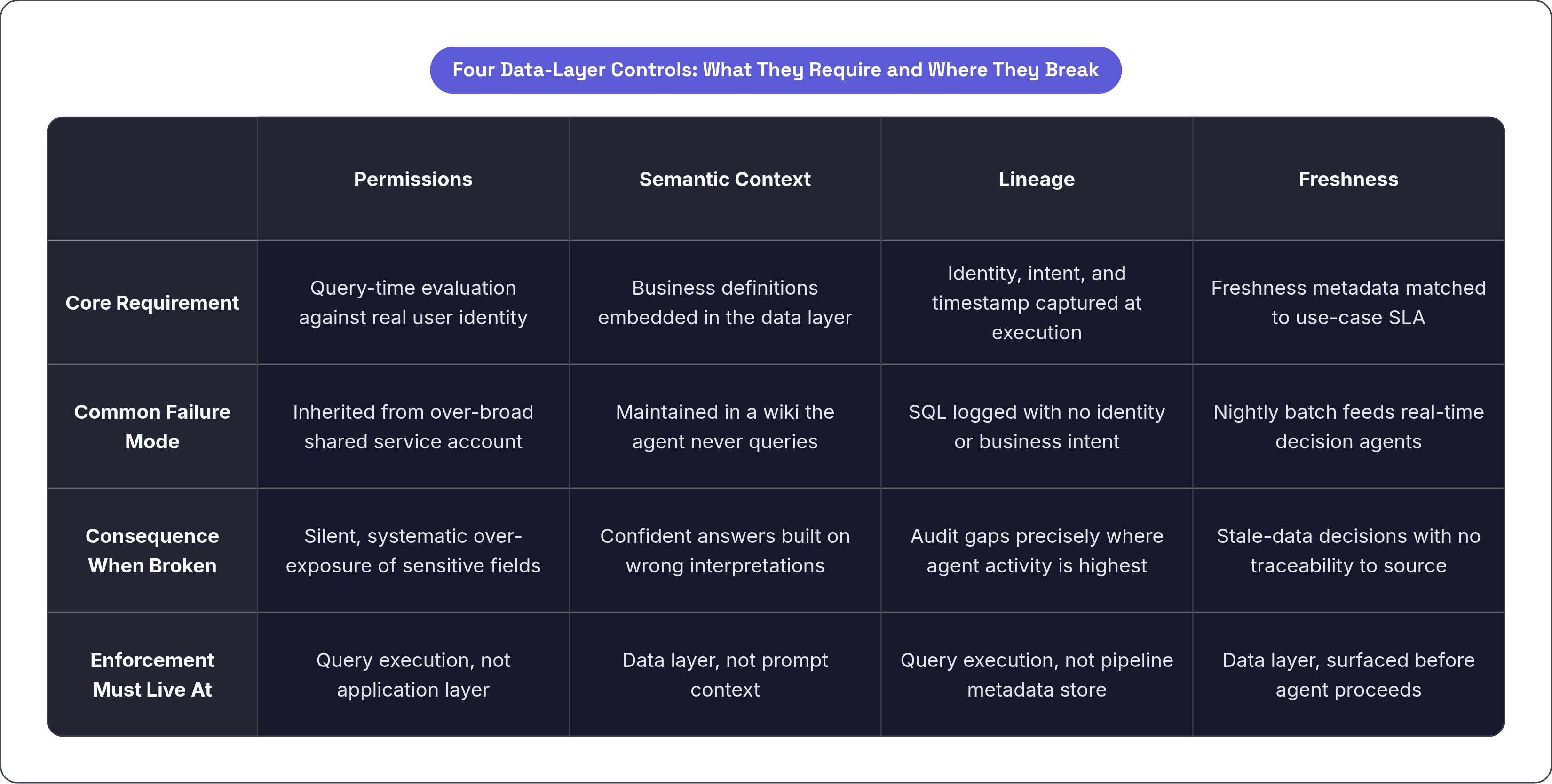
A governance framework that lives only in a policy document, or is patched onto the model layer, cannot enforce anything at the moment data is actually accessed. That moment, query execution, is the only moment that matters.
Four components must be solved at the data layer, not upstream.
Permissions: who and what can access which data, evaluated at query time against the actual requesting identity, not inherited from a service account configured months ago for a different workload.
Context: what the data means, including metric definitions, entity relationships, and business rules, carried by the data itself rather than assumed by the consuming agent.
Lineage: where data came from, how it was transformed, and what queries produced a given result, captured with enough fidelity to be useful at agent-level query volume and satisfy regulatory audit requirements.
Freshness: whether the data is current enough for the decision being made, matched to the use case rather than to a reporting cadence.
Each of these can be documented in a governance charter. Documentation is not enforcement. The sections that follow take each component in turn.
Why Permissions Enforced Above the Query Layer Systematically Over-Expose Data to AI Agents
Here is the common pattern: an AI agent is granted access through a shared service account, inheriting whatever permissions that account holds. Those permissions are often broad, rarely scoped to the specific workload, and frequently accumulated over time as teams added integrations without cleaning up prior access grants.
In practice, the agent's effective permissions are those of the service account, not the end user whose question triggered the query. If that service account has read access to compensation data, the agent can query it, even if the human on whose behalf it's acting could not. And if you need to revoke access for one workload, you have to revoke the service account, which breaks every other workload sharing it.
Presidio's AI Readiness Report found that 86% of organizations struggle with significant data challenges including inconsistent permissions, and that's before accounting for the complexity AI agents introduce. I've watched teams discover this problem only after an agent had been querying fields it had no business touching for weeks, with no alert, no audit flag, nothing. The exposure doesn't announce itself.
Permissions must be evaluated at query time, scoped to the actual end user's identity, and revocable at the level of a single workload without cascading failures. Data classification is the precondition for any of that to work: metadata tagging that identifies PII, sensitive financial data, and regulated fields before access decisions can be meaningfully scoped.
Sensitivity also has to be evaluated at the point where data is combined. A join that crosses two individually innocuous fields can produce a record that is sensitive in combination, and field-level tagging alone doesn't catch that. The enforcement logic has to operate on the composite result, not just the source inputs.
Write actions by agents raise the stakes further still. Reads that are misconfigured expose data. Writes that are misconfigured change it. Those failure modes no longer carry the same risk profile, and governance must treat them differently.
Why Agents Without Semantic Context Produce Answers That Are Valid but Wrong
An agent querying a schema without context is working from column names and data types. It has no knowledge of what a metric means, how two tables relate in business terms, or which of three "revenue" fields is the canonical one. The result is not an error message. It's a confident answer built on the wrong interpretation, which is considerably harder to catch than an obvious failure.
This is the part that surprises people who haven't lived inside it. The agent doesn't know it's wrong. There's no exception thrown, no null returned. It just picks the most plausible interpretation of an ambiguous column name and runs. It's like asking someone for directions and they give you a perfectly confident, detailed answer — to the wrong city.
Internal Google testing on LookML found it reduces data errors in generative AI natural language queries by as much as two-thirds, which implies that without a semantic layer, roughly two in three AI-generated queries on raw schemas produce incorrect results. Gartner elevated the semantic layer to essential infrastructure in its 2025 Hype Cycle for Business Intelligence and Analytics. MIT CISR research covering 41 organizations, with interviews conducted in the first half of 2025, found that key practices sustaining taxonomies and ontologies remain underdeveloped even among enterprises that recognize their importance. The gap between intent and implementation is wide, and it's costing teams credibility with every wrong answer their agents produce.
What the semantic layer must carry is well understood: table and field descriptions in business terms, not just names; metric definitions with calculation logic for revenue, margin, churn, and any KPI the business actually cares about, defined once and reused everywhere; entity relationships an agent can traverse; signal about which datasets are certified and which are not.
Semantic context must be embedded in the data layer itself, not added at the prompt layer. Prompt-layer context can be inconsistent, version-mismatched, and is not auditable the way a governed semantic model is. The GigaOm Radar for Semantic Layers and Metric Stores classified this category as mature for the first time in 2025. This is not an emerging space. It's infrastructure enterprises are expected to have in place.
What Lineage Must Capture at Agent-Level Query Volume to Be Useful
Traditional lineage answers a narrow question: where did this dataset come from, and what transformations touched it? At agent scale, that framing breaks down. What's needed is the ability to reconstruct who or what issued a specific query, under whose identity, at what time, against what version of the data, and what result was returned.
Without identity in the log, audit trails are anonymous. Volume is captured but accountability is not. Without intent, meaning the question the agent was actually answering, a log entry is a query string with no business meaning, and those are nearly impossible to review at scale. Without lineage tying the result back to source fields, an investigation into a bad output has no clear starting point. I've seen compliance teams spend days reconstructing what an agent did from logs that captured the SQL but nothing else. Days, for a single incident. A log without identity and intent isn't a trail — it's just tracks in the snow with no name attached.
The EU AI Act's logging requirements for high-risk systems assume this level of fidelity. The NIST AI Risk Management Framework similarly treats traceability as foundational. Governance programs citing NIST alignment need lineage that can demonstrate it, not just describe it.
The practical challenge is scale. Agent-level query volume can be orders of magnitude higher than analyst-level query volume. Logging infrastructure designed for monthly human audits doesn't hold up under continuous agent operation without intentional design choices made early. Retrofitting this is expensive; the teams that get it right build for agent volume from the start.
Lineage also has to surface when data was combined in ways that create new sensitivity. A log entry for a join that produced a sensitive composite record should be as retrievable as a log entry for a direct access to a flagged field. If it isn't, the audit trail has precisely the gaps that matter most.
How the Standard Data Pipeline Model Gets Freshness Wrong for AI Use Cases
The standard enterprise model is familiar: data lands in the warehouse on a schedule, nightly or hourly, and dashboards query that snapshot. For human analysts, a snapshot a few hours old is usually fine. The analyst reviews it, applies judgment, acts. The latency is absorbed by the person in the loop.
An AI agent making decisions in real time has no such buffer. Yesterday's snapshot is already stale, and the agent has no mechanism to flag that it's working from old information unless the data layer carries that signal explicitly. Absent that signal, the agent proceeds with full confidence on data that no longer reflects current state. Nobody in the loop. No flag raised. Feeding a real-time AI agent from a nightly batch pipeline is like navigating rush-hour traffic with last night's road map — the roads haven't moved, but everything that matters has.
The governance dimension here is underappreciated. A decision made on stale data can be wrong in ways that aren't traceable unless the lineage record includes a timestamp of when the source data was current, not just when the query ran. Those are different timestamps, and conflating them produces audit records that look complete but are not.
Freshness must be matched to use case, not to reporting cadence. A fraud detection agent querying account status needs near-real-time data; a planning agent summarizing quarterly trends can tolerate a daily batch. The data layer must carry freshness metadata, including SLA, last-updated timestamp, and latency from source, so agents and their orchestrators can evaluate fitness for the decision at hand before proceeding.
The most successful enterprise pattern here is continuous replication via change-data capture feeding into a stream processing layer, with governed data routed to AI destinations at the freshness level the use case requires. Static pipelines that assume stable sources and stable schemas are structurally incompatible with this. Only about 29% of technology leaders, per a 2024 IBM Institute for Business Value survey, strongly agreed that their enterprise data meets the quality, accessibility, and security standards needed to scale generative AI. Freshness is a significant dimension of that accessibility gap, and it's one of the last things teams address.
Why Governance Programs That Look Complete on Paper Still Fail in Production
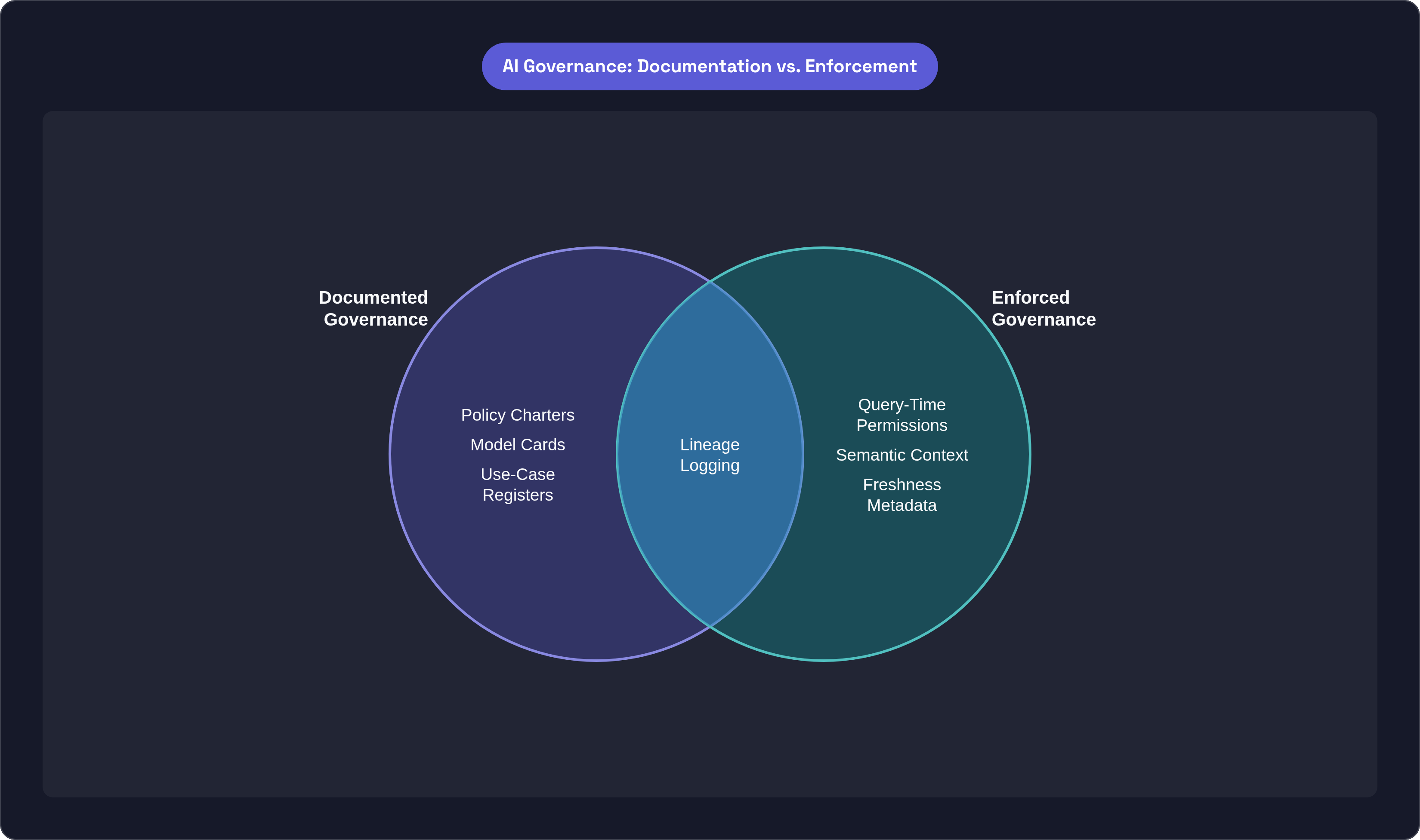
Back to the Cisco finding: 75% of organizations report having a dedicated AI governance process, 12% describe their efforts as mature. Gartner found just 13% of IT application leaders felt their governance structures were actually equipped for AI agents. The gap between "having a process" and "having enforcement" is where most programs break.
The failure modes are depressingly predictable. Permissions documented in a policy but enforced at the application layer, so a new agent or integration bypasses them. Semantic definitions maintained in a wiki the agent never queries, leaving the model to interpret raw schema. Lineage captured in a pipeline tool that doesn't log agent-initiated queries, creating gaps exactly where agent activity is highest. Freshness SLAs written in a data contract but never surfaced to the consuming agent, so the agent can't evaluate fitness for purpose.
Governance artifacts like model cards and use-case registers help teams stay aligned. They describe controls. They don't enforce them.
Tredence's governance maturity model distinguishes four stages: Developing, Defined, Managed, and Strategic AI. The distance between Defined, where policies exist, and Managed, where active monitoring and continuous improvement are operating, is precisely where enforcement lives. Most enterprises sit in that gap, often for years, under the impression that having written the policy means something has been secured. McKinsey estimated in late 2025 that enterprises with mature data governance programs were nearly twice as likely to achieve measurable ROI from generative AI. Maturity in that framing means enforcement, not documentation.
Governance only holds if controls are evaluated at the moment a query executes. Any control enforced before or after that moment can be bypassed, intentionally or not, and usually is.
What It Means to Treat the Data Layer as the Enforcement Point, Not the Policy Document
Documentation means policies are written, roles are assigned, artifacts are maintained. That work is necessary. It is not sufficient. Enforcement means something specific: permissions evaluated at query time against real identity; semantic context delivered with the data, not assumed by the agent; lineage captured at query execution with identity and intent attached; freshness metadata carried by every result so the consumer can evaluate fitness before acting.
When these four controls are enforced at the data layer, they hold regardless of which model, which agent framework, or which application sits above them. A new integration can't bypass a permission evaluated at query time. An agent can't misinterpret a metric defined in the semantic layer it has to traverse. An audit trail capturing identity and intent at execution time doesn't develop gaps just because the requester is an agent rather than a person.
The enterprises achieving measurable ROI from generative AI are not doing so because they wrote better policies. They closed the distance between where controls are documented and where data is accessed. If you want to know where your governance program actually lives, don't look at the charter. Look at the query log.