Revoking AI Agent Data Access at Workload Granularity
Scoped credentials and revocation per task eliminate the security cost of denying standing access.

Standing access is exactly what it sounds like: a credential issued once, left open, and rarely revisited. In the context of machine identities, this is the norm. The NHI and Secrets Risk Report for the first half of 2025 found that 7.5% of machine identities in cloud environments are between five and ten years old. Many of those identities outlive the engineers who provisioned them, which is not a metaphor. It is a routine operational fact.
The World Economic Forum's Global Cybersecurity Outlook 2026 makes the accountability dimension explicit: when no one owns an identity, the credential a developer created before leaving becomes an ungoverned access point with no one watching it. At human-analyst scale, this was an annoying audit problem that reviews could eventually surface. At agent scale, the inventory of ungoverned identities compounds faster than any manual process can chase it.
Orphaned identities are not a housekeeping concern. They are live attack surface. OWASP's LLM Top 10 for 2025 identifies prompt injection as a leading risk for AI systems, and a standing-access agent is a particularly attractive target: redirect it through a malicious prompt mid-task and it can exfiltrate data or invoke unauthorized tools using credentials that were never designed to expire. The credential does not need to be stolen. It needs only to be redirected.
Here is the real problem, and it is behavioral before it is technical. Because standing access means revocation is always a breaking event, pulling a credential stops everything downstream that depends on it. So organizations avoid revocation. Not out of negligence, usually, but because the architecture made the safer option too expensive. The risk grows not because anyone decided to tolerate it, but because no one could afford to fix it.
What workload-granularity access actually means
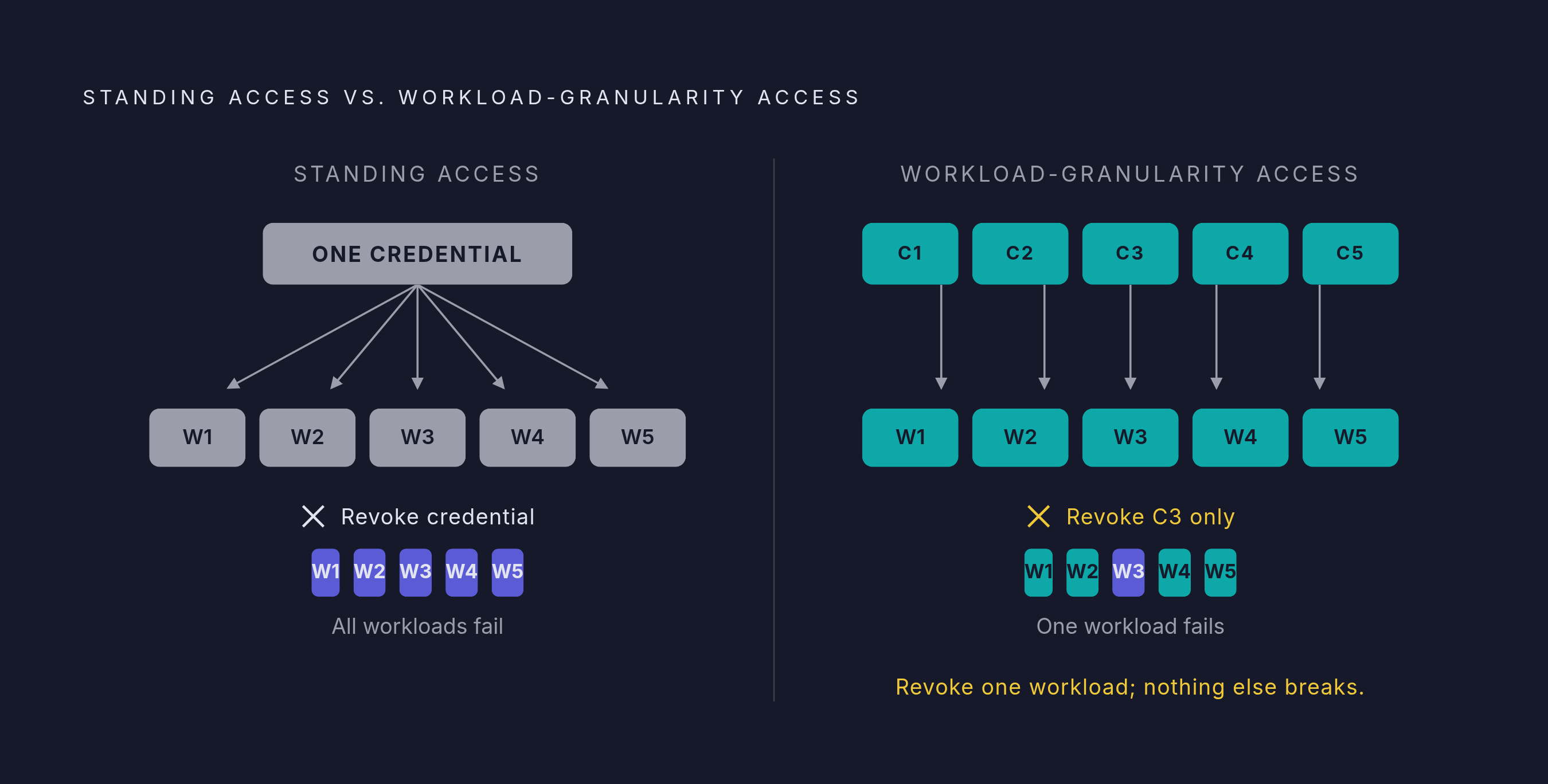
A workload is a single, scoped unit of agent execution. One pipeline run. One triggered action. One task with a specific start and a specific end. Not the agent class it belongs to, not the service account it lives under.
Workload-granularity access means each of those execution units receives its own identity, a permission set scoped to exactly what that task requires, and a credential that can be revoked independently of every other workload running in parallel. When the task completes, the credential expires or is pulled. Nothing lingers.
Role-based access control, still the dominant model in most enterprise environments, assigns permissions to a role and lets the agent inherit it. Simple to administer. Easy to reason about. But the role's permissions are fixed regardless of what a specific task actually needs at a specific moment. An agent inheriting a "data analyst" role gets everything that role covers, whether or not the current task requires a quarter of it. The mismatch between what the role permits and what the task actually needs is where excess access accumulates, silently, across every workload running under that role.
Attribute-based and policy-based models close some of that gap because they evaluate the user, the resource, the environment, and the requested action together, and they can incorporate real-time signals. Just-in-time access is the operational expression of this: the agent requests the specific access the task requires, receives a short-lived credential, and the credential is revoked when the task ends or when behavior deviates. The decisive property is blast radius. Revoke one workload's credential and only that workload stops. Nothing else breaks. That is what makes revocation a routine control rather than an emergency one.
Least privilege at agent granularity is harder than it sounds
For a human analyst, least privilege is a reasonable approximation. Roles are relatively stable. Query patterns are predictable. Annual access reviews, while imperfect, catch most of the drift.
Agents do not afford that predictability. An agent that reads customer records, creates support tickets, updates a CRM field, and posts to a Slack channel inside a single workflow needs precisely scoped access to each of those systems for each of those actions, and nothing beyond. The combinations are dynamic. The task that ran yesterday may touch different systems tomorrow depending on context. The surface area is wide and constantly shifting, and honestly, most governance frameworks were never designed for that.
The effective-authority problem is where most implementations fall short, and it does not get enough attention. It is not enough to configure least privilege at provisioning time. The real question is what each agent can actually reach inside connected systems at any given moment, which changes as workflows evolve and integrations expand. Provisioning-time configuration becomes stale quickly, and it becomes stale without announcing itself.
Row- and column-level policy is where this becomes concrete. The permission should be scoped to the specific human user the agent is acting on behalf of, not to the agent's service account category. A billing agent running a query for a finance analyst should see exactly what that analyst would see. The agent is not the principal; the human is. That distinction matters more than it sounds.
Write actions deserve their own governance tier entirely. An agent reading on the basis of stale data produces a recoverable error. An agent writing to a production system on behalf of a service account with broad authority produces an irrecoverable one. The risk profile is categorically different, and the controls need to reflect that asymmetry, not smooth over it.
Behavioral signals as a continuous revocation trigger
Behavioral signals must serve as a continuous revocation trigger because binary grant-or-deny is too blunt an instrument for agents operating at scale. Deny everything and the agent stops functioning. Grant access and walk away, and you have no mechanism to respond when behavior shifts unexpectedly. The space between those two options is where meaningful control actually lives, and most organizations have not built anything there yet.
Adaptive response fills that space. Throttle request rates before potential damage compounds. Route outputs through human review before they propagate downstream. Trigger partial restriction on a specific data class rather than shutting down an entire workload. The control model should not force a binary when the situation does not require one.
What makes adaptive response possible is a per-workload behavioral baseline. An agent that suddenly bulk-downloads records at three in the morning from an unregistered location is either executing a legitimately scheduled task or a compromised workload being redirected. Without a baseline scoped to that specific workload's normal behavior, you cannot distinguish between those two scenarios. You are left guessing, and at agent volumes, guessing is not a control.
Automated revocation triggered by anomaly detection closes the gap that manual alerting leaves open. The trigger should be the behavioral signal itself, not the ticket that someone eventually files after reviewing the alert. That lag, the time between signal and human action, is precisely where damage accumulates.
OWASP's LLM Top 10 for 2025 flags unbounded consumption as a discrete risk category: recursive agent loops generating runaway financial liabilities through API costs, what practitioners call "denial of wallet" attacks. This is not a data-exfiltration scenario. It is an operational and financial one. Behavioral monitoring must be scoped to catch it, because it will not look like a breach.
The architectural implication follows directly from the identity model. If every workload has its own identity, every workload can carry its own behavioral baseline and its own revocation trigger. The granularity that makes targeted revocation possible is the same granularity that makes behavioral monitoring coherent. These are not separate systems. They are the same design decision, expressed at two layers.
Why the data layer is where revocation policy must be enforced
A revoked credential stops a workload from authenticating. That is necessary, but it is not sufficient, and conflating the two is a real source of residual exposure. If permissions were evaluated at provisioning time and baked into a cached result set or a static pipeline output, revoking the credential does not reach the data already in motion. The workload stops. The data does not.
Permissions must be evaluated at query time, under the real user's identity, every time. Not assumed from a service account's prior authorization. Not inherited from a pipeline configured last quarter. Every query is a fresh policy evaluation. That is the standard the data layer must meet, and most data layers in production today do not meet it.
Access control list preservation is the technical expression of this requirement. The permissions that govern a data asset at ingestion must travel through every transformation, every join, every downstream retrieval step. A record correctly permissioned at the source can still surface where it should not if the query layer downstream does not re-evaluate before returning it. The permissions traveled; the enforcement did not.
Combination sensitivity compounds the challenge. An agent joining two datasets that are individually non-sensitive can produce output that is sensitive in combination. The evaluation must happen at the point of combination, not only at the individual field or source level. This is routine in analytical workloads. It is not an edge case to plan for later.
Only 7% of enterprises report that their data is completely ready for AI, according to a 2026 report from Cloudera and Harvard Business Review Analytic Services. Part of what "ready" means in this context is that governance is encoded in the data layer itself, not patched on at the prompt or model layer after the fact. Governance that lives only at the application surface is governance that data-layer queries can bypass, and agents issue a lot of data-layer queries.
Data-layer enforcement also solves the auditability problem. If every query is evaluated and logged at the data layer, the audit record exists regardless of what happened at the credential layer above it. Revocation at the credential layer and auditability at the data layer are not independent goals. Each one depends on the other to mean anything in an investigation.
What audit logs must capture to be meaningful at agent query volume
At human analyst volumes, a log entry recording who queried what is sufficient for retrospective review. The volume is manageable, the actors are few, and attribution is usually straightforward.
At agent query volumes, that same log format becomes operationally useless. "The service account issued 40,000 queries" is not actionable information when an incident occurs and you need to reconstruct whether a specific agent did what it was authorized to do. I have seen security teams stare at logs like that and walk away with nothing. The entry cannot be read; it can only be counted.
A meaningful log entry at agent scale must capture several things simultaneously: which human user the agent was acting on behalf of, which specific workload issued the query, which policy evaluated the request and what decision it produced, what data was returned, and the lineage of that data through prior transformations. Identity, intent, and lineage, together, in the same record. Remove any one of those elements and the log entry cannot answer the question that matters when something goes wrong.
Per-workload identity makes this tractable. If each workload carries its own credential, each log entry is already scoped to that workload. Attribution is solved at the identity layer before anyone touches the logs. You do not need to reconstruct it from post-hoc log parsing, which at these volumes is simply not a realistic option anyway.
The architectural decision to use workload-granularity identity is the same decision that makes the audit log coherent. Targeted revocation and meaningful auditability are not two separate engineering problems to be solved in sequence. They are the same problem, solved once at the identity layer, with benefits that surface in both directions.
What enterprises need in place before workload-scoped revocation works
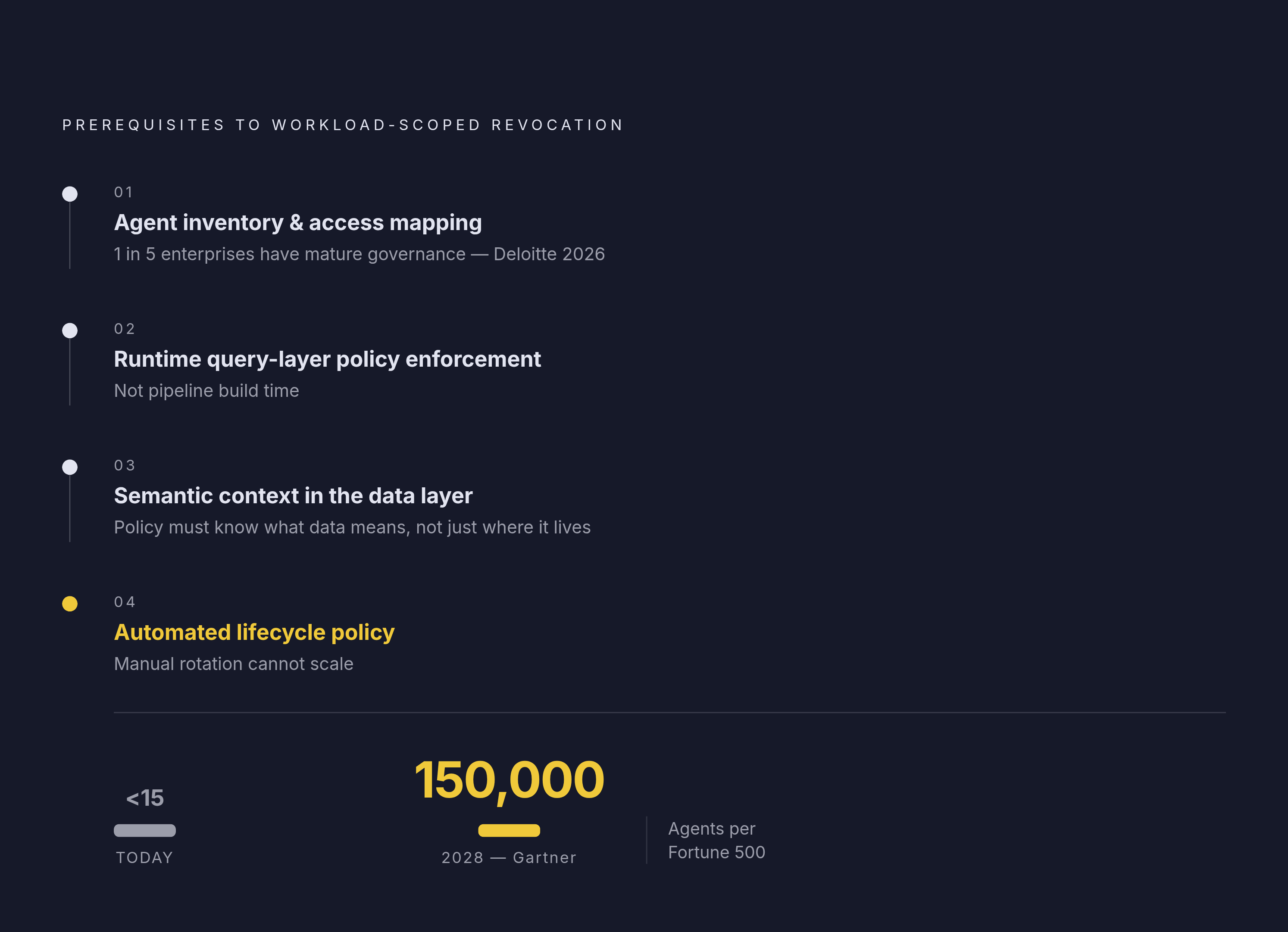
Most enterprises are missing critical prerequisites for workload-scoped revocation, and that gap is worth being direct about.
First: an actual inventory of agent workloads and their real data access patterns. Deloitte's 2026 State of AI in the Enterprise reports that only one in five companies has a mature governance model for autonomous agents. Most organizations do not have a reliable accounting of what their agents are accessing today, which means they cannot scope least-privilege policies against a known baseline. You cannot govern what you have not mapped.
Second: a query layer capable of enforcing policy at runtime rather than at pipeline build time. Static pipelines that assume stable schemas cannot re-evaluate permissions when a workload's scope changes mid-execution. The enforcement point must be dynamic, and building that capability into an existing pipeline architecture is not a trivial lift.
Third: semantic context embedded in the data layer itself. Agents carry no institutional memory. Without table descriptions, metric definitions, and relationship maps built into the data model, a workload-scoped agent operating under genuine least privilege will either over-request access to compensate for uncertainty or return incorrect results with unwarranted confidence. Both outcomes undermine the governance model, and both are common.
Fourth: automated lifecycle policy tied to workload activity, not to calendar dates. Gartner projects upward of 150,000 agents in a typical Fortune 500 by 2028, up from fewer than 15 today. Manual credential rotation cannot keep pace with that trajectory. Once the process is manual, orphaned identities start accumulating, and you are back at the beginning of the problem.
The constraint that enterprises cannot route around is the heterogeneous-estate reality. Most organizations will layer modern data platform architecture on top of existing warehouses and legacy SaaS systems, not replace them. The governance model must work across that mixed estate. A clean-slate rebuild is not a realistic precondition for most of the companies that need this now.
The sequencing implication is straightforward: treat workload identity as the unit of governance from the first agent deployment. Retrofitting granular revocation onto a shared-credential estate that has already scaled is significantly harder than building the identity model correctly at the start. The cost of doing this right early is low. The cost of correcting it later, at 150,000 agents, is the kind of number that ends up in a board presentation.