Data Mesh vs Data Lake for Enterprise AI
Data governance, not algorithms, determines whether enterprise AI actually works in production.

Here's the pattern I keep seeing. A team builds a pilot on a clean, hand-picked dataset. The demo works great, leadership signs off, and then the project hits production data and just falls apart. That gap between the pilot and the real system is where most enterprise AI initiatives die, and it has almost nothing to do with the model.
Production data lives everywhere at once. It's scattered across warehouses, a dozen SaaS tools, and operational systems that were never built to talk to each other. Nobody agrees on what "customer" means, let alone "revenue" or "order." Finance counts revenue one way, sales counts it another, and both are technically right within their own context. Historical records have gaps, and formatting is inconsistent between platforms. Lineage, the record of where a piece of data came from and what happened to it along the way, tends to vanish the moment data crosses from one system into the next. And governance, when it exists at all, was usually bolted on after the fact. It rarely extends cleanly into the query paths an AI system actually uses.
The Precisely and Drexel University 2025 Data Integrity Trends and Insights report puts a number on this: a large majority of organizations name AI as a strategic priority, but only a small fraction say their data is actually good enough and accessible enough to support an AI implementation. That same report names data governance, not model quality and not compute cost, as the single biggest challenge holding AI progress back.
Gartner's research points in the same direction. Their projection is that by 2027, a large share of organizations will fail to get the value they expected from AI, and the reason traces back to incoherent data governance frameworks, not weak algorithms. That's worth sitting with. The architecture decision you make before you ever pick a model is, in a real sense, your first governance decision.
I'm not naming a winning architecture yet. Before you can judge a data lake or a data mesh, you need a clear picture of the problem both of them are supposed to solve, and most organizations underestimate that problem badly.
What a data lake actually gives you, and the problems it creates at AI scale
A data lake's original pitch was simple and genuinely useful: dump raw data, structured or not, into one central place, and figure out the schema later when someone actually needs to query it. That idea, schema-on-read, was a real innovation. It got rid of the old bottleneck where you had to transform and model data before anyone could analyze it, and for data scientists doing exploratory work, that was a big deal.
But scale exposes the cracks. Without an enforced schema, lakes fill up with files that almost nobody understands and even fewer people trust. People call this the "data swamp" problem, and it's not some accident of bad hygiene; it's structural. It's what happens when you optimize for storage flexibility and defer every hard decision about meaning.
Security and lineage controls were added on afterward in most lake implementations, and they get applied unevenly as the estate grows. A central data team, however skilled, usually owns the lake without owning the business context behind it. They can store the data, but they often can't tell you, accurately, what it means. And when a query engine has to scan across sprawling, unstructured directories, the latency that's fine for a quarterly report becomes a real problem for an agent trying to make a decision right now.
That's the AI-specific failure mode worth naming directly: an agent queries the lake, gets back something that's syntactically valid, meaning it's a properly formatted result, but semantically opaque. No embedded definition of what the field means, no signal about how fresh it is, and nothing telling the agent whether the join it just built crosses a permissions line it shouldn't.
The lakehouse, built on open formats like Apache Iceberg or Delta Lake, is the industry's answer to the swamp problem, and it's a genuine upgrade. It merges warehouse-grade governance with lake-scale flexibility, cuts down on duplicated infrastructure, and gives you a better foundation for both BI and AI workloads. Most practitioners I trust recommend it over a traditional lake at this point.
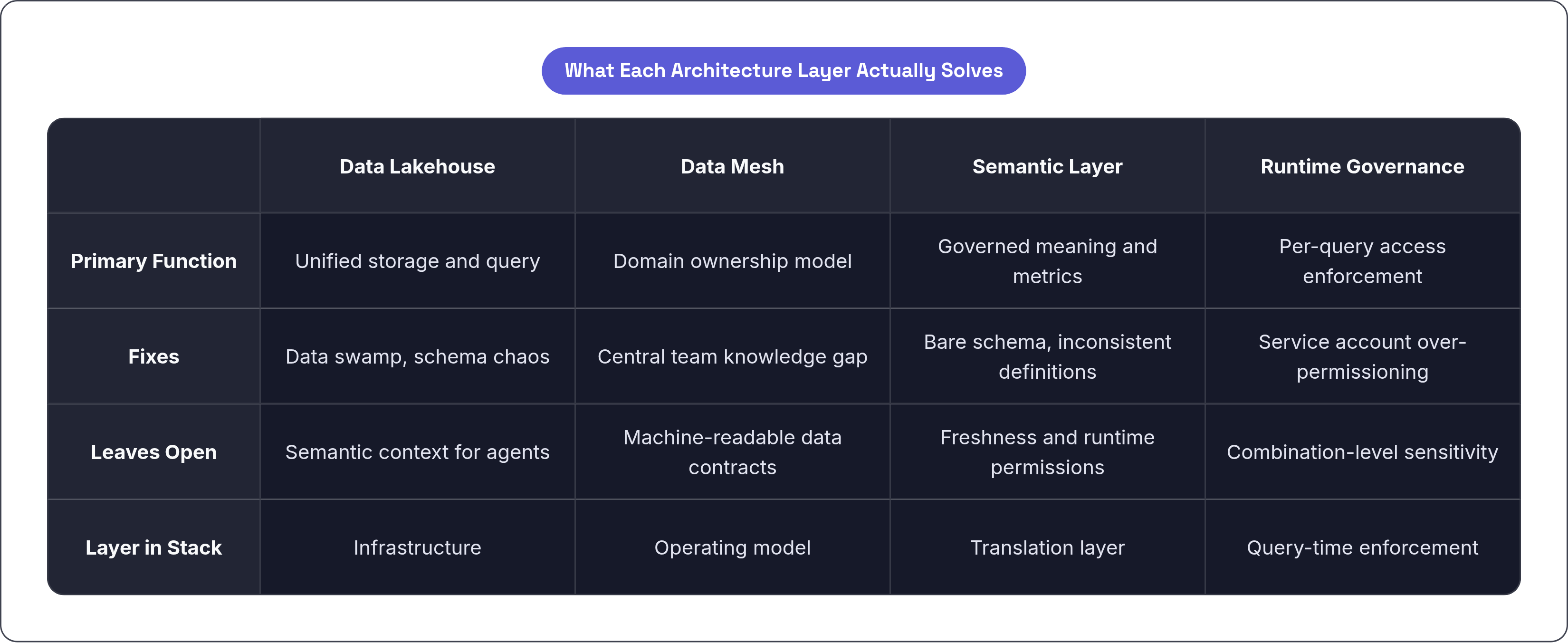
But I want to be precise about what it fixes. A lakehouse improves your storage and query layer. It does not, on its own, answer whether the data reaching an agent carries context, whether permissions are enforced at the moment of the query, or whether the agent knows how fresh what it's reading actually is. Those questions live one layer up.
What data mesh actually is, and why most implementations fall short of the theory
Data mesh gets misunderstood constantly, so let's be clear up front: it's not a storage technology, and it doesn't compete with a data lake or lakehouse at the infrastructure layer. It answers a completely different question, which is who owns the data and how it gets delivered to the people who need it.
The insight behind mesh is a good one. Centralized data teams, no matter how sharp, don't have the domain context to define and certify data that comes out of, say, a claims department or a logistics operation. The people closest to that context should own quality, documentation, and reliability for their own data. Mesh formalizes that into four principles: domain-oriented ownership, treating data as a product, self-serve infrastructure so domains aren't blocked waiting on a central team, and federated computational governance, meaning shared rules enforced across domains rather than dictated from one place.
Where this actually works, it works well. Domain teams write better definitions because they live with the consequences of bad ones. They catch quality problems earlier because they're the ones who'll get paged about it. They build more trustworthy service agreements because they're judged on whether people downstream actually use and trust what they publish, not just on whether they shipped something.
Thoughtworks, after watching a lot of these rollouts up close, found that the real obstacles aren't technical at all. They're organizational, and data teams typically sit inside IT as a cost center, funded through short, project-based budget cycles. That structure is basically incompatible with the long-term, product-oriented thinking mesh demands. And decentralization without shared standards doesn't create more capability; it multiplies variation. Every domain ends up inventing its own schema, its own formats, its own definitions, and now you've got five versions of "customer" instead of one.
Here's the AI-specific gap, and it matters even in a mesh implementation that's running well. Mesh improves ownership and domain accuracy. It does not, by itself, guarantee that a data product handed to an AI agent carries machine-readable context, enforces permissions under the real requesting user's identity at query time, or signals how fresh it is. Those are open problems regardless of how well the mesh is organized.
How most large enterprises are actually running these architectures in combination
The lake-versus-mesh debate, framed as an either/or choice, is largely a false one in practice. A large majority of large enterprises have landed on hybrid setups rather than committing fully to one model or the other.
The combination usually looks like this: a lakehouse or lake handles storage and processing, and domain-oriented ownership gets layered on top of it. Mesh becomes the operating model; the lakehouse is the infrastructure it runs on. Neither one replaces the other, since they're solving different layers of the same stack.
McKinsey's October 2025 survey backs this up with data: hybrid approaches outperformed both pure mesh and pure fabric implementations on the metric that actually matters, which is whether the organization hit its objectives within a defined timeframe. Gartner's research from its 2025 Enterprise Data and Analytics Summit found something similar, and arguably more important: organizations that planned for hybrid from day one, rather than pivoting into it after a pure implementation failed, saw meaningfully faster time to value, lower total cost of ownership, better adoption, and fewer governance conflicts. Forrester's 2025 analysis goes a step further, noting that a growing number of enterprise architects no longer see mesh and fabric as competing choices at all. They see convergence as inevitable.
I think that's right, and I also think it doesn't finish the job. Combining mesh ownership with lake or lakehouse storage gets you better-organized, better-owned data. It does not automatically get you data an AI agent can trust. The governance question, who enforces what, at which layer, under whose identity, stays unresolved unless someone explicitly designs it into the query path itself.
That's the structural gap. Everything after this section is about closing it.
The question neither architecture fully answers: whether data is trustworthy at the moment an agent queries it
Both the lake and the mesh were designed around a human analyst as the final consumer. A human can ask a follow-up question, look at a number, and think, that seems off, let me check. A human, from context and experience, often knows that "revenue" in this dashboard means something different than "revenue" in that one.
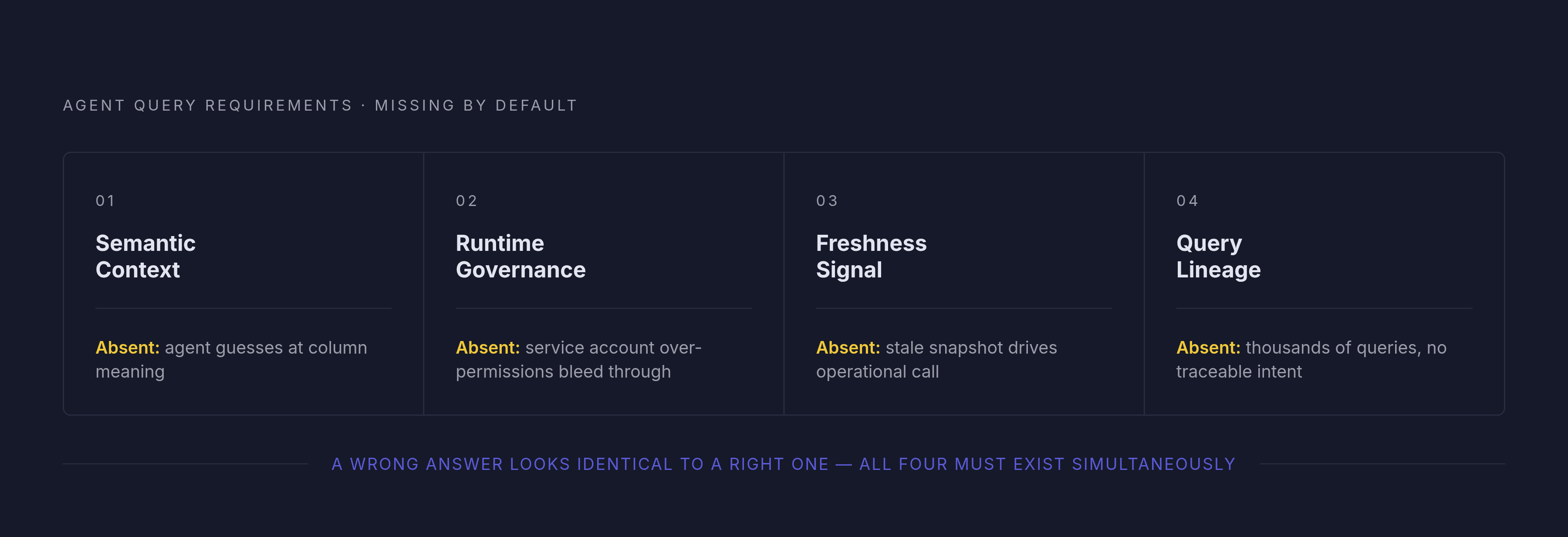
An AI agent has none of that. A wrong answer looks exactly like a right one to an agent, unless the data itself is carrying the proof of its own trustworthiness. That's a much higher bar than either architecture was built to clear, and it comes down to four things that have to exist at the moment of the query, not somewhere upstream in the architecture diagram.
Semantic context, first. The data has to carry its own meaning: table descriptions, metric definitions, how fields relate to each other. An agent has no institutional memory to fill in what a bare schema leaves out.
Runtime governance, second. Permissions need to get checked at the actual moment of the query, scoped to the real end user, not inherited from a service account or assumed from a previous session. Agents can query at a speed and volume that makes reviewing things after the fact pointless.
Freshness, third. The agent needs to know how current its data is relative to the decision it's making. A snapshot that's perfectly fine for a Monday morning dashboard might already be stale for an agent making an operational call at 2pm.
And lineage, fourth. Every query needs to log identity, intent, and lineage together, at whatever volume the agent is running. A log with just the query string in it is useless when an agent is firing off thousands of queries an hour and something goes wrong.
None of this comes free with a data lake, a lakehouse, or a mesh. These properties have to be designed into a layer that sits between the storage architecture and whatever AI system is consuming from it. That layer is what the rest of this piece is really about.
What a semantic layer does that a storage architecture cannot
The GigaOm 2025 Radar for Semantic Layers and Metric Stores classified this category as mature for the first time. That's a meaningful shift, and it means the semantic layer isn't an experimental nice-to-have anymore; it's infrastructure enterprises are expected to run. Gartner made a similar call in its 2025 Hype Cycle for Business Intelligence and Analytics, elevating the semantic layer to essential infrastructure. Read between the lines and the message is blunt: if you're treating this as optional, you're building on a foundation with a hole in it.
So what does it actually do? A semantic layer is a governed translation layer that sits between raw schema and business meaning. "Revenue" gets defined once and applied consistently, no matter which underlying system the query happens to touch. It gives an AI agent metric definitions, table relationships, and field descriptions it can actually read and reason from, instead of guessing at what a column named revamt2 is supposed to mean. And it becomes the single place where you enforce who can see what, expressed in plain business terms rather than scattered across a dozen different database permission systems.
This connects directly to something a lot of AI teams have already run into: the Model Context Protocol, or MCP. MCP solved a real technical problem, giving language models access to governed business logic instead of raw, uncontextualized tables. But MCP needs something to point at, and the semantic layer is that something.
The industry is converging fast here. dbt Labs open-sourced MetricFlow. Snowflake formalized an open semantic interchange standard. GigaOm's 2025 radar specifically calls out open standards and interoperability as core criteria for evaluating vendors in this space. On the vendor side, you've got Snowflake with Semantic Views and Cortex Analyst, Databricks with Unity Catalog Metric Views and LakehouseIQ, dbt's MetricFlow, AtScale, and Kyvos Insights, among others. The pattern across all of them is the same: definitions are moving closer to the data platform itself, with governance enforced centrally through the platform catalog rather than scattered across individual tools.
One caveat, and it's an important one. A semantic layer has to sit on top of a query path that also enforces runtime permissions and freshness. Without that, you can have a beautifully governed semantic layer and still hand an agent stale or over-permissioned data underneath it. MIT CISR's 2024 Data Monetization Survey found that the practices needed to sustain taxonomies and ontologies, the actual foundation a semantic layer depends on, remain underdeveloped at most organizations. The gap isn't awareness anymore, since everyone knows this matters. The gap is execution.
What runtime governance must enforce that neither the lake nor the mesh handles by default
Governance for AI agents is not the same problem as governance for human analysts, and treating it as the same problem is how a lot of enterprises get burned. The volume, speed, and autonomy of agent queries make manual review a non-starter. By the time you catch a problem in an audit log, the agent has already run ten thousand more queries.
Here's where storage architectures leave the door open. A data lake typically grants access at the bucket or table level, often through a service account with fairly broad permissions. Whatever agent is running under that service account inherits its access, regardless of which actual end user's request it's fulfilling. A data mesh is better here, in the sense that ownership and documentation are clearer, but it doesn't automatically enforce that a query crossing a domain boundary is checked against the identity of the person who originated the request.
Runtime governance has to close that gap directly. Permissions get evaluated at the moment of the query, scoped to the real end user, never assumed from a service account or carried over from an earlier session. Sensitivity gets evaluated at the point where data actually gets combined, not just at the level of individual fields or sources; a join across two datasets that are each individually fine to access can produce a combination that violates policy the moment they're put together. And permissions need to be revocable at the level of a single workload, so that cutting off one misbehaving agent doesn't mean cutting off everything else sharing its service account.
Audit logs need to capture identity, intent, and lineage together, not just the query string and not just the result in isolation. At agent-level query volume, anything less is functionally useless for compliance or for investigating an incident after the fact.
And write actions deserve a harder line than reads. An agent that can update a record, kick off a workflow, or trigger a downstream system carries a risk profile that read-only analytics never did. Treating writes and reads under the same governance rules is a mistake I see enterprises make constantly.
The practical upshot: governance bolted on at the model or prompt layer is governance applied too late. By the time a prompt is being interpreted, the data's already been pulled, under whatever permissions the retrieval step happened to assume. If governance isn't built into the retrieval itself, it isn't really governance.
How to actually get there
Start with the storage question honestly. If you're still running a raw lake, move to a lakehouse built on an open format like Iceberg or Delta Lake before you do anything else; it's the cheaper fix and it removes an entire category of swamp-related headaches.
Layer domain ownership on top, not instead of. Mesh principles, domain teams owning definitions and quality, work as an operating model regardless of what's underneath. Don't tear out your storage layer to adopt mesh. Run them together, the way most large enterprises actually do.
Then build the layer that neither architecture gives you for free. Stand up a semantic layer and make it the thing your AI systems query against, not the raw tables underneath it. Point your MCP implementation, or whatever agent framework you're using, at that semantic layer rather than at the lake directly.
Design runtime governance into the query path itself, evaluated per user, per query, with sensitivity checked at the point of combination. And treat write-capable agents as a distinct risk category from the start, with stricter approval and audit requirements than anything read-only.
None of this is a product decision. It's an architectural one, and it's the decision that determines whether your AI initiative reaches production or joins the pile of pilots that never made it past the demo.