Data Mesh vs Data Fabric Architectural Comparison
Mesh reorganizes data ownership; fabric connects data you already have across systems.

Data mesh and data fabric get lumped together as "modern data architecture," but they answer completely different questions. Mesh asks who should own data and how teams should be structured around it. Fabric asks how you connect data that already exists across a dozen different systems without moving it all into one place. One rewrites accountability; the other automates plumbing.
I've watched too many architecture teams treat this like a bake-off, like you're picking Snowflake over Databricks. You're deciding which of two entirely different problems you have, and most organizations, if they're honest, have both. The confusion costs real time: I've seen teams spend two quarters debating "mesh vs. fabric" in a working group when the actual fix was to write one down as the org chart problem and the other as the pipe problem, then go solve each on its own clock.
What data mesh actually is (and what it requires of an organization)
Mesh is a decentralization model. The core idea, credited to Zhamak Dehghani back in 2019, is that the teams closest to the data should own it, end to end, instead of shipping it off to a central data team that doesn't understand what "customer lifetime value" means in three different business units.
There are four pillars, and each one is a real operational demand, not a slogan on a slide:
- Domain ownership. Product owns product data. Finance owns finance data. Each domain is responsible for its own data the way a software team is responsible for its own service.
- Data as a product. Domains don't just dump tables somewhere. They publish data with a schema, a documented owner, an SLA, and a known set of consumers. Treat your dataset like you'd treat an API: version it, document it, support it.
- Self-serve infrastructure. A platform that lets domain teams manage and publish their own data products without filing a ticket to a central team and waiting three weeks.
- Federated governance. Standards get set collectively, then applied locally. No single team dictates every naming convention or access policy from the top down.
Here's what nobody puts on the slide: this requires new job titles. You need data product owners, which is a role that didn't exist five years ago at most companies. It requires a cultural shift in who gets blamed when a dashboard breaks, from "the data team" to "the marketing team that owns that pipeline." And it requires central IT to give up control it has held for a decade, which is the hardest sell in the whole exercise.
Mesh timelines run in organizational change cycles, not sprints. I'd tell any exec asking for a quarter-long mesh rollout that they're setting themselves up to fail. This is a multi-quarter, sometimes multi-year, transformation. It pays off most in large organizations with many domains producing siloed data, where the actual bottleneck isn't a missing pipeline; it's that nobody trusts anyone else's numbers. Thoughtworks' 2026 field report goes so far as to frame mesh maturity as a prerequisite for production-grade AI: clean, owned data with real schema contracts is what makes an AI system's inputs trustworthy in the first place.
What data fabric actually is (and what it takes to deploy)
Fabric solves a different problem entirely. Per Gartner's definition, it's a composable, metadata-driven architecture that connects data scattered across cloud, on-prem, operational, and analytical systems through one access and governance layer, rather than requiring everything to be centralized into a single store.
The mechanics matter here, so let me be specific:
- Active metadata layer. This continuously collects and acts on technical, operational, and business metadata, in real time, rather than sitting as a static catalog someone updates once a quarter.
- Cataloging and lineage. You can trace where a piece of data came from and every hop it took to get to your dashboard.
- Policy enforcement at query time. Governance rules get applied the moment someone runs a query, reducing reliance on an analyst upstream remembering to mask the SSN column manually.
- API-based access. One interface sits over everything, whether the source is a fifteen-year-old Oracle database or a Snowflake warehouse spun up last month.
What fabric does not do is just as important. It doesn't reorganize who owns anything. It doesn't reassign responsibility. It works with the mess you already have, and it doesn't ask permission from HR to do it.
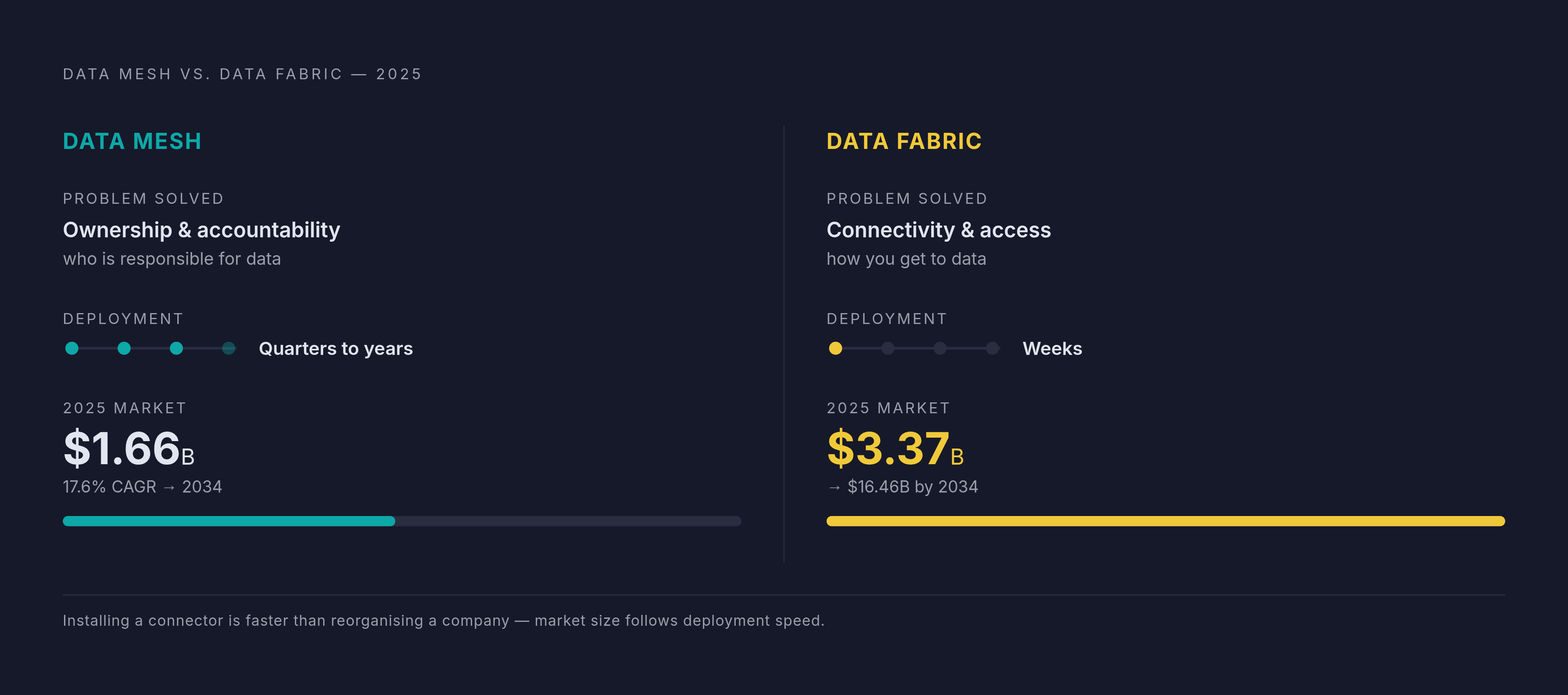
That's exactly why fabric deploys fast. There's no cultural negotiation, no new job titles, no domain team convincing a VP to give up control. It's a technical exercise, so timelines run in weeks, not quarters. Gartner's 2025 Strategic Roadmap describes fabric as the architecture underpinning current and near-term AI and analytics use cases, the technical substrate that makes AI-ready data possible. And the market is voting with its wallet: data fabric was valued at USD 3.37 billion in 2025 and is projected to hit USD 16.46 billion by 2034, according to Fortune Business Insights (2026). That kind of growth curve doesn't happen unless enterprises are already buying in at scale.
The structural difference that changes every downstream architectural decision
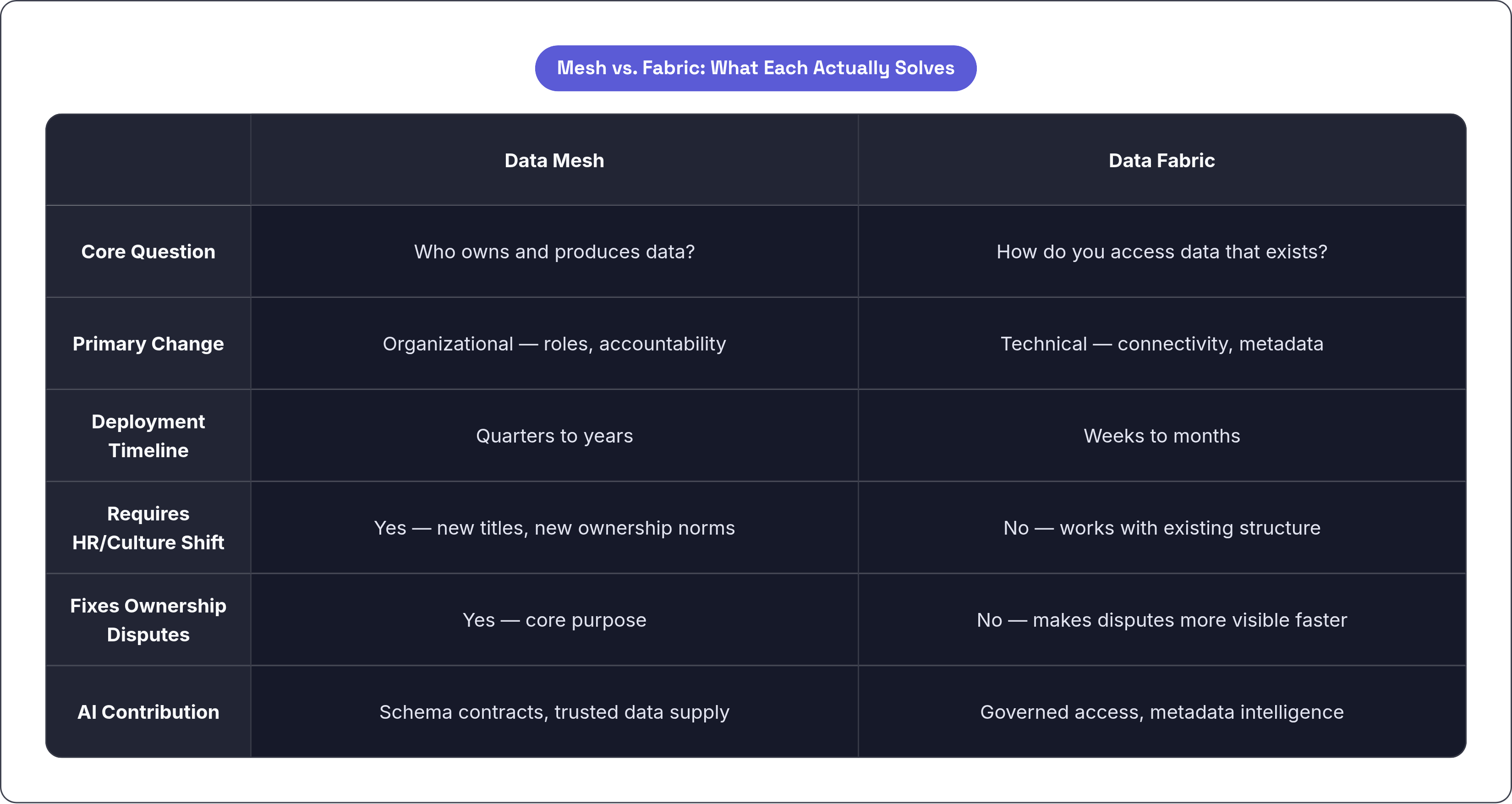
Boil it down to one line: mesh is about who's responsible for data, fabric is about how you get to it.
Mesh changes the supply side. It restructures how data gets produced, owned, and published in the first place. Fabric changes the access side. It restructures how data gets discovered, connected, and consumed once it exists. Different axes entirely, which is exactly why the two aren't in competition and, in most real deployments, need each other.
This distinction should drive every decision downstream of it, because "should we adopt mesh or fabric" is a diagnosis question more than a technology question. If your analysts can't get data from another department because nobody there wants to share it or doesn't trust the ask, that's an ownership problem. Fabric will not fix it; it'll just make the refusal happen faster, over a nicer API. If your teams already own clean, well-documented data but connecting it across five systems takes a contractor and three weeks of custom ETL, that's a connectivity problem. No amount of domain restructuring solves that.
Consistent with mesh's steeper organizational climb, the mesh market is smaller: USD 1.66 billion in 2025, growing at a 17.56% CAGR through 2034 per the same Fortune Business Insights report. Real growth, but a fraction of fabric's trajectory, because reorganizing a company is a lot harder than installing a connector.
Where organizations get into trouble by treating the choice as either/or
I've watched two failure patterns play out enough times that I'd bet money on which one hits a given org before I even ask about their tech stack.
Pattern one: a company deploys a fabric layer assuming it'll dissolve their ownership disputes. It doesn't. It just makes those disputes more visible, faster, in front of more people. You've built a beautiful highway connecting two towns that still refuse to trade with each other.
Pattern two: a company launches a mesh initiative, gets domains publishing tidy little data products with real schemas and real owners, and then discovers nothing can query across them uniformly. Each domain built its product island perfectly. Nobody built the bridge.
There's also a subtler trap I'd call the demo-to-production gap. A fabric can make fragmented, badly owned data technically reachable in an afternoon. But data that's stale, ambiguous, or undocumented doesn't become trustworthy just because a unified query layer can now touch it. Accessible and reliable are not the same word, and treating them as synonyms is how a demo that wowed the steering committee turns into a production incident three months later.
The governance version of this failure is the most expensive one. Teams build the architecture first and tell themselves ownership and lineage can wait. By the time anyone circles back, three critical systems already depend on a dataset nobody can explain. Per Precisely's 2025 Data Integrity Trends research, 62% of organizations name a lack of data governance as the top obstacle to their AI initiatives, and governance is fundamentally an ownership and accountability problem. No integration layer, however well built, fixes accountability. The organizations that get this right stop asking "which one" and start asking which problem needs solving first, and in what order the fixes get layered on.
Why AI workloads make the distinction between the two more consequential, not less
An AI agent can't raise its hand and ask what "revenue" means in this context. It just answers, confidently, whether the underlying data supports that confidence or not. A wrong answer delivered with total conviction is indistinguishable, on the surface, from a right one, and that's the whole danger.
What an agent actually needs is data that's owned, so someone is accountable when it's wrong; semantically defined, so a term means the same thing across every domain that touches it; provably current, with freshness that matches the use case; and auditable, with lineage captured at the moment of the query, not reconstructed after the fact.
The numbers on AI project failure back this up in a way that should worry anyone shipping agentic systems right now. Gartner found that at least 30% of generative AI projects got abandoned after proof of concept by the end of 2025, and the root cause traced back to data foundation failures, not model failures, over and over. QuickLaunch Analytics' 2026 report found that 42% of companies abandoned most of their AI initiatives that year, up from 17% in 2024. That's nearly a threefold jump in a single year. The problem isn't getting easier as adoption scales; it's getting worse.
Mesh's contribution to fixing this is the ownership contracts and schema definitions that give an agent something trustworthy to read in the first place. Thoughtworks' 2026 report even introduces the idea of "dual-use data products," built to serve human analysts and AI agents at the same time through machine-readable context interfaces. Fabric's contribution is the metadata intelligence and governed access that make sure the agent is querying the right data, under the right identity, with a full trail behind it. For AI specifically, you don't get to pick one. You need the product discipline of mesh to get the supply right, and the integration muscle of fabric to make runtime access trustworthy.
The semantic layer as the bridge neither architecture fully provides on its own
Say mesh has done its job. Domains are publishing clean, owned data products. Say fabric has done its job too, and everything connects through one governed access layer. Agents still hit a wall: what does "revenue" mean here, and does it mean the same thing over in that other domain's product?
That's the gap a semantic layer fills. It sits above both mesh and fabric and translates raw (however well-governed and connected) data into business meaning that a human and a machine can both read without guessing. GigaOm's 2025 Radar for Semantic Layers classified the category as mature for the first time; required infrastructure rather than an emerging idea. Gartner elevated the semantic layer in its 2025 Hype Cycle for BI and Analytics for the same reason, and the stakes are getting higher, not lower: Gartner forecasts, per Fluree's 2026 citation, that more than 40% of agentic AI projects will be abandoned by 2027.
For AI use cases specifically, a semantic layer has to carry more than what a typical BI tool needs. It needs table and metric definitions, so an agent knows what a column actually represents rather than just its name. It needs the relationships between entities across domains, the join logic that no single data product contains on its own. It needs sensitivity classification applied at the point two fields get combined, because a column that's safe by itself might not be safe once it's joined to another. And it needs lineage attached to every single query result, so an audit log captures intent and provenance, not just a record that access happened.
This is where a platform like Peaka is worth paying attention to. It bakes a semantic layer directly into the query interface, with governance enforced at query time under the actual identity of the person or agent asking, rather than bolted on as a separate compliance step after the fact. That's the layer that remains missing even after mesh gets ownership right and fabric gets connectivity right: the context and permission layer that lets an agent produce an answer that's correct, not merely syntactically valid.
How to decide which to pursue first, and under what conditions to combine them
Start with a real diagnosis, not a vendor pitch. If the honest answer is "nobody's accountable for data quality and three teams define the same metric three different ways," you have an organizational bottleneck, and mesh principles come first. If the honest answer is "our teams own their data fine, but connecting it across systems takes a contractor and a month," you have a connectivity bottleneck, and fabric comes first.
Most large enterprises, if they're being straight with themselves, have both problems running at once. In that case, sequence it: fabric buys you time by making existing data technically reachable while mesh builds the slower, more durable organizational foundation underneath it. Layer the semantic layer across both once they're in motion, not after.
Size matters more than most architecture decks admit. A smaller company with a handful of domains rarely needs a full mesh rollout; the organizational overhead outweighs any benefit you'd get. A large enterprise with a dozen autonomous divisions, though, usually can't get AI into production reliably no matter how good its integration layer is, because the ownership problem never got solved.
Timeline expectations should shape the pitch to leadership too. Fabric deploys in weeks and shows near-term ROI on infrastructure modernization, the kind of win you can point to at the next board meeting. Mesh shows better long-term value but demands sustained commitment measured in quarters, and it will not look like a win in month two. The end state worth building toward: fabric as the runtime access and governance layer, mesh as the organizational model deciding who publishes what with what guarantees, and a semantic layer carrying meaning and permission across both. That's the stack that actually serves AI agents reliably, and the good news is neither piece requires ripping out your existing warehouse or pipelines to get there. Both are designed to sit on top of what you've already built, which, for most enterprises, is the only realistic path forward anyway.
What the vendor landscape reflects about how enterprises are actually implementing this
The vendor market has split along the exact same fault line as the architecture itself. Some vendors sell organizational enablement: mesh tooling, data product marketplaces, domain governance platforms. Others sell technical integration: fabric platforms, metadata automation, unified access layers.
Informatica is the clearest signal of where the fabric side is headed. Now operating as "Informatica from Salesforce" after an $8 billion acquisition closed in November 2025, and serving roughly 5,000 customers across more than 100 countries, it shows fabric-style infrastructure getting absorbed into broader enterprise platform plays rather than staying a standalone category.
Watch the marketing language closely, though, because a lot of it blurs on purpose. A product sold as a "data fabric" might tack on domain-ownership features. A "data mesh platform" might quietly include metadata-driven integration under the hood. Vendors chase both labels because both are selling well, which is exactly why understanding the underlying architectural distinction matters more than trusting whatever category a vendor slaps on its homepage.
Zoom out and the growth makes sense: Gartner projects the overall data and analytics software market to hit $175 billion in 2025 and grow to $358 billion by 2029, a 15.4% CAGR. Fabric and mesh markets are both expanding at once, not because one is winning and the other losing, but because they're solving different problems for the same buyers.
Whatever vendor you're evaluating, ask one question before anything else: does this address the ownership problem, the connectivity problem, or both? And if it claims both, ask how it handles the seam between them, because that seam is where most of these projects actually break.
The architectural conclusion: one reorganizes people, the other connects systems, and AI needs both working together
Restate it plainly: data mesh is an operating model that determines how data gets produced and owned. Data fabric is a technical layer that determines how data gets accessed and governed at the moment someone (or something) asks for it. Neither one, by itself, is enough for what AI workloads now demand.
Fabric without mesh gives you technically accessible data that's ambiguous, inconsistently defined, and owned by nobody in particular; agents will consume it with total confidence and hand back wrong answers dressed up as right ones. Mesh without fabric gives you well-owned, well-defined data products that sit behind walls no unified query can reach; agents can't work across domains no matter how clean each individual domain's data is. And even with both in place, without a semantic layer, you've got connected, owned data that agents still can't interpret correctly, because the definitions live in a wiki page somewhere instead of in the query interface itself.
The real question is which problem you actually have, which layer addresses it, and in what order you build. Only 7% of enterprises say their data is completely ready for AI, according to Cloudera and Harvard Business Review Analytic Services' March 2026 research. That gap (the vast majority of enterprises not there yet) is the real argument for treating mesh, fabric, and the semantic layer as three parts of one stack rather than three competing options. The organizations that get AI into production reliably are the ones who stop debating which architecture wins and start fixing the supply-side problem first.