Types of Data Integration and Their AI Suitability
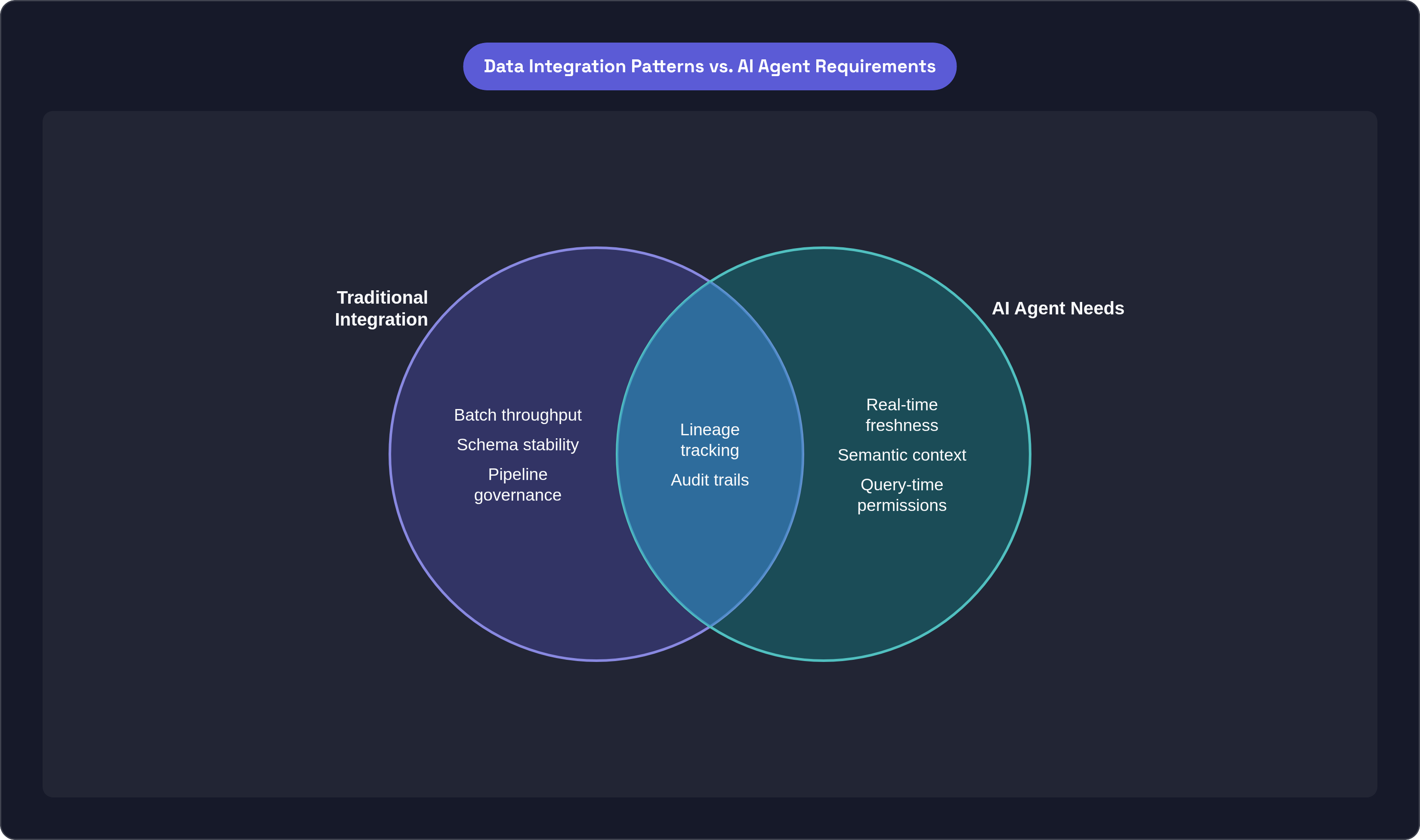
Agents need real-time data context that traditional pipelines were never designed to provide.

Twenty years of data integration patterns, and not one of them was built with an AI agent in mind. I've spent enough time in this space to say that plainly: ETL, ELT, CDC, virtualization, APIs, zero-ETL, each one solves a real problem, and each one leaves a different piece of the agent-readiness puzzle untouched. This piece walks through all six, scored against what an autonomous agent actually needs at the moment it queries, a different bar than what a BI dashboard needed five years ago.
For most of my career, the scorecard for data integration was throughput, cost, schema compatibility, pipeline reliability. Those criteria haven't gone anywhere. But agents force a second scorecard on top of the first: freshness, semantic context, queryability, lineage, permission enforcement, all evaluated at query time instead of design time.
Why do the criteria split like that? A human analyst asks a follow-up when a column name is confusing. A human tolerates a six-hour-old report because they know to caveat it out loud. An agent does neither. A stale answer looks identical to a fresh one to a model making a call at 2am, and there's no institutional memory to lean on when a field is named custstat2 and nobody ever wrote down what it means. The pipeline never attached that context, and there's no human standing in the loop to supply it after the fact.
Adam Wright, a research manager at IDC, said it better than I can: traditional data strategies were built for reporting, BI, and automation, but AI needs far more dynamic, granular, real-time pipelines. Two decades of data engineering did their job well within their original brief. The mismatch most teams haven't reckoned with yet is simply that the brief has changed, and pretending otherwise doesn't make it go away.
ETL: reliable governance, but structurally mismatched with agent workflows
ETL pulls data from source systems, transforms it, then lands clean, structured tables in a warehouse. Built for stable schemas and regulatory reporting, where a batch delay of a few hours, or a full day, never broke anything.
In that world, it still earns its paycheck. Pre-load transformation means governed, documented data by the time it lands, which is exactly what you want training a historical ML model on a weekly refresh. Audit trails tend to sit at the pipeline level too, giving you a governance floor that beats nothing.
Put an agent in front of it, though, and the seams show fast. Hours or days of batch latency doesn't work for an agent deciding something right now, based on current state, not last Tuesday's snapshot. Worse, that pre-load transform locks the data into a shape built for a human's dashboard. Need a different cut for the agent? Someone rebuilds the pipeline. And since ETL tosses the raw data after transforming it, you lose exactly the flexibility that AI feature engineering tends to need six months later.
I used to chalk agent failures like this up to bad data quality, until I traced enough of them back to pipelines that were doing exactly what they were designed to do. A dataset can be spotless, accurate, fully documented, and still miss what AI workloads require, deeper history, tighter consistency, lineage you can actually trace end to end. Most BI-oriented ETL pipelines were never built to hand any of that over. ETL still has a job, feeding training sets, running regulated batch loads, but as the only pattern in your stack, it can't support an agent that needs to know what's true right now.
ELT: the pattern that gives AI workloads the most room to work
ELT flips the sequence: land the raw data first, transform it afterward, inside the warehouse, using native compute. Snowflake, BigQuery, and the rest of the cloud-first crowd converged here because schemas now change faster than a pre-load process can keep pace with.
That ordering buys real room to maneuver. Raw data sticks around, so different teams run different feature engineering approaches off the same source without re-extracting a thing. Transformation logic lives as versioned code, which matters a lot when you need to reproduce a model's exact training conditions for an audit. And because several transformation layers can sit on the same raw foundation, one source table feeds a dashboard and a training pipeline simultaneously, no duplicate copies required.
It doesn't solve everything, though. Transformation still runs on a schedule, so the tables an agent actually queries can lag behind the fresher raw layer sitting underneath them. And semantic meaning doesn't just appear because the transform step moved downstream; somebody still has to define what a column means and write that definition somewhere an agent can find it.
The lakehouse pattern, modern ELT running on Databricks or Microsoft Fabric, is turning into the practical foundation serving both BI and AI/ML off one governed layer. Weighing it against the other five patterns here, it's the best general-purpose batch option I've run across for AI suitability. It carries real limits, though: it isn't built for real-time agent calls, and meaning still has to be attached to the data separately rather than arriving with it.
CDC: the integration pattern closest to what real-time AI agents actually need
Change data capture watches source databases for row-level changes, inserts, updates, deletes, and streams just the delta to the target, event by event, close to instantly. That sub-second latency is what separates CDC from every batch pattern on this list.
For an agent, speed here isn't a bonus feature. An agent making a fraud call, allocating inventory, approving a procurement decision, is acting in one specific moment; yesterday's batch export isn't a resource at that point, it's a liability sitting on the table. RAG pipelines only stay current if the retrieval index updates as the source changes, and CDC is the mechanism that makes that happen. Live inference works the same way: the feature store has to reflect the current state of the world, and CDC is how teams keep it honest.
You'll find CDC doing real work in fraud detection, inventory systems, recommendation engines, agentic decision layers generally. But speed alone doesn't attach meaning. A field renamed at the source shows up renamed at the target, with zero explanation of why. Permissions, lineage, sensitivity tags, none of that rides along with the event stream on its own; you have to build that layer separately, every time.
CDC is the pattern I'd default to for keeping any AI workload current. Speed earns its keep, but trust still has to be built on top of it separately.
Data virtualization and federation: genuine freshness, real performance costs
Virtualization builds a logical query layer across source systems without moving any of the underlying data. Queries run against live sources the instant they're asked, no replication lag, because there's no replication happening at all.
That's a genuine advantage in specific situations. Compliance and data residency rules sometimes flatly prohibit consolidating data physically, and federation lets an agent reach data it couldn't otherwise touch. Zero duplication means the agent always sees source-of-truth state. And for exploratory work, where you don't yet know the shape of the data you'll need, federation skips the waste of moving data you might never use.
The cost shows up at inference time, though. Query complexity multiplies fast. A federated join across a slow or rate-limited source can stall an agent that's waiting on an answer right now, and an agent's patience for that kind of delay is thin. Batch pipelines fail in predictable ways; federated queries fail in unpredictable ones. There's a semantic snag baked in here too: the same business concept, defined slightly differently across two source systems, comes back as two different numbers, with nothing reconciling them for you.
Federation earns its place paired with a semantic layer that irons out those definitional conflicts before the agent sees the result, and in the cases where compliance genuinely rules out copying data elsewhere. It solves a real, narrow problem, and it's a poor default for high-frequency agent queries generally.
API-based integration: structured business logic that agents can consume directly
APIs work differently from everything above: direct, real-time calls, data moving both directions, no warehouse sitting in between. That changes where they land on an AI suitability scale, because an API call usually hands back interpreted business logic, not a raw row. Call /inventory/sku/12345 and you get a structured answer someone already reasoned about, saving the agent from making sense of a raw table itself. An agent consuming that API is consuming meaning that got baked in back when someone designed the endpoint.
This is the exact problem the Model Context Protocol was built to solve: giving LLMs governed access to business logic instead of raw data dumps. MuleSoft adding MCP support to its Anypoint Platform is one concrete example of that shift, treating API-based integration as the expected approach for agentic workflows. The scale of MuleSoft's deployment is worth sitting with too: it runs as the integration spine for more than 150,000 Salesforce customers, which is a large enough footprint to suggest API-based integration is already functioning as shared infrastructure agents can plug into directly.
The limits are real, though. An API exposes only what its designer thought to expose. An agent needing some novel combination of data waits on a new endpoint, or falls back to something less governed. Governance happens call by call, so tracing lineage across a chain of several API calls gets genuinely hard once you hit agent-level query volume. And rate limits that were fine for human traffic patterns become an actual constraint once a machine is hitting that same endpoint at machine speed.
APIs score well for operational AI use cases with stable, well-defined interfaces. They're a worse fit for exploratory or analytical agent work, where you don't know the shape of what you need until you're already halfway through querying for it.
Zero-ETL and native integration: narrowing the gap but not eliminating it
Zero-ETL promises native, near-real-time sharing between platforms, Snowflake to Snowflake, Aurora to Redshift, no pipeline code required. What it actually does is move the work somewhere else. The effort shifts from moving data to making it accessible and auditable right at the source. That's a redistribution of the integration problem, not a fix for it.
There's a real AI case here, to be fair. Less pipeline maintenance means teams iterate on data access faster, without an engineering queue standing in the way. Native sharing inside one platform's ecosystem tends to preserve metadata and governance that custom pipelines often strip out along the way. For teams living entirely inside one vendor's stack, time-to-data drops noticeably.
But it only works between compatible platform pairs, and any heterogeneous environment with legacy systems mixed in, which is most large enterprises, sits outside its reach entirely. Native sharing doesn't magically attach semantic meaning either; the data shows up structurally intact and just as uninterpreted as before. For sensitive or regulated workloads, the realistic setup ends up hybrid: zero-ETL running operational data, traditional ETL or ELT still handling the governed workloads next to it. Zero-ETL cuts real friction in ecosystem-constrained scenarios, and it functions best as one layer in a broader stack rather than a general answer to AI readiness on its own.
Why no single integration pattern is sufficient for an AI-ready stack
Each pattern trades one thing for another: ETL buys governance, CDC buys freshness, ELT buys flexibility, APIs buy encapsulated logic, federation buys around residency constraints. I haven't seen an enterprise data environment yet that gets to pick just one. They all end up running at once, whether or not that was ever the plan.
A realistic stack looks like this: ETL handling structured batch loads, CDC running real-time database replication, APIs carrying live operational exchange, ELT doing transformation inside the lakehouse. Combinations, working together, rather than a menu where you order one item and call it done.
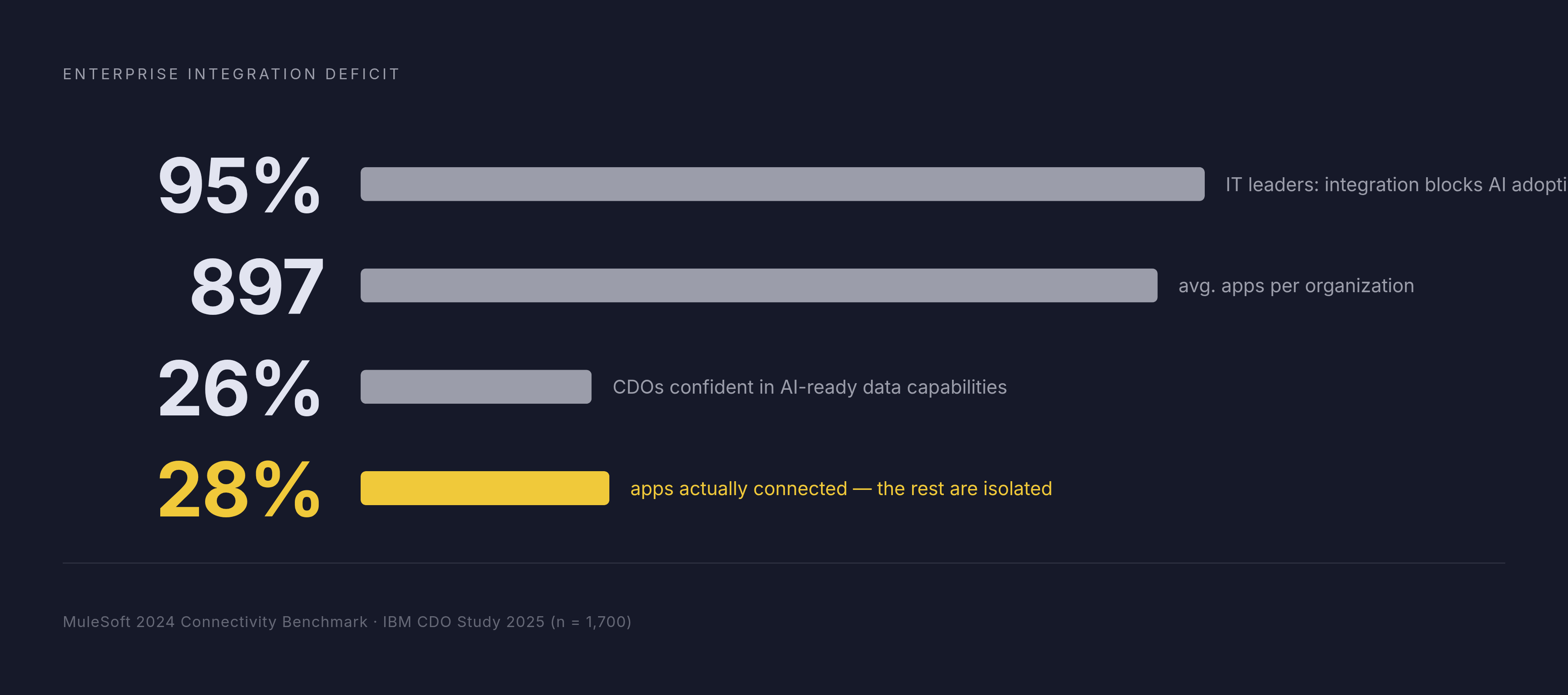
MuleSoft's 2024 Connectivity Benchmark Report puts a hard number on how far behind most organizations actually are. 95% of IT leaders say integration issues are blocking AI adoption outright. The average org runs 897 applications, and only 28% of them are actually connected to each other. Most enterprises aren't starting this work from a clean, integrated baseline; they're bolting AI onto something fragmented and hoping it holds.
Even a genuinely well-integrated stack doesn't finish the job, though. Moving data correctly doesn't make it interpretable. An agent querying a freshly replicated, perfectly accurate table can still fail outright because the column names are ambiguous or the metric behind them was never defined anywhere in writing. Permissions enforced at the pipeline level don't stop an agent from querying through a service account with wider access than the underlying human user should ever have had. And lineage captured at the pipeline level tends to vanish the moment an agent chains several queries across different sources, right when you need that audit trail the most.
That's the gap, plainly. The integration layer's job is moving data. Something else, sitting above it, has to make that data interpretable and governed enough for a system to act on it without a human checking the work first.
What the integration layer can't supply: context, meaning, and consistent governance
IBM's 2025 study of 1,700 CDOs worldwide found only 26% confident their data capabilities can actually support new AI initiatives. Eighty-two percent said their data goes to waste if employees can't get to it for decisions. Flip that around for agents instead of employees, and it gets worse, not better: an agent can't route around a bad permission setup or a missing definition the way a persistent human eventually learns to.
No pattern on this list, not one, supplies two specific things. Semantic context is the first: what a metric actually means, how a term gets defined one way in finance and another way in sales, which table is the real source of truth for revenue. None of that rides along with a pipeline automatically, no matter how well the pipeline itself is built. Consistent governance at query time is the second: permissions set back at the pipeline level don't follow the data once it lands somewhere new, so an agent can end up querying a joined result that exposes fields the underlying user was never individually cleared to see.
Get the plumbing right. It has to be right, no argument there. But plumbing alone was never going to be where this particular problem got solved.