Data Integration Tools Evaluation for AI Teams
AI agents need data foundations designed for inference, not dashboards repurposed for automation.

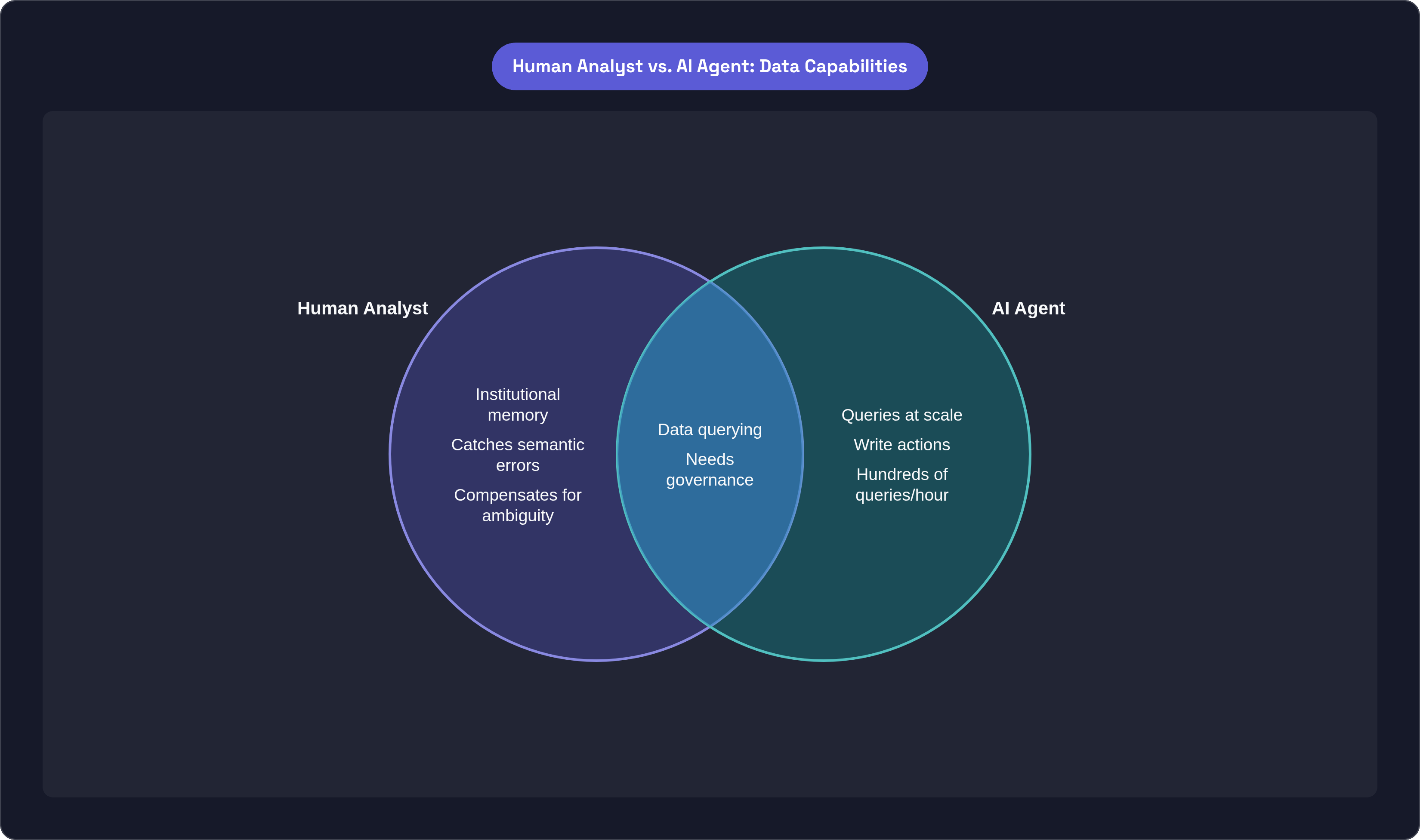
An analyst browses. She opens a dashboard, notices a number that looks off, pulls the underlying query, checks the date filter, adjusts. She carries institutional memory: she knows that "revenue" in the marketing schema excludes refunds, that the EMEA table hasn't been reconciled since Q3, that the customer ID in one system doesn't map cleanly to the customer ID in another. That knowledge lives in her head, accumulated over years of getting burned by bad joins.
An agent has none of that. It queries programmatically, at scale, without the capacity to pause and inspect. And here's the thing that keeps practitioners up at night: a confident wrong answer looks identical to a confident right one. The pipeline doesn't break. It runs beautifully. The agent makes a consequential decision on data it fundamentally misunderstood, and nobody finds out until something downstream has already moved.
Volume makes this worse in ways that aren't immediately obvious. A human analyst issues dozens of queries in a workday. An agent in production issues hundreds per hour, across multiple workloads, on behalf of different users with different access rights. The governance surface expands by orders of magnitude. That exposure isn't theoretical; it's arithmetic.
Then there's write access, which most integration evaluations treat as an afterthought. Agents don't just read. They trigger workflows, update records, route tickets, initiate procurement actions. A data integration layer that's safe for a dashboard is not automatically safe for an agent that can write. Most enterprise data estates were designed for transactional or analytical workloads: schemas normalized for joins, metadata scoped to table provenance, access controls built around row-level human queries. None of that architecture maps cleanly to what retrieval and reasoning by an agent actually requires.
The mismatch is architectural. Evaluating tools without addressing the architecture first is where most of these projects quietly fail.
What "AI-Ready Data" Actually Requires Before Any Tool Is Chosen
Most teams are already evaluating integration tools before their underlying data estate qualifies as a safe input for an AI workload. That sequencing problem is where a lot of AI projects die, and they die quietly, not in a dramatic failure but in a slow accumulation of results nobody can trust.
AI-ready is not the same as BI-ready, and conflating the two is an honest mistake with real consequences. A dataset clean enough for reporting can still fail an AI workload. Agents cannot compensate for ambiguity the way an analyst can. An analyst notices the number looks wrong and goes hunting. An agent reports it with confidence and moves on.
Five conditions have to hold simultaneously, and I'd argue most organizations are genuinely meeting two or three of them at best. Every dataset needs to be registered in a catalog with business context that agents can query at runtime, not just metadata that humans browse in a UI and then mentally translate. Data needs to flow with enough freshness for inference, not batch exports that are stale by the time an agent reasons over them. A single identity model and policy engine needs to cover every engine and every agent traversal, uniformly, not as a patchwork of system-specific controls someone checks annually. Data contracts and quality SLAs need to ensure that what reaches the model is trusted and versioned. And lineage needs to be traceable end-to-end, not just to the last transformation step.
McKinsey's 2025 State of AI found that high performers were nearly three times as likely to have fundamentally redesigned their data workflows rather than incrementally improved existing pipelines. That finding doesn't surprise anyone who's watched a capable AI project stall out six months post-deployment. The teams winning with AI rebuilt the foundation; they didn't bolt a retrieval layer onto what already existed and hope for the best.
The practical implication for evaluators is blunt: a tool that moves data efficiently into a non-AI-ready estate doesn't move the needle. Readiness is a precondition. No tool fixes it after the fact.
Semantic Context: The Criterion Most Evaluation Guides Omit
Here is the failure mode almost no evaluation framework accounts for, and it's the one I find myself explaining most often to teams who are convinced they've done their due diligence.
An agent queries your warehouse, joins what appear to be the right tables, and returns a revenue figure. The SQL is valid. The number is wrong. It aggregated at the wrong grain, used a definition of "revenue" that finance doesn't recognize, and joined a table the marketing team stopped maintaining six months ago. No error was thrown. The agent reported the result with the same confidence it would have reported a correct one.
This is not hallucination. It's semantic error, and it's far more common, far less dramatic, and far harder to catch than hallucination, which is precisely why it persists in production systems long after teams think they've addressed data quality.
What a semantic layer actually does for an agent is supply the institutional knowledge an analyst accumulates over years: table descriptions, metric definitions, join relationships, grain specifications, all available before the query runs. It gives the agent the context it structurally cannot build for itself. Gartner elevated the semantic layer to essential infrastructure in the 2025 Hype Cycle for Business Intelligence and Analytics. That designation reflects where the industry has arrived, not a speculative bet on where it's heading.
When evaluating a tool, the questions are specific, and teams should resist accepting vague answers. Does the tool expose semantic definitions that agents can consume at query time, or does it only surface metadata that humans browse in a catalog? Are metric definitions centralized and versioned, or duplicated separately across BI, analytics engineering, and AI copilots? Does the semantic model cover relationships and business logic, or only column-level descriptions?
Query-Time Governance: Why Permissions Baked Into Pipelines Aren't Enough
The traditional pattern goes something like this: a service account is granted broad read access when the pipeline is built, and every downstream consumer inherits that access. For a team of analysts querying a dashboard, the blast radius of that model is manageable, maybe uncomfortable but manageable. For agents operating across multiple user contexts simultaneously, it isn't manageable at all.
An agent serving a marketing analyst should not be able to retrieve the same rows as one serving the CFO. Under a shared service account, it can. A compromised or misbehaving agent operating with service-account-level permissions has access to everything that account can touch. In most enterprise environments, that's quite a lot, and the exposure is not hypothetical.
A Drexel University and Precisely study found that 62% of organizations cite lack of data governance as the primary barrier to successful AI initiatives. Governance isn't a compliance checkbox teams address after deployment. It's the thing most commonly blocking production in the first place, and yet evaluation frameworks still treat it as secondary to connector counts and throughput benchmarks.
Query-time governance means something specific. Permissions are evaluated at the moment a query is issued, scoped to the actual end-user identity, not the agent's credential. Sensitivity is evaluated at the point where data is combined, because a join can surface a sensitive inference that column-level policies wouldn't flag individually. Write actions are governed more strictly than reads, proportionally to the risk an agent acting on data actually poses. Access is revocable at the level of a single workload, not tied to a shared credential that breaks everything downstream if it's pulled.
The evaluation question for any tool: does access control evaluate the real user's identity at query time, or does it rely on the permissions granted to the integration layer as a whole? If the answer is the latter, the governance model was designed for a different era.
Audit and Lineage Requirements When Agents Are Querying at Volume
A log that captures "query ran at 14:32" is sufficient for auditing a human analyst. It is effectively meaningless when an agent issues hundreds of queries per hour. The log needs to capture who the real user was, what the agent was trying to accomplish, and what data it touched, as a single connected record, not three separate entries across three systems that a governance team has to manually correlate after something has already gone wrong.
Lineage also means something different in an agentic context. The question is no longer just "where did this data come from." It's "what did the agent do with it, and what action followed." Those are the questions a governance team needs to answer when something breaks, and they require lineage that extends beyond the last transformation step into the action the agent actually took.
What I've seen in practice is that audit and lineage gaps don't surface as a compliance risk during an annual review. They surface as a production liability when an agent takes an action nobody can explain and a governance team is left manually reconstructing a chain of events across disconnected logs. That's a different kind of urgency than anything a quarterly audit reveals.
Evaluate any tool on these specific points: does it log identity, intent, and lineage together as a unified record? Can those logs be queried programmatically to detect anomalous agent behavior, or do they require manual review? Is lineage available at the combined-dataset level, or only per source?
An audit log adequate for quarterly compliance is not the same instrument needed to govern an agent operating in real time. Those are genuinely different tools serving different purposes, and conflating them during evaluation is a mistake that tends to be expensive to correct later.
Freshness and Runtime Access Versus Static Pipelines
A snapshot that's hours old is acceptable for a dashboard summarizing last quarter. It is not acceptable for an agent routing a customer support ticket based on current account status, or triggering a procurement action based on inventory levels that shifted since the last sync. The staleness problem for agents is practical and immediate, and yet freshness evaluation still often defaults to a single system-wide metric that collapses genuinely different requirements into one inadequate answer.
Freshness requirements are use-case-specific, and that specificity matters more than teams typically account for. An agent summarizing historical sales can tolerate a day-old snapshot without consequence. An agent taking action on live operational data cannot. A single system-wide freshness setting cannot serve both workloads. Most evaluation frameworks don't even ask whether per-use-case configurability is possible.
Static pipelines also assume stable schemas, and enterprise schemas are not stable. They shift constantly, and data teams spend a significant share of operational time chasing breakage caused by upstream schema changes. In a human-operated workflow, a broken pipeline surfaces as a failed job and an alert someone investigates. In an agent-operated workflow, schema drift can produce silently wrong results: the query runs, data returns, the join condition no longer maps correctly, and nobody knows until something downstream has already acted on stale or malformed data.
The evaluation questions here are straightforward. Does the tool support live query access to source systems, not just exports into a warehouse that then ages? Can freshness guarantees be configured per use case? Does schema drift trigger automated remediation or silent failure? That last question tends to reveal a lot about how a tool was originally designed and for whom.
How Leading Integration Tools Perform Against These AI-Specific Criteria
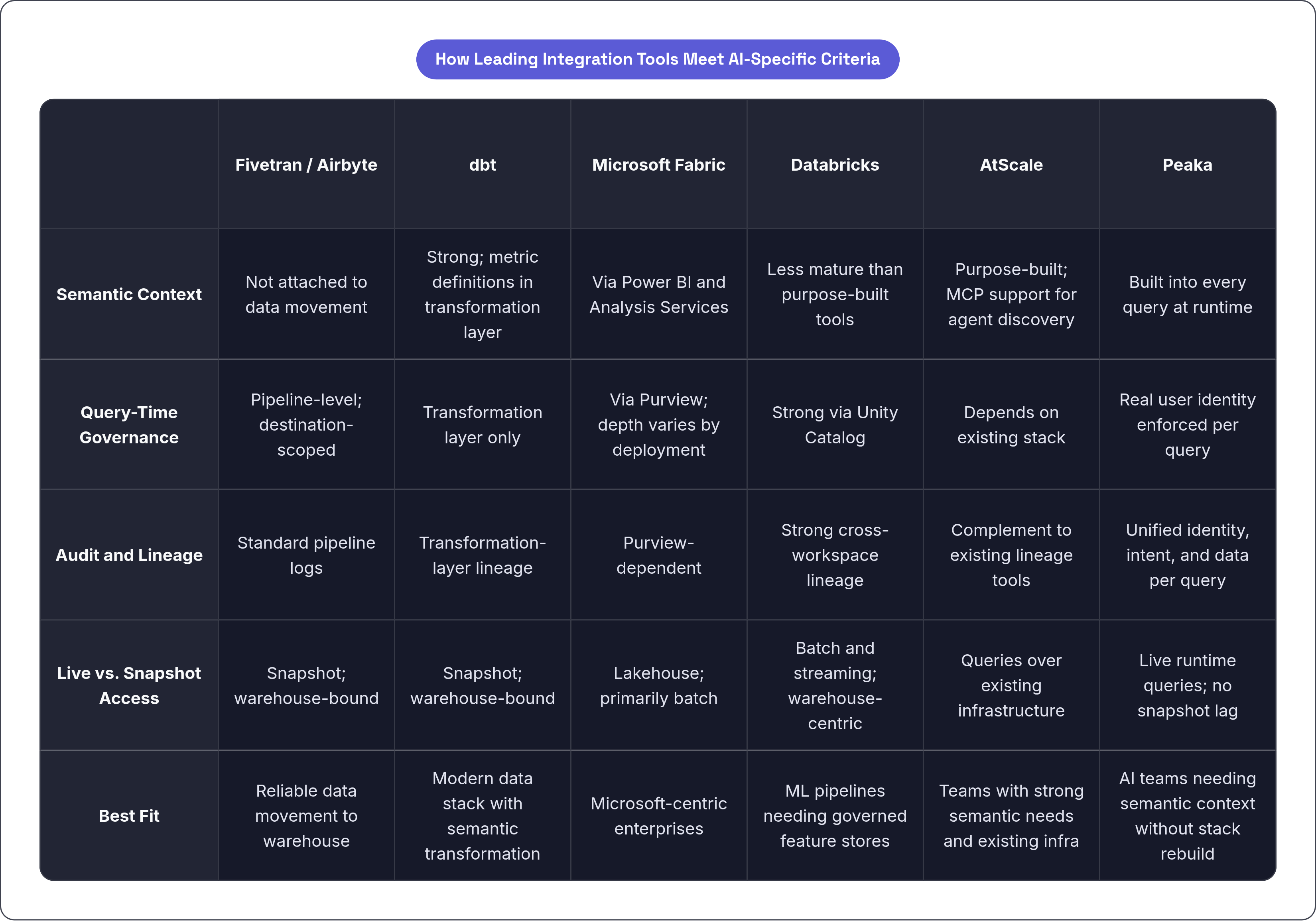
No tool performs well across every criterion. I want to be direct about that, because evaluations that pretend otherwise are not useful to anyone making a real decision. The honest question for any evaluation is which combination of gaps the team can absorb given their specific workloads, their existing stack, and where they're actually trying to go.
Fivetran and Airbyte
Both are strong on connector breadth and pipeline reliability, which are the traditional evaluation criteria for good reason: moving data dependably and at scale is genuinely hard, and both tools do it well. Against AI-specific criteria, they show the same structural gap. Data is moved without attaching semantic definitions that agents can consume. Governance is pipeline-level, access granted to the destination rather than enforced per query per user. Neither operates as a live query layer. They're well-suited for teams whose primary need is reliable data movement to a warehouse, with semantic context and query-time governance supplied by additional tools in the stack; the architecture works, it just requires more pieces.
dbt
The dbt Semantic Layer directly addresses the metric-definition consistency problem, and dbt is increasingly capable on semantic context as a result. Its participation in the Open Semantic Interchange initiative alongside Snowflake and Salesforce signals that the ecosystem is converging on portable metric definitions, which matters more for interoperability than teams sometimes realize when they're evaluating in isolation. Governance remains primarily at the transformation layer rather than query time. Best fit: teams already operating on a modern data stack who want semantic definitions woven into their transformation layer rather than bolted on afterward.
Microsoft Fabric
More than 21,000 paying organizations use Microsoft Fabric, including a substantial portion of the Fortune 500, and that scale reflects genuine enterprise depth rather than marketing momentum. Its lakehouse architecture is designed to serve both BI and AI/ML workloads from a single governed foundation. Semantic models are delivered via Power BI and Analysis Services; governance runs through Microsoft Purview. For Microsoft-centric enterprises, Fabric offers real coverage. The quality of governance and semantic layer depth, though, depends heavily on how completely Purview is deployed, and that varies significantly across implementations in ways the vendor's own materials don't fully convey.
Databricks
Unity Catalog provides cross-workspace governance and lineage, and Databricks performs well on audit and lineage as a result. It's natively suited to AI/ML workloads and strong on governed feature stores. The semantic layer is less mature than purpose-built semantic tools, which is a meaningful gap for teams whose agents need to reason over business metrics rather than raw features. Best fit: teams running ML pipelines who need governed lineage and feature stores more than they need business-metric semantic definitions.
AtScale
AtScale is purpose-built as a semantic layer and has added Model Context Protocol support, allowing AI agents to discover and query semantic models without requiring custom integration work. It performs well on the semantic context criterion specifically. It's less comprehensive as a full integration layer. Teams with strong semantic needs and existing infrastructure for data movement and governance will find it a capable complement rather than a standalone solution.
Peaka
Peaka sits on top of existing infrastructure without requiring migration or replacement of warehouses and SaaS systems, which matters practically for teams who've spent years building what they have. Semantic context is built directly into the query interface: table descriptions, metric definitions, and relationships are exposed at query time as part of every query, not maintained as a separate documentation layer someone has to remember to update. Permissions are enforced at query time under the real user's identity. Every query is logged with full lineage, capturing identity, intent, and data touched as a unified record. Access to source data is live rather than snapshot-based, with freshness matched to the requirements of each use case. For AI teams that need semantic context, query-time governance, and agent-safe access patterns without rebuilding their existing stack, Peaka addresses the AI-specific criteria most directly.
A Revised Evaluation Checklist for AI Teams
The checklist most teams bring to an integration tool evaluation was written for a world where analysts sit downstream and can compensate for what the tooling gets wrong. That world is not the one AI agents operate in. Here is a revised version organized around what actually determines whether an agent can operate safely and accurately.
Semantic context. Does the tool expose semantic definitions, including metric definitions, join relationships, and grain specifications, that agents can consume at query time? Are those definitions centralized and versioned, or duplicated across BI tools and AI copilots in ways that will eventually diverge?
Query-time governance. Does access control evaluate the real user's identity at the moment a query is issued, or does it rely on permissions granted to a shared service account? Can access be revoked at the level of a single workload without breaking everything else?
Agent-safe write governance. Does the tool treat write actions differently from reads, with stricter controls proportional to the risk that an agent acting on data actually poses?
Audit and lineage at scale. Does the tool log identity, intent, and lineage as a unified record per query? Can those logs be queried programmatically to surface anomalous agent behavior, or does investigation require manual reconstruction across disconnected systems?
Freshness configurability. Does the tool support live query access to source systems? Can freshness guarantees be set per use case rather than as a single system-wide parameter that collapses genuinely different requirements?
Schema drift handling. Does schema drift trigger automated remediation, or does it produce silent failure that only surfaces after something downstream has already acted?
AI-readiness as a precondition. Before evaluating any tool: have the five conditions of AI-readiness been assessed honestly? A tool that performs well against every criterion on this list cannot compensate for a data estate that doesn't meet the preconditions. That's not a caveat; it's the whole point.
The teams succeeding with AI in production didn't find a better pipeline tool. They rebuilt the foundation those pipelines run on, then chose tools that respected what agents actually need from data. Evaluating tools before addressing readiness is the wrong order of operations, and no tool on the market can fix that for you.