Audit Log Requirements for AI Agent Query Volume
Audit logs must capture vector retrieval and authorization chains to survive compliance review.

Out of the box, most LLM-based systems produce the same small set of fields: prompt sent, response returned, timestamp, token count. Some platforms append a session ID or user identifier, but those are additions someone chose to make, not defaults you can rely on. That telemetry tells you the system ran. It is useful for debugging latency and tracking API costs.
It cannot tell you who authorized the action, which agent acted, what data was accessed, whether a human approved the step, or how one tool call connects to the next. Default instrumentation was never designed to answer those questions, and it shows.
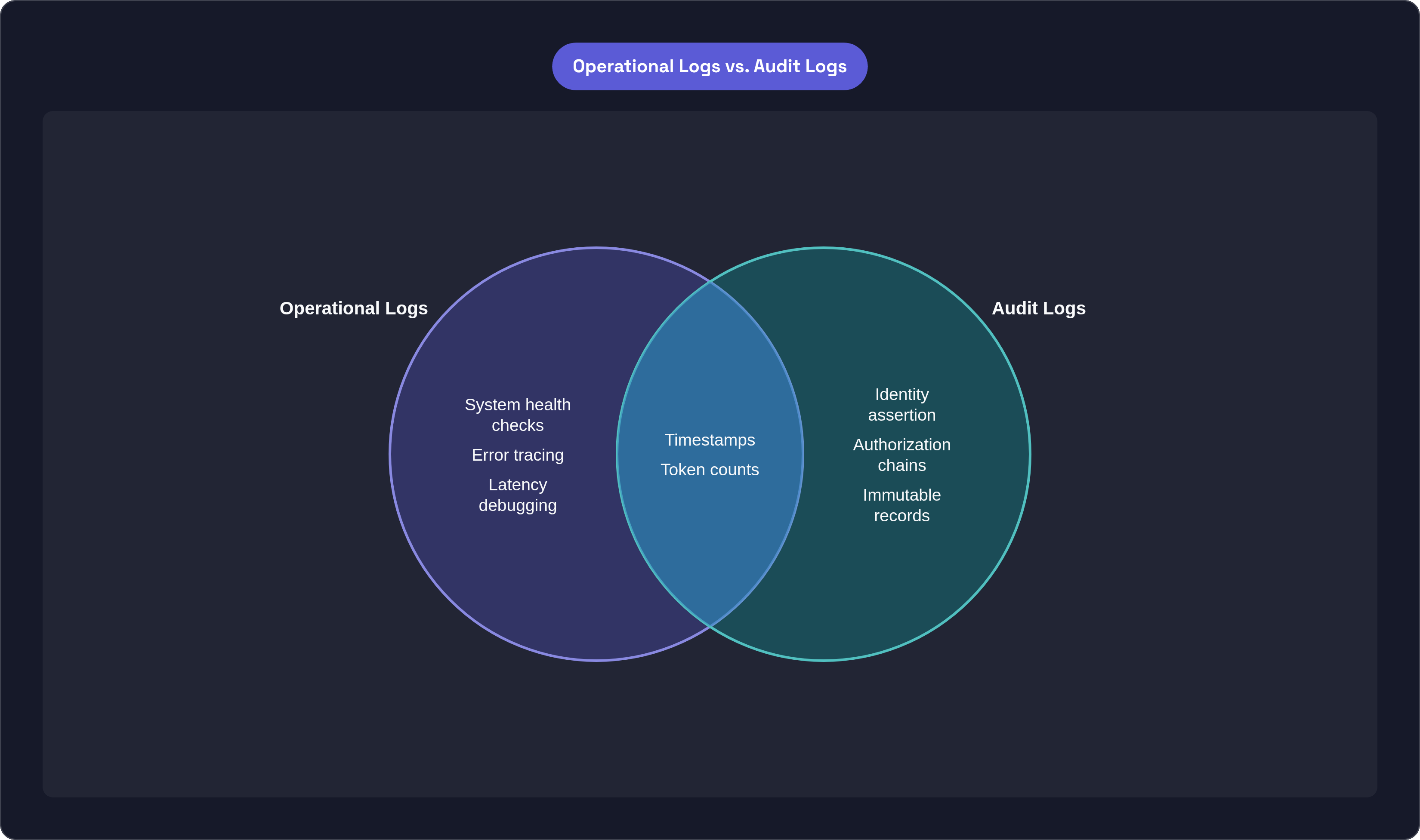
The confusion I keep seeing in organizations that are otherwise technically sophisticated is that they treat operational logs and audit logs as the same document. They are not. Operational logs serve engineers: surface errors, expose system health, trace failures. Audit logs serve compliance officers and regulators: prove accountability, satisfy legal requirements, survive formal review. Default telemetry does the first job. Almost no team produces the second without deliberate, additional architecture. Think of it this way: an operational log is a doctor's notes scribbled during surgery, and an audit log is the signed, witnessed record that goes before the medical board. One helps you remember what you did; the other proves you were authorized to do it.
One gap that rarely enters these conversations is vector store retrieval. When an agent queries a vector database, the documents it retrieves directly shaped the response the model produced. Most audit implementations do not capture what was retrieved at all. Unlogged retrieval is unauditable influence, and that becomes a serious problem the moment anyone needs to explain why the agent said what it said. I have sat in rooms where compliance reviews stalled for weeks, sometimes collapsed entirely, on exactly this point. The engineers knew what the system did. They just could not prove it to anyone who mattered.
The Regulatory Pressure Now Demanding More Than Operational Telemetry
Three frameworks are converging on a shared requirement for comprehensive, immutable audit logs. The EU AI Act, the NIST AI Risk Management Framework, and the OWASP LLM Top 10 approach the problem from different angles and arrive at the same destination.
EU AI Act Article 12 mandates traceability for high-risk AI systems and sets six months as the minimum retention floor. The NIST AI RMF 1.1, which functions as the practical standard for US federal and enterprise contexts, structures its expectations across GOVERN, MAP, MEASURE, and MANAGE, each mapping to a distinct domain of AI control. The combined effect of these frameworks is a requirement that goes beyond logging what the AI did. You must be able to prove who authorized it, what data it touched, and how decisions were reached.
Enterprise behavior is already shifting. The August 2026 deadline for full EU AI Act high-risk system obligations is the near-term forcing function most enterprise teams are planning against. The organizations that have yet to plan against it are behind, and that gap is harder to close the longer it stays open. Regulators are not asking for better operational telemetry. They are asking for a provable account of what the system did and why. Producing one when asked for the other does not go well.
The Six Event Types and Triple-Identity Fields a Compliant Agent Audit Log Must Capture
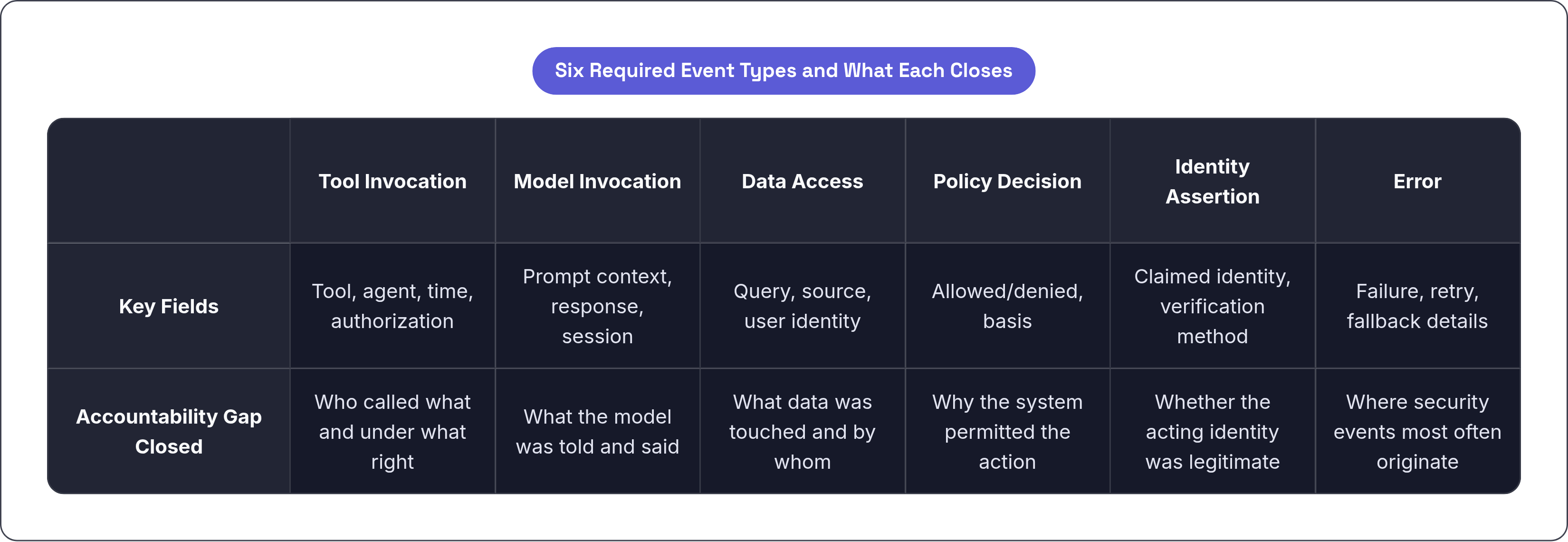
A compliant audit log for agent-driven systems requires six distinct event types, and the specificity matters because each one closes a different accountability gap.
Tool invocation: which tool, which agent, at what time, under what authorization. Model invocation: the prompt context and the response, linked to the session. Data access: what was queried, from which source, under whose identity. Policy decision: what the system allowed or denied, and on what basis. Identity assertion: who claimed to be acting and how that claim was verified. Error: failures, retries, and fallbacks, because security events disproportionately originate at the edges of normal operation rather than in the happy path.
Alongside those six event types, every data access and tool call must carry what amounts to a triple-identity record: User, Agent, and Tool, captured together. Capturing only one or two of those fields leaves the log unable to answer the basic accountability question. When a financial discrepancy surfaces, you need to know which agent made which call on whose behalf. Without all three, that chain breaks and the investigation stalls on the first day. A two-legged stool is not a stool.
Delegation chains require explicit treatment as well. Agents frequently act on behalf of users, services, or other agents, and the log must capture who authorized whom, what permissions were transferred, what scope was granted, and what the originating identity was. Authorization is not a single event; it is a chain, and the log must reflect the full length of it.
Confidence scores are where most teams underinvest. A field extracted at high confidence and one extracted at low confidence produce identical-looking outputs in the final record but carry meaningfully different risk profiles. Logging the score preserves the ability to audit whether the system's self-assessment was appropriate at the moment of the decision.
Sampling is not permissible for compliance logging. Every tool invocation must be recorded without exception. Sampling works for performance monitoring. It fails to satisfy legal requirements, where the absence of a single relevant entry can compromise an entire audit.
Why Identity, Intent, and Lineage Must Be Captured Together to Be Useful
Identity alone tells you which agent acted. It does not tell you whether the action was authorized or what it produced downstream.
Intent fills that gap. Because agents are non-deterministic, the same agent, the same tool, and the same data can produce different outcomes depending on context. Intent, meaning the originating user request and the session goal, is what transforms a sequence of individual events into a reviewable narrative rather than a list of timestamped facts. Without it, you have chronology. You do not have explanation.
Lineage is what makes the log reconstructable after the fact. Without a traceable connection between tool call A, data access B, and output C, you have a collection of events, not a provable account of what happened. At production agent volumes, a log that captures events without lineage becomes practically unsearchable. Reconstructing the causal chain manually for a compliance review is feasible in a sandbox and nowhere else.
There is also an authorization exposure that lineage specifically surfaces, and it is one that operational logs will never catch. Agents retrieve data using the permissions of the identity they authenticate as, but frequently output to shared workspaces where recipients may hold entirely different permissions. A log that captures retrieval but omits the downstream recipient cannot detect that exposure. Several significant vulnerabilities identified across major AI platforms in 2025 followed exactly this pattern: authorized retrieval, unauthorized recipients. Lineage logging is what surfaces that discrepancy before it becomes a breach rather than after.
Behavioral anomaly detection depends on this combined record too. Baselines for invocation frequency, delegation patterns, and data volume access only become meaningful when they are linked by identity and session. Strip any one of the three and the baseline loses its interpretive anchor.
Immutability and Tamper-Evidence as Technical Requirements, Not Optional Properties
An audit log that can be modified after the fact has no evidentiary value. That point seems obvious until you look at how most organizations actually store their logs, which is in the same mutable data stores they use for everything else.
Access controls are not sufficient protection here. The architecture itself must enforce immutability, because access controls can be circumvented, misconfigured, or overridden by administrators holding legitimate credentials. The question is not whether your access controls are good. The question is whether the architecture allows modification at all.
The technical standard is an append-only log architecture with hash chaining, where each entry is cryptographically linked to the one before it. Merkle audit chain properties extend this further: entries cannot be removed or reordered without changing the root hash, and verification requires only a logarithmic number of hashes rather than the full log. That last property is what makes efficient verification feasible at the scale AI agent logs actually generate.
Retention policy must be governed by regulatory context, not operational convenience. Operational log retention is often measured in days or weeks. EU AI Act Article 12 sets six months as the minimum for high-risk systems, and other regulatory contexts extend that further. Treating compliance retention like operational retention is a category error that surfaces badly during audits, reliably at the worst possible moment.
Audit logs also need to be kept physically separate from application logs and metrics. That separation ensures the audit trail survives application failures and prevents high-volume operational logging from contaminating the compliance data store. Immutability, tamper-evidence, and proper retention together transform a log from a debugging artifact into evidence. Any one of the three missing, and it does not survive formal review.
Why Enforcing These Requirements at the Data Layer Is Different From Enforcing Them at the Model or Application Layer
Model-layer and prompt-layer logging captures what the model was told and what it said. It does not capture what data was actually accessed, under whose identity, or through which retrieval path. Application-layer logging captures what a specific tool or integration did, but in multi-agent, multi-tool architectures, no single application sees the complete chain. That is not a criticism of those layers. It is a structural reality of how the systems are built.
The data layer is the one layer that every agent query must pass through, regardless of which model, which orchestration framework, or which tool is in use. It is the only place where a complete picture exists.
Permissions enforced at query time, under the actual user's identity rather than assumed from a service account, are the only mechanism that aligns access control with audit capture simultaneously. The log records not just what was accessed, but whether that access was legitimate for that specific identity at that specific moment. Only the data layer can make both of those claims in the same record.
Lineage that lives at the data layer also carries interpretable meaning. When a log entry is written at the source of the data, it inherits schema context, metric definitions, and the relationships exposed by the semantic layer. The audit record becomes something a compliance officer can read without a specialist decoding raw SQL under time pressure.
The alternative, patching governance onto the model or prompt layer, means rebuilding the logging logic for every new agent, every new tool, and every new integration added to the stack. The data layer enforces it once, for everything that queries through it. The logging gap in most organizations is downstream of a foundational data readiness problem, and centralizing at the data layer addresses both simultaneously.
What Organizations Can Act On Now Before Regulatory Deadlines Close In
Start with an honest inventory of what current logs actually contain. Do they capture User, Agent, and Tool for every data access event? If not, that is the first gap to close, and it belongs at the top of the priority stack, not in a backlog.
Establish session context. Every tool call needs to be grouped under a session ID linking it to the originating request and the authorized scope. Without that grouping, the log is a pile of fragments that looks complete and cannot be reconstructed into a coherent timeline.
Separate audit logs from operational logs now. The separation is low-cost and is a prerequisite for both immutability and retention compliance. This is one of the few things on this list that has no meaningful downside and can be done before anything else changes.
Address delegation chains explicitly. For any agent acting on behalf of a user or another agent, log who authorized whom, what scope was granted, and whether a human approved the step or the system acted autonomously. The authorization structure of an action is as important as the action itself.
Add hash chaining to any log intended for compliance use. Immutability is an architectural choice that must be made before logs accumulate. It cannot be retrofitted cleanly after the fact.
Close the vector retrieval gap. At minimum, log document IDs retrieved per query. What was retrieved shapes what the agent said, and that exposure becomes indefensible once a regulator asks to see the chain.
The organizations that will be ready when the August 2026 EU AI Act deadline arrives are the ones that treated audit logging as a data architecture decision, made once and enforced everywhere, rather than something bolted on tool by tool as the stack grew.