Why Enterprise AI Initiatives Stall at the Data Layer
Data quality problems in production, not model limitations, derail most enterprise AI projects.

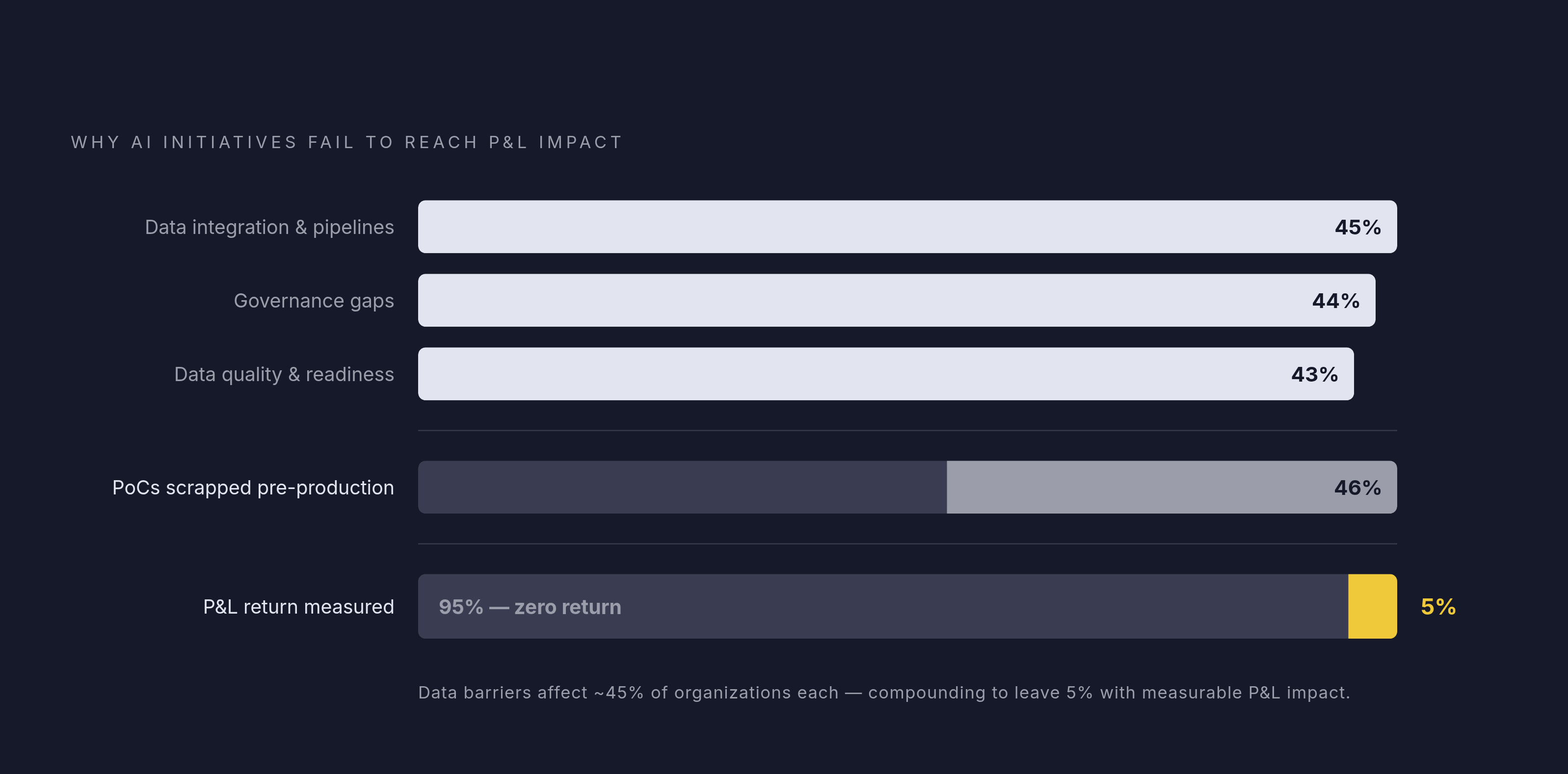
Enterprise AI spending has hit a scale almost nobody predicted three years ago. But the returns aren't following the same curve. MIT Project NANDA's 2025 report, covering more than 300 initiatives, found that 95% of organizations deploying generative AI saw zero measurable return to the P&L. The average organization scrapped 46% of its AI proofs-of-concept before they ever reached production, and Gartner's 2026 research puts the abandonment rate even higher, with more than half of GenAI projects dying after the pilot stage. Model capability keeps climbing. Something underneath it keeps failing.
Why the model is almost never the reason an initiative stalls
Every vendor demo you've sat through worked, and that should tell you something right there. Demos run on clean schemas and curated data, staged that way because nobody sells software by showing off their worst tables.
Production runs on years of inconsistent, undocumented data that nobody cleaned up, because nobody had to before now. I've sat in enough post-mortems to recognize the pattern immediately: "it worked in the demo but broke in production" is almost never a model story. Pull the thread and you find a data problem underneath, every time.
RAND Corporation's root-cause analysis of failed AI projects backs this up: inadequate data foundations, not model limits, keep showing up as the actual culprit. Informatica's CDO Insights 2025 survey found 43% of respondents naming data quality and readiness as a top obstacle, tied with lack of technical maturity and ahead of skills shortages. Blame the model and you'll fix the wrong thing. A sharper model fed bad data produces confident, polished output that happens to be incorrect.
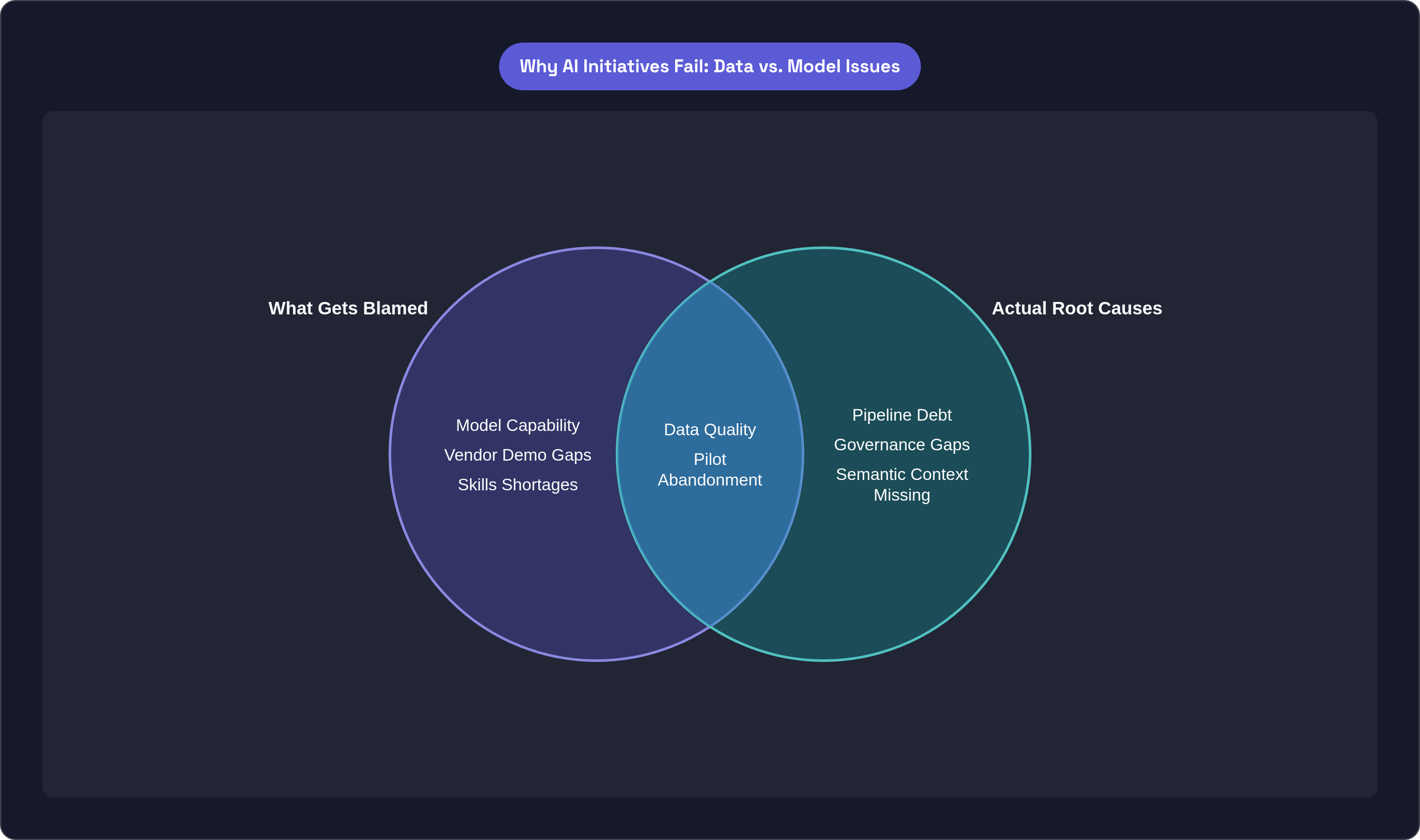
How enterprise data estates were built for a different consumer
Most enterprise data estates were built for transactional or analytical work. Schemas got normalized for joins. Metadata described table history for whichever engineer inherited the mess next. Access controls got scoped to the kind of row-level query a human analyst runs, not what an AI agent needs.
None of that had an agent in mind, and the gap shows up fast once you start looking for it. A human analyst who hits a confusing column name walks over and asks a colleague what it means. An agent can't do that. A dashboard tolerates a batch refresh from yesterday afternoon; an agent making a live decision can't. A BI report usually reads from one system, but an AI workload might need to reconcile identity, consent, and history across CRM, support, billing, and product analytics, all at once, in a single query.
Four gaps keep showing up: lineage, time-awareness, real-time access, and a semantic layer that encodes how the business actually uses its data rather than how the tables happen to be structured. AI exposes these gaps faster than anything before it, because fragmentation that BI tools could shrug off becomes a hard blocker at AI scale. Split data ownership across business units and it gets worse. Every cross-functional AI use case forces a reconciliation the estate was never built to perform.
None of this is purely architectural, either. Governance lives inside the same broken systems.
The pipeline maintenance trap that consumes the capacity needed for AI
Ask a data engineering team what eats their week, and the answer rarely involves building new things. The AI Readiness Playbook found data integration and pipelines rank as the top challenge in preparing data for AI, cited by 45% of respondents, ahead of governance at 44% and quality at 43%.
Fivetran and Redpoint found something worse. Organizations that had already centralized most of their data still spent the overwhelming majority of their engineering time just keeping existing pipelines alive, which leaves almost nothing left over for AI work. Static pipelines assume stable sources and stable schemas. Neither assumption survives contact with a real enterprise, where source systems change constantly and nobody sends a memo about it.
Line these findings up and the compounding effect is obvious: the more data you centralized the old way, the more pipeline debt you're carrying, and the less runway you have to build anything new on top of it. That 46% abandonment rate for AI proofs-of-concept isn't noise. Teams run out of data-readiness capacity long before they get anywhere near production.
Solve the pipeline problem and you still haven't cleared the course, because governance is waiting right behind it.
Why governance gaps at the data layer kill initiatives that data quality didn't
A study from Drexel University and Precisely found that a lack of data governance is the primary barrier to AI success for most organizations surveyed. The AI Readiness Playbook put governance at 44%, second only to pipelines.
Here's the governance problem AI surfaces that BI tools never had to deal with. Pipelines run on service accounts, broad permissions handed to a process instead of a person, which means an AI query executes at a privilege level no individual employee would ever get directly. A stale answer looks exactly as confident as a correct one. Nothing flags a skipped permission boundary or data that's three weeks old. And at the query volume agents generate, a shared service account produces an audit log that can't tell you who asked what, or why. Hand that log to a regulator, and it tells them nothing.
People blame model capability for abandoned AI initiatives far more than the evidence supports. Most of the time, the real gap between pilot and production traces back to governance, wearing a different label. Patching this at the prompt layer doesn't fix it, either. By the time a query reaches the model, the data's already been pulled. If it was pulled without real controls, the damage happened before the model ever saw a thing.
Missing context, missing governance. Put the two side by side and the shape of what's actually needed starts to come into focus.
What missing semantic context costs an AI agent in practice
Ask an LLM "What were Q3 sales in Canada?" and it doesn't inherently know which table holds the answer, how "sales" gets defined at this particular company, or which joins need to happen behind the scenes. It guesses. That's exactly where the mistakes creep in.
The most common AI data quality failure I've run into in enterprise environments involves metric inconsistency rather than missing or dirty records: the same business concept, defined three different ways in three different systems. A model queried across those systems absorbs the contradictions with no way to flag them. Two agents can query the same underlying fact, both produce technically valid SQL, and return two different numbers. Neither one is right.
BigDATAwire reports roughly 40% of enterprise leaders now name the absence of semantic context as a major blocker for operational AI. MIT CISR's research, built from interviews across 41 organizations in 2025 and 2026, found real pressure to invest in semantic technologies, but also found that practices like sustaining taxonomies and ontologies remain underdeveloped almost everywhere. Gartner made it official in its 2025 Hype Cycle for BI & Analytics, calling the semantic layer essential infrastructure instead of an architectural preference.
A semantic layer built on knowledge graphs can push AI accuracy well past the ceiling most organizations are stuck under, moving a system from frequently wrong to reliably right. Skip it, and the AI layer inherits every bit of ambiguity the data layer never bothered to resolve.
What separates the 5% of initiatives that reach production from the rest
MIT NANDA found that only about 5% of AI pilot programs achieve rapid revenue acceleration. Accenture calls the organizations behind those numbers "data reinventors," and the name fits. Their edge has almost nothing to do with the model. They rebuilt the layer underneath it.
Data reinventors post profit margin gains meaningfully above their industry peers, which tells you this isn't academic; it shows up on the income statement. What separates them operationally comes down to a handful of habits. They earmark somewhere between 50% and 70% of their timeline and budget for data readiness, meaning extraction, normalization, governance metadata, quality dashboards, before the model layer gets any real attention. They treat AI-ready data as an ongoing condition rather than a cleaning project you finish once and move past. And they define readiness across several criteria at once: discoverability, real-time access, end-to-end governance, certified quality, semantic context, instead of picking one and calling it done.
Gartner predicts most AI projects lacking AI-ready data will be abandoned through 2026. The outlier group isn't smarter or better funded; they built what the majority skipped. The Open Data Institute, working with SAP in 2025 on research pulled from 23 publications and a round of expert interviews, produced 21 recommendations for designing datasets, metadata, infrastructure, and governance for AI. Twenty-one recommendations sounds like a lot, until you realize how many separate dimensions this problem actually touches.
The real question is what has to be inside this layer, and whether building it means gutting everything you already have.
The architecture an AI-ready data layer actually requires
An AI data foundation is the layered set of capabilities sitting between raw operational systems and every model, agent, or RAG pipeline running on top of them. It's distinct from a data lake, a vector database, or any single product you can buy off a shelf.
Four tests decide whether an AI data foundation is actually ready for production. Any approved AI workload needs to request data through one stable interface. Every piece of data coming back needs known provenance, known freshness, and known access controls attached to it. The workload's use of that data has to get logged in a form an auditor would actually accept, meaning identity, intent, and lineage captured together, not a timestamp nobody can interpret. And changes to underlying source systems need to flow through with stability guarantees, so the foundation doesn't break the moment someone upstream renames a column.
Freshness has to match the use case. A snapshot that's fine for a weekly dashboard is already stale for an agent making a decision in real time. Permissions need evaluation at query time, scoped to the actual person behind the request, not assumed from whatever broad access a service account happens to carry. Sensitivity needs evaluation at the point where data gets combined, not just at the individual field, because agents join data in ways no field-level control was ever built to anticipate. And write actions taken by an agent deserve stricter governance than reads; the two carry meaningfully different levels of risk.
The most common architectural mistake I run into: bolting a vector layer on top of an existing warehouse without rebuilding the metadata underneath it. That's exactly how you end up back at the demo-works-production-doesn't failure from the top of this piece. The MCP protocol helps standardize how LLMs access business logic, and that part genuinely helps, though MCP without a consistent semantic layer underneath it falls short on its own. The wire matters less than what's actually traveling over it.
How organizations close the gap without replacing existing infrastructure
Here's the constraint every enterprise actually faces: ripping out your warehouses and operational systems and starting over isn't realistic. The AI-ready layer has to sit on top of what already exists, not replace it.
The practical sequence looks something like this. Expose one query interface across your fragmented sources without forcing a migration nobody has budget for. Add semantic context, table descriptions, metric definitions, entity relationships, so AI workloads finally get the business meaning the raw schema never captured. Enforce permissions at query time under the real user's identity, not a shared service account carrying more access than anyone intended. Log every query with identity, intent, and lineage together, and not just for compliance. At the query volume agents generate, a weaker log is operationally useless anyway.
Structured questions deserve structured, queryable answers, a job a vector database built for semantic retrieval was never designed to do. The architecture should match the question being asked.
Some platforms are built on this premise, sitting on top of existing infrastructure, whether that's a warehouse, a handful of SaaS tools, or operational systems that predate the AI conversation entirely, exposing a single interface with semantic context and governance enforced at every query, without requiring migration. The semantic layer gives agents the table descriptions, metric definitions, and relationships they need to produce answers that are actually correct: syntactically valid SQL that also reflects what the business means. Permissions get scoped to the real end user and checked at query time, and every query gets logged with full lineage attached. Access runs live and runtime-based, which matters, because it doesn't depend on static pipelines quietly assuming schemas that changed six months ago.
The broader industry is converging on the same direction. dbt's MetricFlow, Snowflake's open semantic interchange work, and GigaOm's 2025 Semantic Layer Radar all point toward one principle: define once, govern centrally, apply everywhere. That's the architecture the outlier 5% already figured out, built on the layer the other 95% skipped rather than on a better model. Nobody has to stumble onto it by accident anymore.