What a Data Product Is in the Modern Data Stack
A reusable data asset with embedded ownership, semantics, and governance—not just raw tables.

What a data product actually is, and what it is not
The modern data stack solved the wrong problem first. The industry spent a decade building an elegant, cloud-native toolchain: separate layers for ingestion, storage, transformation, orchestration, observability, each composable, each specialized. The result was a system extraordinarily good at moving data. It was not, by design or accident, good at making data legible, trustworthy, or reusable across an organization. That gap is now the central infrastructure problem of the AI era, and the data product is the answer to it.
Most organizations do not have data products. What they have are raw tables, one-off extracts, and pipeline outputs built for a single report and quietly abandoned when the project that requested them ended. The distinction matters enormously, and not in the abstract.
A data product is a purpose-built, reusable, governed data asset designed to deliver value to a defined set of consumers, whether those consumers are human analysts, downstream pipelines, or AI agents. Zhamak Dehghani's data mesh framing, which crystallized around 2019 and 2020, gave this concept its structural rigor. A data product encapsulates three things together: the data and its metadata, the code to ingest and serve it, and the infrastructure to run and store it. Not the data alone. All three. That packaging is what separates a product from a file.
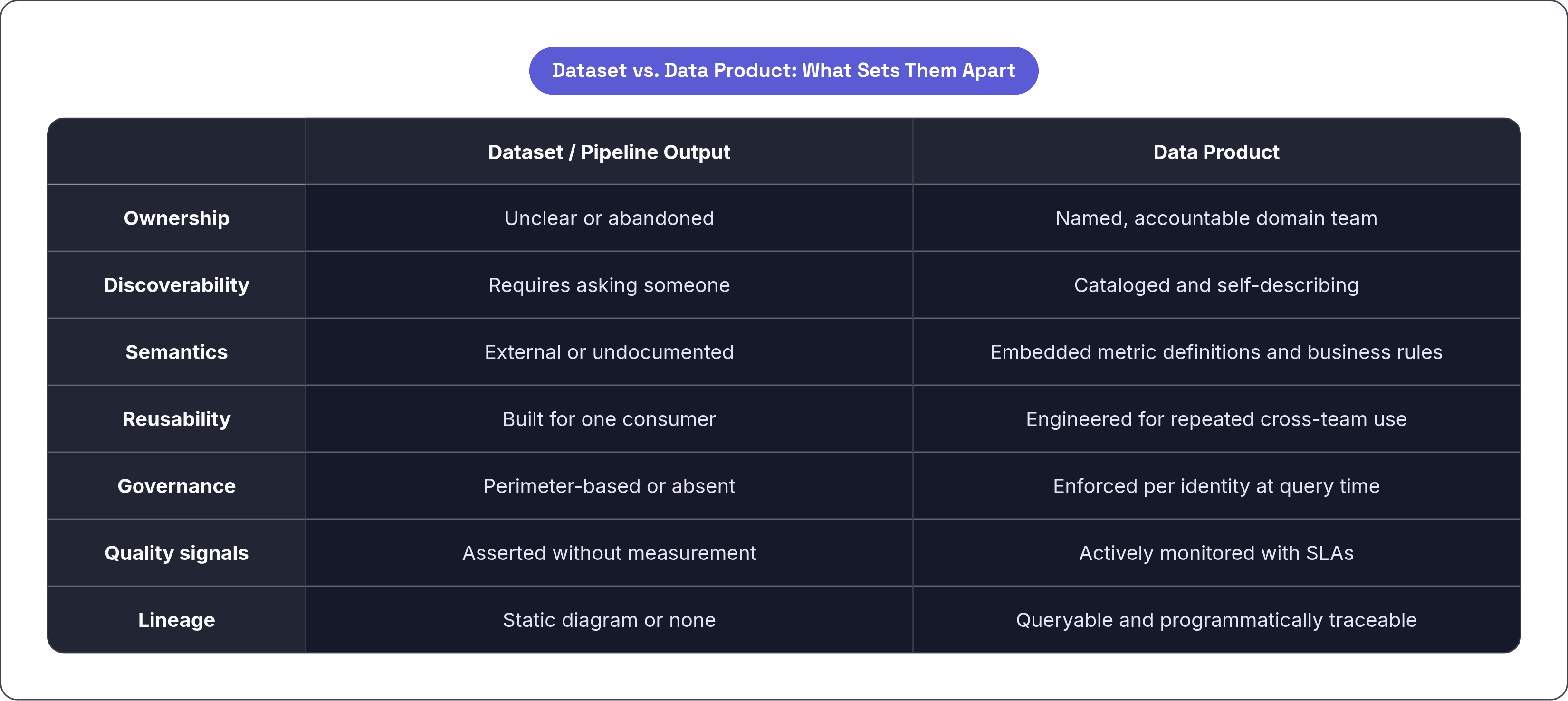
The product analogy is exact. A software product has clear ownership, a documented interface, quality expectations, and lifecycle management. A data product demands the same. What actually distinguishes it in practice: the asset is cataloged so consumers can find it without asking someone; it was engineered for repeated use across teams rather than for a single consumer; lineage, quality signals, and access controls are embedded into the asset itself rather than stapled on after delivery.
What falls outside this definition: CSV exports, BI dashboards scoped to one team, pipelines whose logic lives only in the author's memory. Those are outputs. They are not products. In July 2025, the Linux Foundation's Bitol project released an early version of the Open Data Product Standard. The industry is not debating whether data products matter. It is standardizing how to build them.
Why ownership and domain boundaries are structural, not organizational preferences
Domain ownership is not a governance preference. It is a structural requirement for the product contract to be credible.
In the data mesh model, each data product is owned by the domain that generates it. The team closest to the data's meaning is accountable for its quality, its interface, and its service level agreement. Centralized data teams break down at exactly this point, and they break down predictably. They own the pipeline, not the business logic. Documentation is thin because the central team was absent when the business decisions that shaped the data were made. Metric definitions drift because no one with authority over the definition is accountable for the table. When a number changes unexpectedly, finding the answer requires chasing someone through three layers of Slack threads, and there is no guarantee anyone still knows.
Domain ownership resolves this because the owning team can actually answer what the data means, how it is refreshed, what its quality thresholds are. More importantly, that knowledge gets encoded directly into the product's contract: the data dictionary, freshness guarantees, quality signals, and the access interface. Downstream consumers do not need to reach a person to get it. The contract is machine-readable and discoverable.
Here is a concrete case. In a retail organization, the "customer" entity owned by the CRM domain carries different semantics than the "customer" in the orders domain. One might count a customer from first account creation; the other from first completed purchase. A data product forces that divergence to be explicit and resolved. Without one, the conflict exists silently, and every downstream system quietly inherits a different answer to the same question, each confident it has the correct one. Nobody knows it is happening until something embarrassing surfaces in a board presentation.
Without clear ownership boundaries, reusability collapses. Consumers copy data rather than rely on a shared product, definitions diverge, and duplication spreads through the organization. That is not a data quality problem. It is an ownership problem masquerading as a technical one.
How context and semantics become part of the asset itself
A data product is self-describing. It carries not just data but the meaning of that data: metric definitions, entity relationships, business rules, lineage. All of it travels with the asset. This is the property that most separates a data product from even a well-labeled table, and it has become considerably more urgent as AI enters the picture.
An AI agent has no institutional memory. It cannot ask a colleague what a vague column header means. It cannot detect that the definition of "active customer" shifted six months ago when the product team changed the inactivity threshold. A stale or partial answer from an ungoverned table looks exactly as confident as a correct one. The model does not know what it does not know, and ungoverned data gives it no mechanism to find out. That is not a model problem. It is a data problem.
The semantic layer is what operationalizes context at scale. It defines business concepts once and applies them consistently: what "revenue" means, which customer segments qualify as "active," how "premium" is defined across two systems running different schemas. One system encodes premium customers as "cust\type: PREM," another as "customer\tier: premium." Without a semantic layer, downstream consumers either hard-code brittle mappings that break on schema changes or, more often, quietly get it wrong. Internal Google testing found that using LookML reduced data errors in generative AI natural language queries by roughly two-thirds. That is the difference between a system you can trust and one you are constantly auditing.
Semantic context is not documentation added after the fact. It is queryable, machine-readable structure enforced at access time. The Futurum Group projects semantic layer adoption growing from roughly 16% in 2026 to 30% by 2031. Capital is rotating toward the intelligence layer built on top of the plumbing because the plumbing alone was never the bottleneck. People are starting to notice.
Why access controls and governance must be built into the product, not applied around it
A data product is not governed because it sits behind a policy document or inside a secure network perimeter. It is governed because permissions are enforced at query time, scoped to the actual requesting identity, evaluated against the actual data being requested. The difference between those two models is the difference between a lock on the front door and a lock on each room.
The failure mode of perimeter-based governance is familiar to anyone who has operated inside a large enterprise. A service account holds broad access. Every downstream consumer inherits it. No one can trace which workload read what, acted on what, or combined what. The audit log records that a query ran; it does not record who initiated it, what business intent it served, or what chain of data it touched on the way to an answer.
There is a subtler problem that perimeter governance misses entirely. Sensitivity cannot be evaluated at the individual field level alone. A join that combines two fields, each innocuous in isolation, can produce a result that is sensitive in combination. Re-identification is the canonical case: name, ZIP code, and date of birth are each harmless; together, they can uniquely identify an individual in most datasets. Governance must be evaluated at the point where data is combined, not only where it is stored. That is an architectural requirement, not a configuration option.
The regulatory environment has formalized what was once an operational best practice. The EU AI Act entered into force in August 2024, with phased obligations beginning in February 2025. Enterprises now need to prove auditability, not merely assert it. The audit log adequate for human analysts querying at human pace is insufficient for agents operating at machine volume, and a data product's access model must account for that asymmetry directly. Write actions by agents introduce a risk profile categorically different from read access. Treating both under the same loose permissions is a liability dressed up as a design decision.
What happens to AI initiatives when the data layer lacks these properties
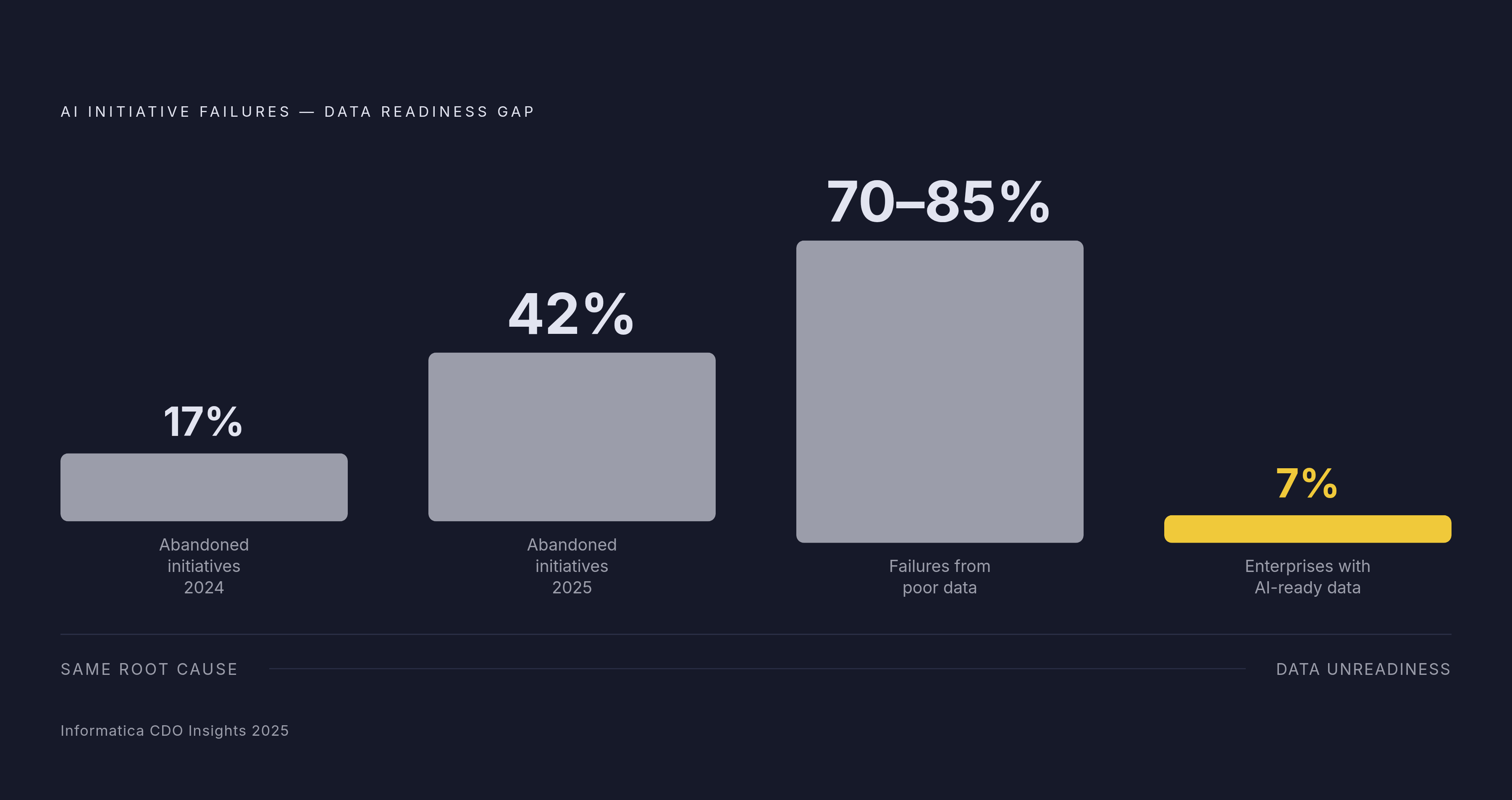
AI initiatives are failing at scale because the data layer beneath them was never made trustworthy. The failure rate is not anecdotal: an S&P Global survey of more than 1,000 enterprises found that 42% of organizations abandoned most of their AI initiatives in 2025, up from 17% the prior year. Per Informatica's CDO Insights 2025, between 70% and 85% of AI failures trace back to poor data foundations. The model is not the problem. The ground beneath it is.
The pattern holds across industries. Critical data sits scattered across ERP systems, CRMs, legacy databases, and cloud services with no single governed view. Every AI project begins with months of manual integration work. By the time the model is running, it is drawing on stale inputs, conflicting definitions, and fields whose meanings were never formally encoded. The output sounds authoritative. It is built on a structurally compromised foundation, and nobody in the presentation room knows it yet.
McKinsey's 2025 State of AI research found that organizations are accelerating investment in large language models and agents faster than they are repairing the data infrastructure beneath them. The money is going to the visible part of the problem. Only 7% of enterprises currently have AI-ready data, according to analysis cited by Fluree in 2026. The rest are discovering, often late, that the model was never the constraint.
The organizations succeeding made a different sequencing decision early on. They committed 50% to 70% of timeline and budget to data readiness before building model-facing applications: extraction, normalization, governance metadata, quality dashboards, semantic layers. That is not conservative caution. It is the precondition for AI that produces reliable results rather than plausible-sounding errors. Data products are not organizational housekeeping in this context. They are the prerequisite.
How data products become reusable infrastructure across an organization
Each data product encapsulates a specific business entity: customer, transaction, product, inventory. With consistent semantics, quality guarantees, and embedded business rules, each product becomes a building block. New AI applications and analytics use cases draw on existing products rather than rebuilding the same foundations from scratch. Deployment timelines compress because the trust layer is already established, not negotiated anew for each project. That compounding effect is the actual point.
The marketplace model is where this becomes tangible. Whether the catalog is internal or shared across partners, a data products marketplace makes assets discoverable and shareable with governance intact. A consumer finds the "customer" product, reads its dictionary, checks its freshness SLA, confirms its quality signals, and plugs it into their use case. No Slack thread. No tribal knowledge. No waiting for someone to respond to a question that should have been answered in the documentation the first time.
Each product added to the catalog raises the ceiling for every future use case. A team building a new recommendation engine does not start from raw tables; they start from governed, semantically rich products representing months of prior work. The organization's data investment becomes cumulative rather than siloed, which is a fundamentally different relationship between effort and outcome. Roughly 38% of organizations in 2025 listed governance frameworks and semantic layers as a top investment area. The marketplace is where that investment materializes as reusable organizational capability rather than a one-time project cost.
What distinguishes a mature data product from a well-labeled dataset
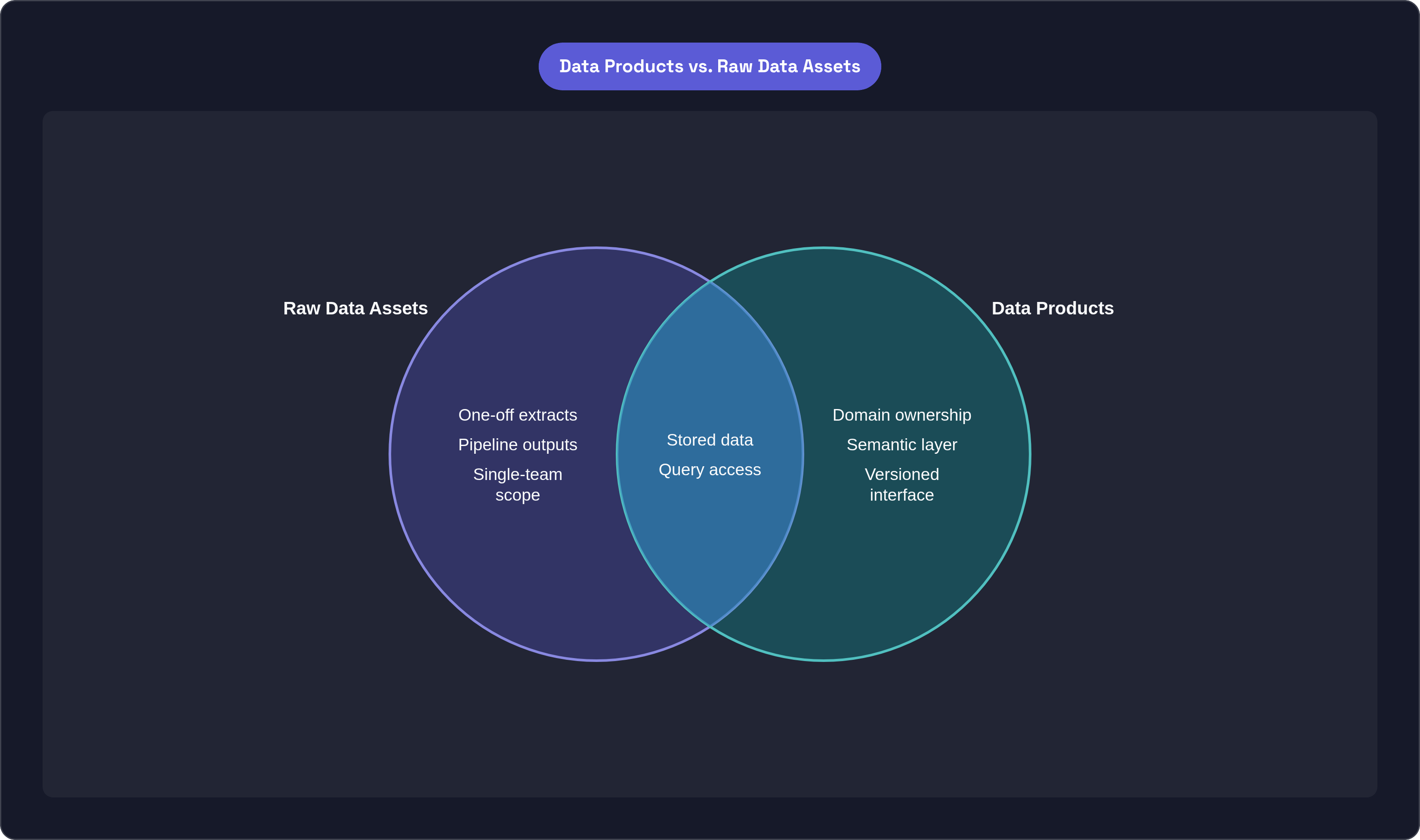
A dataset with a description is not a data product. The practical test is direct: can a downstream system, whether an AI agent, a BI tool, or another team's pipeline, consume this asset correctly without any communication with the team that built it? If the answer is no, you have a dataset with aspirations, not a product.
The maturity markers are specific. Ownership is named and accountable, not listed as a team that no longer exists or a person who left the company eight months ago. The interface is stable and versioned so downstream consumers are not broken by schema changes without warning. Quality SLAs are defined and actively monitored, not asserted without measurement. Access controls are enforced per consumer identity at query time. Lineage is queryable, meaning a downstream consumer can trace provenance programmatically rather than reading a diagram someone made in a slide deck two years ago and never updated.
Freshness deserves particular attention because it is use-case dependent in ways many governance frameworks ignore entirely. A daily snapshot that is perfectly adequate for a weekly executive dashboard is already stale for an agent making a real-time operational decision. The same asset, the same table, used in two different contexts, carries two different acceptable latencies. A mature data product declares its freshness contract explicitly and makes it visible to every consumer before they build a dependency on it. That transparency is what allows downstream teams to make informed architectural decisions rather than discovering the constraint after something breaks in production, usually at the worst possible time.
The broader shift is architectural, and it is not optional. The data stack was built to serve reports to analysts. The data layer now needs to serve decisions made by agents operating at machine speed and volume. A data product is the unit of trust at that layer. Organizations treating data as a strategic asset, building reusable products with clear ownership, embedded semantics, and enforced governance, are the ones positioned to deploy AI reliably. The organizations abandoning AI initiatives at an accelerating rate are not failing because they chose the wrong model. They skipped the step that makes any model trustworthy, and that particular skipped step has a way of collecting its debt on its own schedule.