Data Integration Strategies for AI-Driven Organizations
Most AI projects fail due to fragmented, undocumented data—not model limitations.

Only about a quarter of chief data officers worldwide feel confident their data can support new AI-enabled revenue streams. That figure comes from IBM's 2025 study of roughly 1,700 CDOs, and it lands harder when you set it next to what organizations are actually spending on AI right now. Budgets are expanding aggressively. Confidence in the data underneath those budgets is not moving.
Roughly half of AI proofs of concept are abandoned before reaching production, per S&P Global's 2025 Voice of the Enterprise survey. Gartner predicts the majority of AI projects unsupported by AI-ready data will be scrapped through 2026. IBM's 2025 CEO Study puts the share of AI initiatives that have reached genuine enterprise scale at a small fraction of what's been attempted. These are a convergent pattern pointing at one structural problem.
RAND and MIT research names the same root causes consistently: unclear success definitions, weak data foundations, poor workflow integration. Model failure is not the primary culprit. The models are performing roughly as advertised. What falls short is the organizational and data infrastructure surrounding them.
Here is where the problem becomes concrete. Demos run on curated schemas, documented relationships, and clean test data assembled specifically to showcase a capability. Production environments run on years of inconsistent, under-documented data that nobody cleaned because nobody needed to before. A human analyst navigating that environment carries contextual knowledge accumulated over months or years of working in those systems. An AI agent arrives at the same schema without any of that, makes inferences, and produces output that looks authoritative regardless of whether those inferences are sound.
That is a data and integration problem, not a model problem.
What the Enterprise Data Landscape Actually Looks Like When an AI Agent Tries to Use It
Nearly nine in ten organizations now operate in a multicloud environment, according to Flexera's 2024 State of the Cloud report, and modern enterprises typically rely on hundreds of applications. Each one produces data in its own format, at its own cadence, under its own schema conventions. Those schemas were designed for human workflows. The CRM was built for salespeople. The ERP was built for finance and operations. The warehouse was built for analysts who could bring judgment to ambiguous results.
Data silos are not primarily the product of negligence. They are the accumulated residue of individually rational decisions: a compliance requirement that mandated data residency in a specific region, an acquisition that brought in a legacy system nobody wanted to migrate, a departmental tool that quietly grew into a system of record because it was the one people actually used. Each decision made sense locally. Collectively, they produce a fragmented landscape where the same concept, "revenue" or "customer," is defined differently across three or four systems with no authoritative reconciliation between them.
What an AI agent encounters in this landscape is a disambiguation problem it cannot solve on its own. It does not know which definition of revenue to use. It does not know which join to apply. It does not know that the field labeled "close date" in one system refers to contract signature and in another refers to invoice payment. So it infers. Sometimes the inference is correct. When it is not, the error is invisible, and it propagates downstream before anyone notices.
The deeper problem is structural. The institutional knowledge required to make data interpretable, specifically, knowledge about what was intended when the data was structured the way it was, lives in the heads of the people who built the systems and the analysts who learned to navigate them. It does not live in the schema. Agents are left without it, and they have no way to ask.
Every AI initiative that solves its own integration problem in isolation adds another disconnected layer to this landscape. The problem compounds. And the organizational cost of poor data quality, widely estimated across industry research in the tens of millions annually, is exactly what happens when that rift between producers and consumers is never systematically closed.
What Gartner's Definition of AI-Ready Data Actually Requires, and Where Most Organizations Fall Short
Gartner's February 2025 definition of AI-ready data shifts the frame from architecture to discipline. AI-ready data is aligned to specific use cases, actively governed at the asset level, supported by automated pipelines with quality gates, managed through live metadata, and continuously quality-assured.
The word "continuously" is where most organizations fall short, and it is not a small gap.
Traditional data management runs at reporting cadences: quarterly audits, annual reviews, monthly pipeline validation checks. These rhythms were designed for environments where data consumers were humans working at human pace. AI agents in production operate on a different clock entirely. They need data quality signals measured in hours, not months. A stale semantic tag or an outdated governance classification does not produce a cautious output from an agent. It produces a confident one grounded in wrong premises.
The architectural implication is significant. Data must be treated as a reusable product with defined ownership, not as a single-pipeline artifact built to serve one downstream consumer. It must handle batch and real-time needs simultaneously. The most proven enterprise pattern here is Change Data Capture feeding a stream processing layer that validates and transforms operational data in real time, then routes cleaned, governed data to AI destinations. This is not a novel architecture. It is a well-understood one that most organizations have not yet applied with the rigor that agent consumption demands.
Retrieval-augmented generation systems represent a specific, underappreciated failure mode. RAG relies entirely on the freshness of retrieved context. Stale context does not produce a hedged, uncertain answer; it produces a confident hallucination grounded in outdated information, and the system has no mechanism to disclose the problem. The user has no mechanism to detect it either.
Microsoft's approach with Fabric's OneLake connects to data from anywhere, works from a single copy across platforms, and eliminates the proliferation of redundant copies that create freshness discrepancies. The organizational principle behind that architecture, that there is no good AI without a solid, curated data stack, is a commitment most enterprises have verbally endorsed and not yet operationalized.
Why a Semantic Layer Is Now the Non-Negotiable Connective Tissue Between Enterprise Data and AI Agents
When a large language model receives the question "What were Q3 sales in Canada?" it does not know which table to query. It does not know how "sales" is defined in this organization's data model. It does not know which joins to apply, which filters matter, or whether the geographic segmentation in the warehouse aligns with how "Canada" is defined in the CRM. It infers all of this from whatever context it has available. Inference at the schema level is precisely where silent errors originate.
A semantic layer solves this by providing what agents lack: table descriptions, metric definitions, relationship maps, and business rules embedded in the data model rather than reconstructed at query time. The agent does not need to infer what "revenue" means because the definition is supplied. The right join is declared rather than figured out. Context travels with the query rather than being derived from it after the fact.
MIT CISR research, drawn from interviews with 41 organizations in the first half of 2025, found consistent pressure among organizational leaders to increase investment in semantic technologies that make data assets immediately useful to AI models and agents. It also found that key practices, specifically sustaining taxonomies and ontologies, remain underdeveloped across most of those organizations. That gap between acknowledged priority and actual execution is where most semantic layer initiatives stall.
Roughly four in ten organizations now list governance frameworks and semantic layers as a top investment area, according to the State of AI+BI Analytics Global 2025 Report. Internal Google testing found that LookML reduces data errors in generative AI natural language queries by roughly two-thirds.
The industry's architectural response has converged on a clear principle: define metrics once, govern them centrally, apply them everywhere. The Open Semantic Interchange, a vendor-neutral YAML standard developed collaboratively by dbt Labs, Snowflake, and Salesforce, emerged from this. The Model Context Protocol gives LLMs access to governed business logic rather than raw schema. Distillery's deployment using AtScale's MCP Server, which enables natural language data access through Slack and Google Meet, is a live enterprise example of this pattern running in production.
The semantic layer is not a separate workflow step bolted on afterward. It is embedded in the integration layer itself.
How Governance Has to Work Differently When AI Agents Are the Data Consumers
Traditional data governance was designed with human consumers in mind: structured data requests, reporting cadences, access controls tied to individuals who make conscious, deliberate queries and who can be held accountable for how they use what they retrieve. That model does not transfer to AI agents, and the failure modes when you try are not minor.
Agents issue queries at volume, autonomously, often under a shared service account that obscures the actual initiating identity. They combine fields in ways that produce sensitive outputs from individually innocuous inputs: two non-sensitive columns can produce a sensitive result when joined. They generate audit trails at a scale that makes manual review functionally impossible. In agentic systems capable of acting on data rather than merely retrieving it, a governance failure does not produce a bad report. It produces a consequential decision made on the basis of improperly accessed or improperly governed data.
Several governance patterns that work adequately for human consumers fail under agent consumption. Permissions granted to a service account rather than evaluated at query time under real user identity is the most common. Sensitivity assessed at the field level rather than the combination level is pervasive. Audit logs that capture query text but omit identity, intent, or downstream use become compliance theater at agent-level query volume. These are not edge cases. They are the default configuration in most enterprise environments.
Regulatory pressure is accelerating the requirement to solve these problems. The EU AI Act is moving from preparation to enforcement. NIST's AI Risk Management Framework is being operationalized across U.S. enterprises. Lineage, bias documentation, and auditability are no longer aspirational compliance postures. They are demonstrable requirements.
A counterintuitive finding from Snowflake's Data Trends 2024 report is worth sitting with. Application of governance features, including tags on data objects and masking policies on datasets, rose between 72% and 98% from January 2023 to January 2024. In the same period, queries run against policy-protected data rose by 142%. More governance correlated with more usage, not less. The assumption that stricter controls constrain data access does not appear to hold when governance is enforced correctly.
The practical design implication follows directly: governance enforced at the data layer, at query time, under real user identity, is the architecture that scales to agent consumption. Patching it on at the model or prompt layer does not. Peaka's implementation reflects this: permissions are evaluated at query time, scoped to the actual end user rather than a service account, and every query is logged with identity, intent, and lineage together.
The Live Query Layer as the Integration Pattern That Resolves the Freshness Problem
Static pipelines were built on two assumptions: sources are relatively stable, and a snapshot a few hours old is acceptable for the downstream consumer. Both assumptions held for dashboards and batch reporting. Neither holds for AI agents.
A stale answer looks as confident as a current one. The agent has no mechanism to communicate uncertainty about data freshness because it has no visibility into how old the data it is reading actually is. The cost of staleness is invisible until it produces a consequential error, and by then the agent has often already used the stale answer in a downstream decision or communication.
Agents require runtime access through a live query layer that resolves freshness at the moment of the query rather than at the moment the pipeline last ran.
The practical requirement is that this live query layer must sit on top of existing infrastructure rather than replace it. Warehouses and pipelines that took years to build, validate, and integrate into organizational workflows are not realistic candidates for replacement. The integration layer has to work with what exists, expose it through a governed and semantically enriched interface, and add live queryability without requiring rearchitecture. That constraint shapes the design choice significantly.
Revocability at the workload level is a related requirement that static pipeline architectures rarely satisfy. When a specific agent or pipeline needs to be shut off, whether for security, compliance, or operational reasons, that revocation must be achievable without disrupting every other downstream consumer sharing the same service account or pipeline dependency. This sounds administrative. In practice it is a fundamental design constraint that shapes how access credentials, service accounts, and query routing must be structured from the beginning, not retrofitted later.
How to Assess Whether an Existing Integration Approach Is Actually AI-Ready
The diagnostic is straightforward even if the remediation is not. Three questions surface the gaps that matter most.
Can an AI agent determine what a column means, how a metric is defined, and what relationships exist without a human intermediary? If the answer requires a data engineer to explain the schema, the integration is not AI-ready.
Are permissions enforced at query time under the real user's identity, or are agents operating under a broad service account whose queries are effectively ungoverned? If agents are running under a service account with broad access, the governance model was not designed for agent consumption.
Does the integration layer distinguish between data that is fresh enough for a dashboard and data that is fresh enough for an agent making a decision? If the layer cannot answer that question, the agent cannot either.
Common patterns that fail these tests appear in most enterprise environments. A well-governed warehouse that exposes raw schema to agents is connected but not AI-consumable. A vector database used to answer structured business questions is a retrieval-oriented architecture applied to a query-oriented problem. A RAG pipeline with no freshness validation produces confident answers grounded in stale context. Audit logs that capture query text but not identity or purpose are compliance theater at scale.
The useful heuristic: if a human analyst would need institutional knowledge to interpret the data correctly, an AI agent will fail silently in the same situation. The agent will not ask. It will infer. And the inference will look confident.
What a Data Integration Strategy Built for AI Consumption Looks Like in Practice
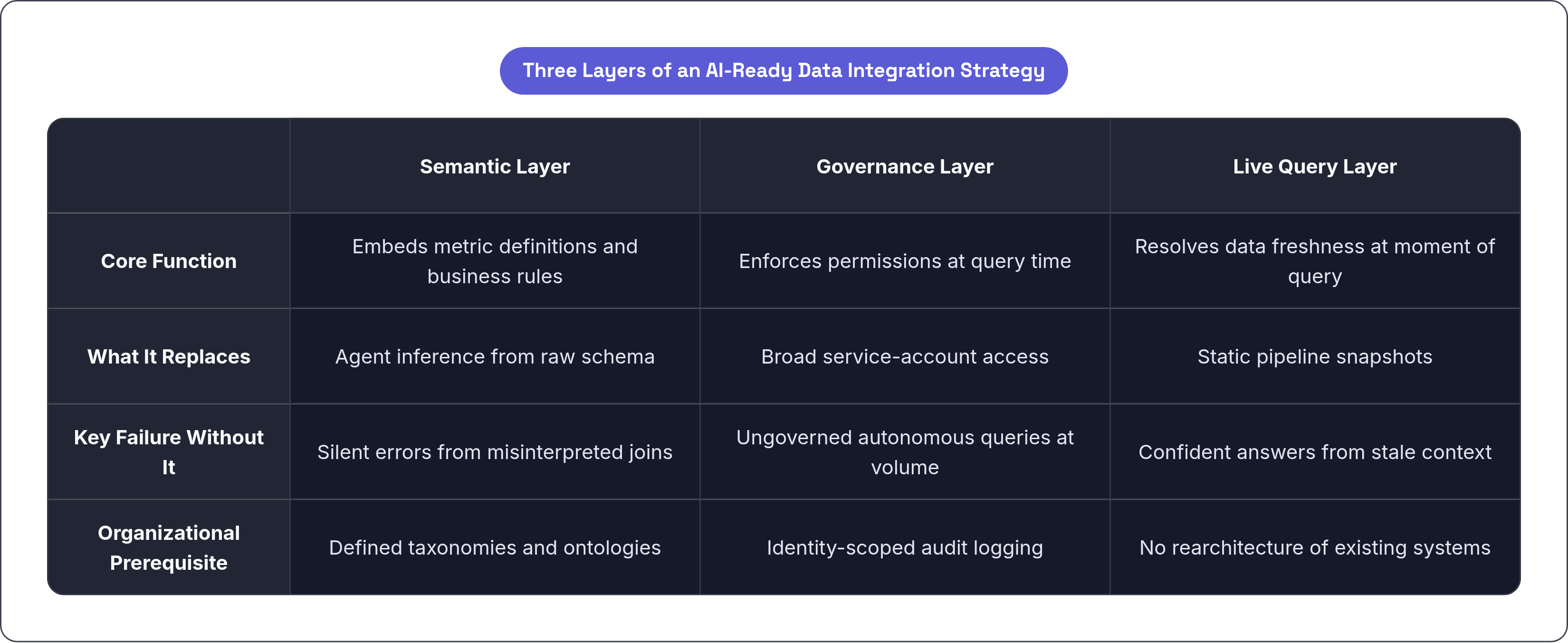
Three layers have to work together. Building one without the others produces a system that passes certain tests and fails others in ways that are genuinely difficult to trace until something consequential breaks.
The semantic layer embeds metric definitions, table descriptions, and business rules in the data model so agents receive context with every query rather than inferring it from raw schema. The governance layer enforces permissions at query time, scoped to real user identity, evaluated at the combination level rather than the field level, logged with full lineage, and revocable at the workload level. The live query layer sits on top of existing infrastructure, resolves freshness at the moment of the query, and does not require rearchitecting systems that already function.
Before any of this architecture pays off, certain organizational prerequisites have to be in place. The MIT CISR finding that taxonomies and ontologies remain underdeveloped across most organizations is a concrete warning: a semantic layer built on undefined or inconsistent terminology will not produce reliable outputs. Data must be treated as a product with defined ownership, not as a byproduct of operational systems that nobody is explicitly responsible for maintaining. The rift between data producers and data consumers must be actively managed, with producers documenting intent and consumers, including AI agents, receiving freshness requirements and context specifications rather than expecting the warehouse to carry that information implicitly.
The Snowflake governance data is worth stating plainly: governance features applied between 72% and 98% more broadly year-over-year correlated with a 142% increase in queries run against policy-protected data. Most organizations are treating governance and capability as opposing forces, and that finding should reframe how they think about the relationship between them.
The organizations whose AI initiatives reach production are the ones that treat data integration as a problem of meaning, trust, and freshness simultaneously, not as a logistics exercise with a cleaner pipeline at the end of it.