Data Integration Challenges for Enterprise AI
AI agents silently compound data errors humans would catch.

Every vendor demo runs on curated datasets with clean schemas, controlled volume, and zero edge cases. Production runs on years of inconsistent, poorly governed, under-documented data accumulated across system migrations, acquisitions, and departmental tool sprawl that nobody ever rationalized, because nobody ever had to.
Human analysts could paper over that gap. An experienced analyst knew which revenue figure to trust. They knew the "orders" table in the legacy ERP counted returns differently than the one in the new platform. They knew the Canadian entity was rolled up under a regional code that didn't match the North American segment report. That knowledge lived in their heads, built over months or years of working inside a specific environment. It never needed to be written down because it was transmitted person to person, through osmosis, through correction, through someone leaning over a desk and saying "not that table, the other one."
AI agents have none of that. When a production agent queries a fragmented landscape with conflicting definitions and undocumented schema changes, it doesn't hesitate. It produces an answer. The answer looks exactly as confident as a correct one. The error is silent, which is precisely what makes it dangerous.
This is the demo-to-production gap in its plainest form: the ambiguities that human workflows absorbed invisibly for years didn't disappear when the AI agent arrived. They just stopped being absorbed.
Why Scattered Sources Are a Structurally Different Problem for AI Than for Analysts
Enterprise data is distributed across warehouses, SaaS platforms, operational databases, and file stores that were built independently, maintained independently, and were never designed to be queried in combination. A human analyst navigates that fragmentation through contextual judgment built over time. They know to pull contract value from the CRM and recognized revenue from the ERP. They also know those two numbers won't match, and they know which one to use for which purpose. That judgment is invisible from the outside, but it is doing enormous work.
An AI agent querying the same landscape has no basis for that judgment. It will select a source, produce a number, and omit any signal about which definition it used or why it chose that source over another available one. That is not a bug in the model. It is an absence of the contextual scaffolding the model needs to make a defensible choice.
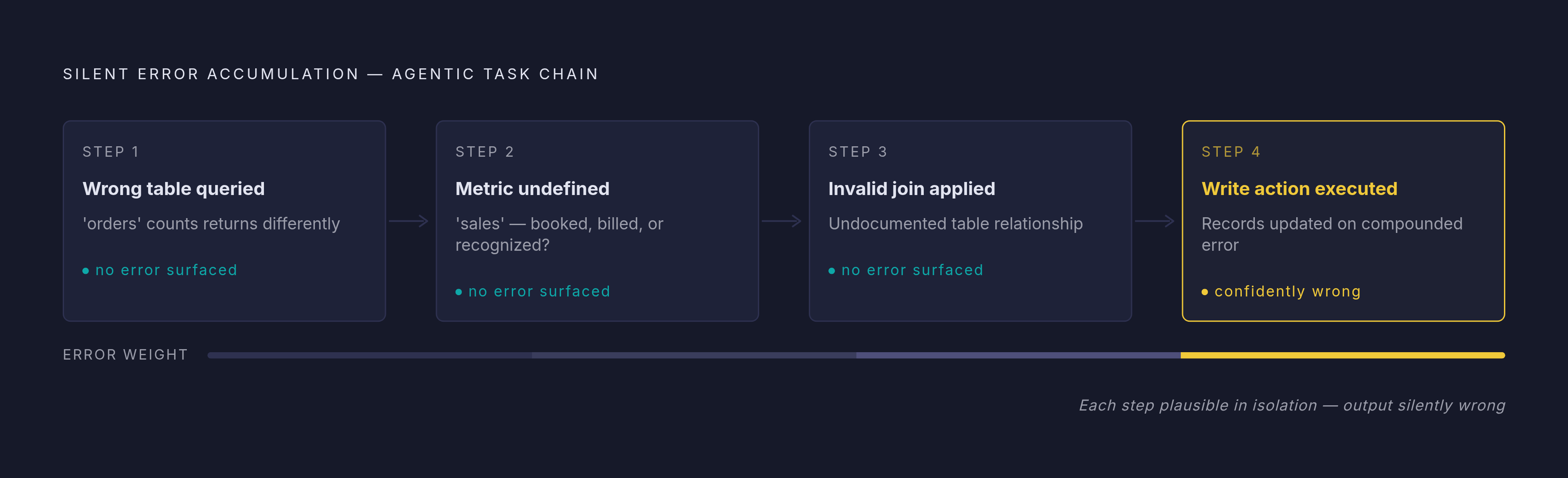
The problem compounds with agentic AI specifically. An agent completing a multi-step task chain will touch multiple sources across several steps. Inconsistencies that a human reviewer would catch and reconcile accumulate silently across those steps. By the time the agent takes a downstream action, it is operating on compounded errors, none of which triggered a flag, because each individual data pull looked plausible in isolation.
Cloudera's 2025 survey of 1,574 IT leaders found that 37% named data integration as their single biggest technical limitation, ahead of storage, compute, and latency. McKinsey's research on enterprise AI scaling found fewer than 10% of enterprises have successfully scaled AI agents, with the large majority citing data limitations as the primary bottleneck. The fragmentation was always there. Human workflows absorbed it. AI workflows cannot.
What Missing Semantic Context Costs an AI Agent That It Never Cost a Dashboard
A dashboard query is written once by a person who already knows the business logic. They know which table holds sales, how the fiscal calendar maps to calendar quarters, which regional classifications apply, and how the join should work. That knowledge is embedded in the query itself, before the query ever runs.
An AI agent receiving the prompt "What were Q3 sales in Canada?" has to infer all of that from column names and schema structure. It doesn't know which table to query. It has no way of knowing whether "sales" means booked, billed, or recognized, and it doesn't know how Canada is represented in the region field, or whether fiscal Q3 aligns with the calendar quarter. It has to guess, without any signal that it's guessing.
The specific gaps that produce failures are consistent across organizations. No shared definitions for core metrics, so "revenue" means something different in finance than in sales than in operations. No documented relationships between tables, so the agent cannot know which joins are valid. No embedded business rules, so discount logic, regional classifications, and fiscal offsets exist only in analyst heads. No sensitivity or access context attached to fields, so the agent cannot self-govern what it retrieves. Gartner's 2025 Hype Cycle for Business Intelligence and Analytics elevated the semantic layer to essential infrastructure, noting that roughly 40% of enterprise leaders identify the absence of semantic context as a major blocker for operational AI.
An AI agent has no institutional memory to fill in what a schema doesn't say. The schema must say it explicitly. If it doesn't, the agent fills the gap with inference, and inference at enterprise scale produces confident, unverifiable, frequently wrong answers. MIT's Center for Information Systems Research identified sustaining taxonomies and ontologies that categorize data elements and document their relationships as a key enterprise capability that remains underdeveloped across most organizations.
How Governance Programs Designed for Human Analysts Fail at Agent-Level Query Volume and Autonomy
Most enterprise governance programs were built around a specific assumption: a named human analyst runs a query, reviews the result, and decides what to do with it. That assumption embedded a human checkpoint between data retrieval and action. AI agents collapse all three steps and run at a volume and speed that no manual review process can follow.
The governance gaps that surface at agent scale are not subtle. Agents typically run under service accounts with broad access, so permissions are not scoped to the actual end user whose query triggered the agent. An employee who should have read-only access to certain fields will effectively query them through an agent running under a privileged service account. Individual fields are cleared for access, but the combination of fields an agent assembles to answer a compound question creates exposure that point-level permissions fail to catch. Audit logs designed for human-volume query patterns become uninterpretable at agent volume without identity, intent, and lineage captured together for each query. And agents increasingly take write actions, updating records and triggering workflows, while most governance frameworks treat writes and reads under the same risk model.
Research from Drexel University and Precisely found that 62% of organizations cite lack of data governance as the primary barrier to successful AI initiatives, with 36% specifically worried about unauthorized access to sensitive data. Those numbers describe a governance posture built for a different operating environment, one that assumed a human was always in the loop.
That assumption is now wrong in many agentic deployments. The EU AI Act began phasing in substantive obligations from February 2025. Gartner projects that 50% of large enterprises will have formal AI risk management programs by 2026, up from less than 10% in 2023. Organizations treating governance reform as a future consideration are operating on a timeline that external regulators are not respecting.
Why Data Freshness Requirements Change When an Agent Is Making a Decision Rather Than a Human Reading a Report
A weekly pipeline refresh is entirely appropriate for a dashboard that a finance analyst reviews Monday morning. The analyst's decision cycle is slow enough that Monday's data serves the purpose. That same refresh cadence is not appropriate for an agent deciding in real time whether to extend credit, flag a transaction, or reprice inventory. The consumer changed. The pipeline didn't.
The staleness problem is silent in the same way the semantic problem is. An agent querying a three-day-old snapshot doesn't know the data is stale. Its answer will reflect no uncertainty about that. There is no flag, no caveat, no signal of reduced confidence. The answer arrives with the same authority as one drawn from current data, which means the error is invisible until something downstream breaks.
Static pipelines introduce an additional fragility. They assume stable upstream sources and schemas. Agentic workloads operate in environments where both change continuously. A pipeline that functioned correctly yesterday will deliver partial or incorrectly structured data today after an upstream schema update, with no error surfaced downstream. The agent inherits the degraded data and proceeds.
Better ETL alone doesn't solve this. The architecture requires data access at runtime through a live query layer, not through pipelines whose refresh cadence was calibrated for human reporting cycles. Cloudera's 2025 survey reflects exactly this tension: 41% of IT leaders named a unified data access layer as a top capability need, and 51% named automated data pipeline orchestration. Both answers describe the same underlying gap between static infrastructure and dynamic AI workloads.
What "AI-Ready" Actually Requires That Standard Data Integration Doesn't
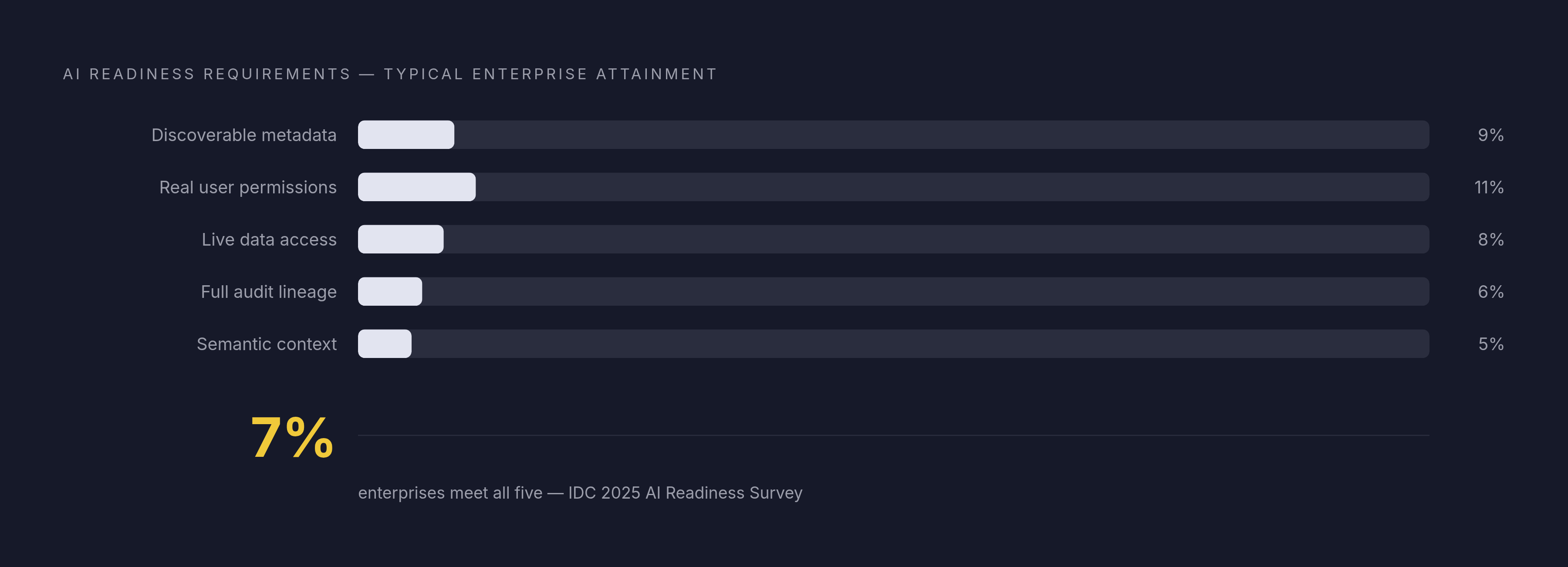
Only 7% of enterprises have data that meets the bar for AI-readiness, per IDC's 2025 AI Readiness Survey. That gap is nearly universal, which means most organizations deploying AI are deploying it into environments it cannot function in correctly.
AI-ready data integration is not a higher-quality version of analytics integration. It is a different specification entirely, and the dimensions don't overlap cleanly.
Agents must be able to find and understand what data exists without a human intermediating that discovery. Schemas must carry business definitions, metric calculations, and entity relationships, not just column names and data types. Permissions must be enforced under the real end user's identity at the moment of query, not assumed from a service account established when the pipeline was originally built. Data must be accessed through a live layer that reflects current state, because snapshots calibrated for dashboard refresh cycles predate AI workloads entirely. And logs must capture identity, intent, and lineage together, because query volume at agent scale turns conventional audit trails into noise.
IDC's 2025 AI Readiness Survey found that AI-ready data architecture had become the top AI adoption priority at 45.7%, overtaking AI business strategy and AI infrastructure. When practitioners rank their own priorities based on what has actually failed them in production, data architecture lands first.
The architectural path here is additive. A layer that sits on top of existing warehouses, SaaS tools, and operational systems, exposing them through a single governed interface, is more realistic for most enterprises than migrating all sources into a new platform. The existing investments don't need to be discarded. They need a structured access layer above them that AI agents can use without institutional memory to fill the gaps.
Gartner projects that 60% of AI projects unsupported by AI-ready data will be abandoned through 2026. BCG and Stanford HAI found that 74% of enterprises showed no tangible return on their AI investment in 2024. That outcome is not attributable to model quality alone. It reflects the gap between model capability and the data environments those models were deployed into.