Institutional Memory Gap in AI Agents

Ask an enterprise AI agent the same question twice and you'll often get two different numbers back. Both syntactically correct. Both returned with full confidence. Neither flagged as inconsistent with the other.
This happens because agents operating without semantic context are essentially reverse-engineering your data every single time they touch it. They re-derive joins, filters, and metric logic fresh from the raw schema on each prompt. And raw schemas don't explain themselves. The agent doesn't know that "revenue" means something categorically different in the sales system than in finance. It doesn't know a field was renamed three years ago and the old name still haunts legacy views. It has no idea that the filter a senior analyst reflexively applies before pulling any pipeline report encodes a decision that came out of a board conversation, was never formally documented, and lives now only in the memory of the three people who were in the room.
What makes this failure mode particularly insidious: a wrong answer and a correct one look identical on the surface. Same formatting, same confidence, and no warning label. When something eventually breaks downstream, someone goes looking for an audit trail and finds a log of queries. Not a log of meaning. No record of which definition was used, or whether it matched the one finance actually trusts.
The DORA 2024 report, drawing on roughly 3,000 respondents, found something structurally parallel at the engineering level: AI adoption improves individual productivity while actively degrading software delivery stability and system-level throughput. The agent solves a problem on Tuesday. Someone has to re-explain the same underlying rationale on Thursday because nothing carried forward.
Institutional memory is not documentation. It's the reasoning behind decisions, the trade-offs that got made, and the context that tells you why a thing is the way it is. Humans accumulate it through tenure, through correction, and through having been in the room. Agents start from zero on every session. And the loss often predates the agent entirely: decisions made on Slack, in hallway conversations, and on late-night calls get documented as outcomes. The logic is already gone by the time the official record gets written.
Research cited by Atlan puts the baseline problem this way: 93% of organizations already encounter conflicting metrics, and 68% report their data isn't trustworthy enough to support AI workloads. Those numbers predate the current wave of agent deployment. That's the environment agents are being dropped into.
The scale of enterprise AI deployment makes this problem urgent rather than theoretical
The AI agents market was valued at roughly $7.84 billion in 2025 and is projected to reach $52.62 billion by 2030, a compound annual growth rate of approximately 46%, per MarketsandMarkets. What matters there isn't the revenue signal; it's the volume signal. Gartner's 2024 Hype Cycle for AI indicates only 17% of organizations have deployed AI agents so far, with more than 60% expecting to do so within two years. The bulk of deployment hasn't happened yet.
IDC projects AI copilots embedded in nearly 80% of enterprise workplace applications by 2026. Those agents will query the same schemas, the same ambiguously named fields, the same conflicting metric definitions that already exist today. But they'll do it at a volume and speed no human analyst ever approached, and they'll do it without anyone in the room who remembers why the data looks the way it does.
What compounds this is where institutional knowledge is actually accumulating, or failing to. Half of enterprise AI leaders report their organizations rely primarily on public tools like ChatGPT or Copilot, per a survey cited by Atlan. Context is building inside vendor systems, with no clear ownership or governance model on the enterprise side. The organization isn't building memory. It's outsourcing the problem and calling it a solution.
The institutional memory gap doesn't hold steady as agent scope increases. It compounds. Every new agent deployment, every additional use case layered onto ungoverned infrastructure, widens the distance between what the data says and what the business actually means.
What the enterprise AI failure data is actually measuring
In 2024, 17% of enterprises abandoned most of their AI initiatives. By 2025, that figure had jumped to 42%, per an S&P Global survey of more than 1,000 enterprises. That isn't drift. That's a structural failure pattern taking shape in real time, and the rate of acceleration is its own kind of signal.
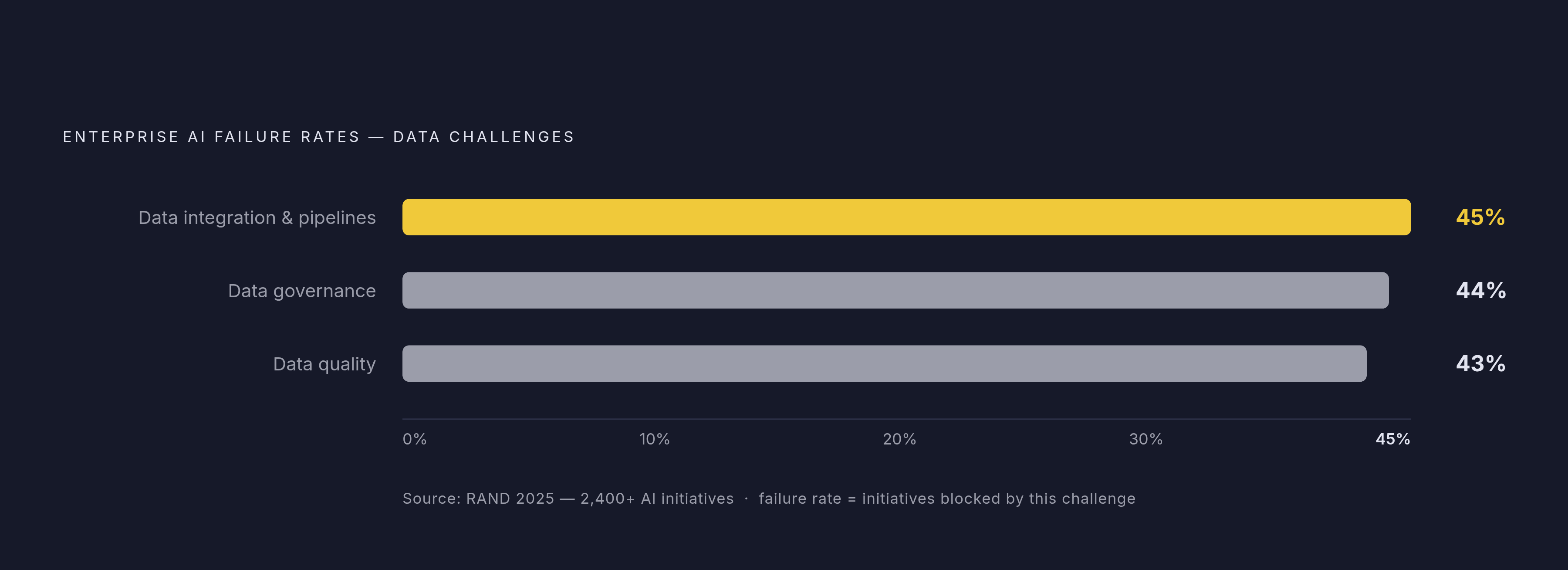
The RAND Corporation's 2025 analysis of more than 2,400 enterprise AI initiatives found that 80% fail to deliver intended business value, with data cited as the leading cause. Among enterprises actively preparing data for AI, data integration and pipelines ranked as the top challenge at 45%, edging out data governance at 44%, and data quality at 43%. Three numbers that close together aren't describing one discrete problem. They're describing a cluster of adjacent infrastructure failures that reliably arrive together.
The underlying technology is rarely why a project fails. Poor data readiness, misaligned success metrics, and broken workflow integration: these are the causes, consistently and across contexts. But organizations tend to measure failure at the model or ROI layer, which means they're looking downstream of where the actual problem is occurring. Agents are being deployed against data that was never prepared to answer the questions agents ask.
Accenture's 2025 survey of 2,000 companies across 15 countries found only 7% have reached the data-readiness level required to scale advanced AI, and those that have are realizing profit margin uplifts up to 1.6 times industry peers. The gap between that 7% and everyone else is not a model capability gap. It is an infrastructure gap, and organizations are misidentifying it as something else almost everywhere.
Why BI-ready data is not the same thing as AI-ready data
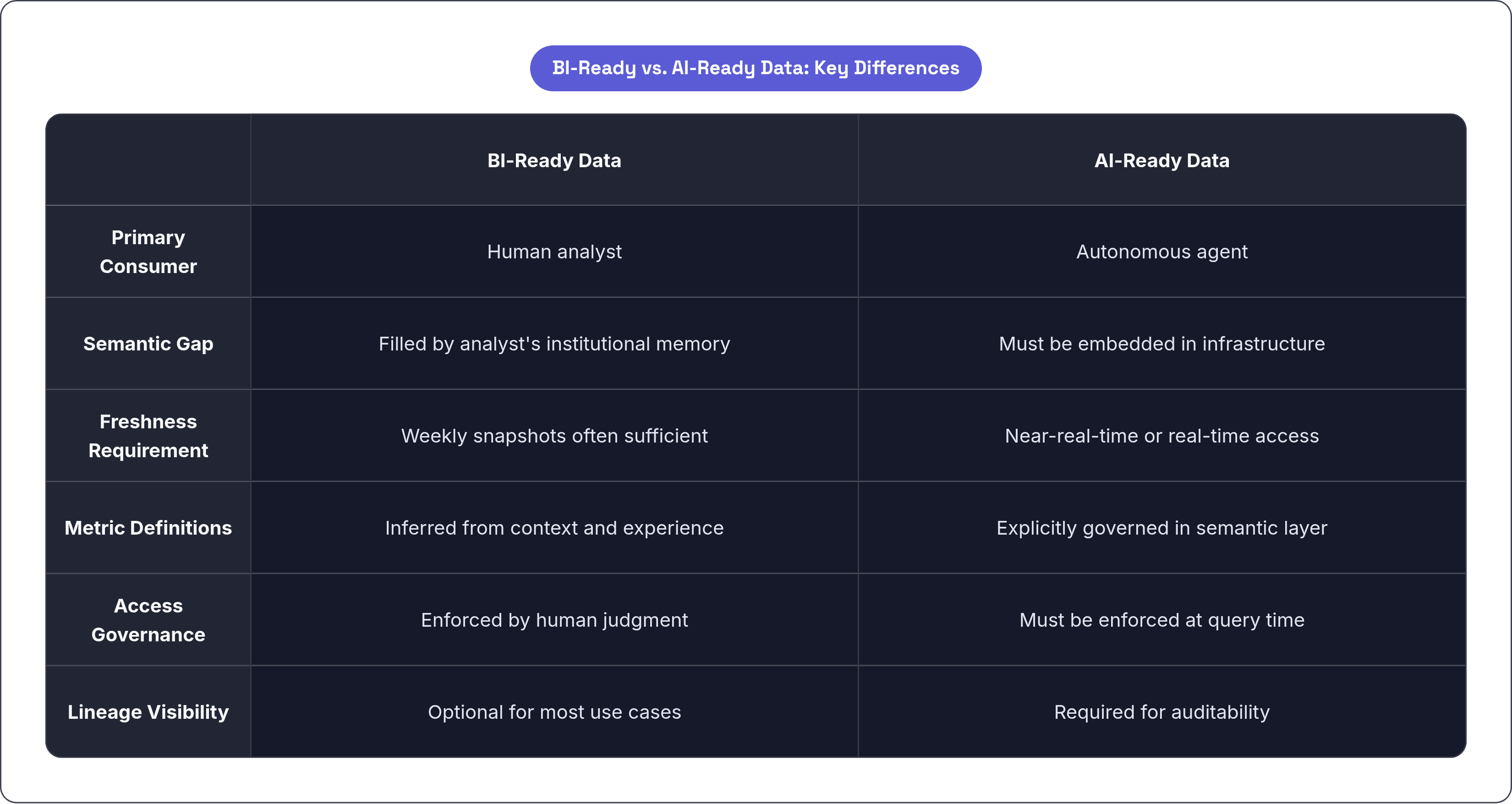
A dataset clean enough for a human analyst to build a dashboard from is not necessarily usable by an agent. The analyst brings institutional memory to fill in what the schema doesn't say: they know what to ignore, what to filter, which definition to trust, and which field has a complicated history. The agent receives the schema and begins inferring. From scratch. With no access to any of that accumulated interpretive knowledge.
The requirements diverge further when you get into freshness. A weekly snapshot that's perfectly adequate for a dashboard review is already stale for an agent making an operational decision at the moment of query. Agents need lineage, time-awareness, real-time or near-real-time access, and a semantic layer that encodes how the business actually uses its data. Most enterprise data infrastructure wasn't designed to provide these things, because it was designed with human analysts in mind.
Gartner's position, articulated in October 2024, is unambiguous: there is no such thing as making data AI-ready in general or in advance. Readiness is entirely dependent on how the data will be used, which means it has to be evaluated at query time, not at ingestion. That's a fundamentally different architectural posture than what most data teams have built toward, and acknowledging it requires admitting that a lot of existing infrastructure is solving the wrong problem.
Cleaning data for AI without also embedding semantic context and access governance into the layer agents actually query doesn't close the institutional memory gap. The result is clean, misunderstood data. Precise, consistent, and completely lacking the interpretive frame that makes it answerable.
What a semantic layer actually gives an agent that raw schema access doesn't
Text-to-SQL gives an agent access to data. That's it. Pointed at raw tables, a language model re-derives joins, filters, and metric logic on every prompt, with no guarantee it respects access rules or the definitional conventions the business established years ago in meetings nobody documented properly.
A semantic layer changes the fundamental nature of the transaction. It defines metrics, dimensions, joins, and access policies once. The agent selects from that governed set instead of authoring SQL against raw tables. The definition of "revenue" in finance is no longer something the agent infers; it's something the infrastructure specifies, explicitly, in a form the agent can read. This is institutional memory made machine-readable: the shared vocabulary that produces consistent outputs across sessions, users, and agents, without requiring anyone to re-explain the conventions each time.
The Model Context Protocol (MCP) is how a modern agent discovers and queries governed metrics in practice. Rather than writing SQL, the agent lists available measures and dimensions and requests them by name. The query resolves against definitions the business has already validated. The agent is, in effect, consulting a governed vocabulary rather than guessing at a schema, and that distinction becomes increasingly consequential as query volumes scale.
Skipping the semantic layer to accelerate deployment tends to produce one reliable outcome: a rebuild. The time saved upfront gets spent later, usually under worse conditions, usually after something has gone visibly wrong.
Semantic context alone isn't enough — governance must be enforced at the point of query
A human analyst knows intuitively which numbers they're allowed to see. Years of working within an organization's access conventions make this automatic. An agent operating under a broad service account has no equivalent intuition, and no constraint unless the infrastructure enforces one. Permissions evaluated at the dataset or pipeline level, rather than at query time, cannot account for the actual end user on whose behalf the agent is acting.
Sensitivity has to be evaluated at the point where data is combined, not only at the level of individual fields. An agent querying five innocuous fields simultaneously may be assembling something no individual field would have surfaced on its own. At the query volumes agents generate, this isn't an edge case. It's routine.
There's a related problem that doesn't get named often enough: agents accumulating context and action histories without governance infrastructure to manage that accumulation. Call it memory debt. As agents move from stateless to persistent, memory debt becomes the primary emerging governance risk. Write actions are categorically more dangerous than reads, and governance frameworks that treat them equivalently don't reflect the actual risk profile. Most current frameworks do exactly this.
Governance patched onto the model layer or prompt layer after deployment cannot retroactively enforce row-level permissions or reconstruct lineage. It has to be built into the layer the agent queries, before the agent queries it. There is no shortcut here that doesn't eventually produce a compliance event or a materially wrong decision.
What it looks like to close the institutional memory gap in practice
The goal is not to build a separate memory system alongside everything else. The goal is to make the data infrastructure itself carry the context that currently lives only in people's heads, and to make it do that in a form agents can consume directly.
In concrete terms: an agent needing data from five systems makes one request to one governed interface and receives consistent, permissioned results. No five separate integrations. No five separate teams managing access independently, with no visibility into what the others are doing. The cross-estate access layer is what makes this possible, and it's what most organizations haven't built yet.
Three capabilities have to work in concert. A semantic metadata layer with business definitions and metric logic connected to the assets agents actually query. Freshness guarantees surfaced to agents at inference time, so they know when data was last updated and whether it's appropriate for the decision at hand. Access controls enforced at inference time across all platforms, not at ingestion, where the access context doesn't yet exist.
This is additive infrastructure, not a rip-and-replace. A semantic layer sits on top of existing warehouses, SaaS tools, and operational systems. It doesn't require migrating data or rebuilding pipelines. The bottleneck it addresses is real: governance benchmark research cited by Atlan finds that 56% of enterprises report it takes six to eighteen months to move a GenAI project from intake to production, with governance and infrastructure bottlenecks as the primary cause, not model readiness.
The test of whether the gap is actually closed is straightforward. An agent that has never seen a schema before queries it, receives a correct and consistent answer, stays within the permissions of the user it's acting on behalf of, and leaves a log a human reviewer can actually interpret. That outcome is an infrastructure problem. Build the right infrastructure and the agent passes the test.