Runtime Data Access vs Static Pipeline Delivery
Agents need fresh data at query time, not stale snapshots—a correctness problem, not a speed one.

What batch latency actually costs when an agent is the one querying
Batch latency is a correctness problem for agents, not merely a performance inconvenience. Even aggressive batch schedules run every five to sixty minutes, while an agent making a decision needs data current within seconds. That gap is a correctness problem, and most infrastructure teams have not fully sat with what that means.
For a human analyst, a thirty-minute-old number is context. It informs interpretation. For an agent acting on that number, it is a premise. Wrong premises produce wrong actions, not wrong charts. The analyst can sense-check against experience, ask a follow-up, triangulate. The agent proceeds.
The workloads where this bites hardest are not obscure: fraud detection, real-time inventory allocation, customer-facing copilots, operational intelligence layers. A pricing agent working from a snapshot that is forty minutes stale is not slow. It is wrong in ways that compound across every decision it makes before the next batch runs.
What makes this failure mode genuinely dangerous is that it is silent. A stale answer looks identical to a fresh one. No error surfaces, no flag fires, no confidence score degrades. The agent outputs a result with full apparent authority, and nothing in the system registers that anything has gone wrong. The pipeline did its job. The answer just no longer reflects reality. Think of it like a ship navigating by a map that was accurate yesterday: the ocean has not moved, but the ice has, and the map will not tell you that.
A snapshot adequate for a monthly report and a live feed for a routing decision are not points on the same spectrum with different tolerances. They are architecturally different requirements, and treating the former as a slower version of the latter is where the trouble starts.
How schema rigidity turns routine upstream changes into downstream agent failures
Static pipelines depend on fixed schemas and predefined mappings. When a source application adds a field, changes a data type, or renames a column, the pipeline breaks. This is not a hypothetical failure scenario. It is the ordinary lifecycle of any production data source. Source systems change because the businesses running them change, and no amount of downstream engineering discipline prevents that.
For a human analyst, a broken dashboard is visible. Someone notices, files a ticket, an engineer investigates, the fix gets scheduled. Annoying, but recoverable. For an agent mid-task, a broken schema silently corrupts its reasoning or halts execution without surfacing a reason. The agent does not know what it does not know. It either proceeds on malformed data or stops, and neither outcome announces itself clearly.
The maintenance burden this creates is already significant even for pipelines serving human consumers. Engineering teams spend a substantial share of their time, often approaching half, keeping existing flows alive as upstream sources do what they inevitably do. That is capacity being consumed by structural fragility rather than building anything new.
Agents compound this in a specific, predictable way. They issue unpredictable, ad-hoc queries that static pipelines were never designed to accommodate. A pipeline built for one fixed consumption pattern cannot route around schema changes dynamically; it assumes it already knows what shape the data will take and what questions will arrive. The agent assumes it can ask anything, at any time, in whatever form the task requires. These two assumptions do not coexist gracefully. Sooner or later, and usually sooner, one of them wins.
The readiness gap between what enterprises have built and what agents require
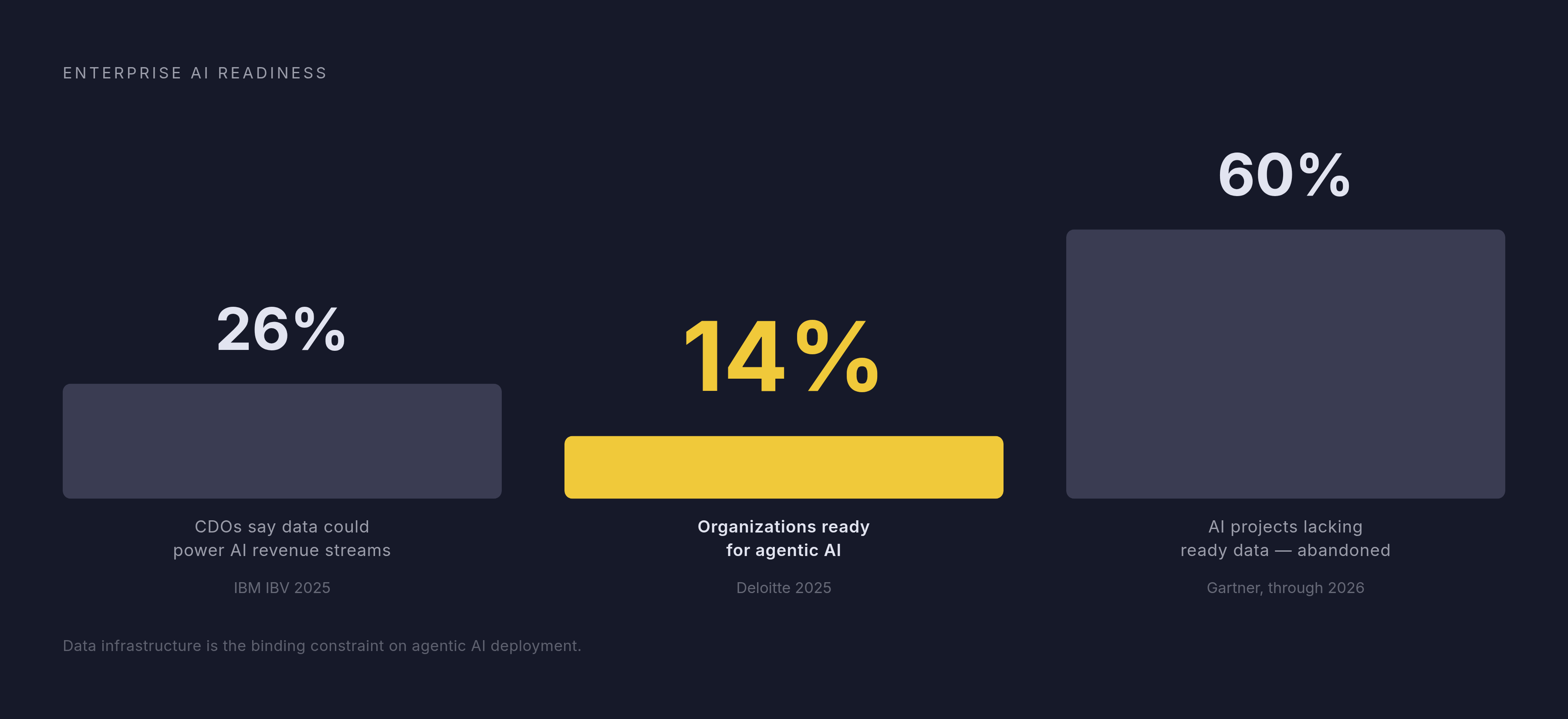
Most enterprise data architectures are structurally unready for agentic AI, and the evidence is consistent enough to be uncomfortable. Only 14% of organizations currently have systems ready for agentic AI deployment, with data architecture cited as the primary bottleneck, according to Deloitte's 2025 Emerging Technology Trends study. Just 26% of chief data officers according to a 2025 IBM Institute for Business Value survey said their data capabilities could power AI-enabled revenue streams. Gartner projects that through 2026, organizations will abandon 60% of AI projects that lack AI-ready data.
These figures are not indicting model quality or prompt engineering. They point at the data layer as the structural ceiling. The models are ready. The infrastructure beneath them, built for a different consumer with different requirements, is not.
Most existing data architectures were designed around a human consumer with a predictable cadence, a mostly known question set, and the capacity to tolerate imperfection when it showed up. Agents query at machine speed with no human in the loop. They do not tolerate staleness gracefully; they proceed on whatever the infrastructure gave them, and the output reflects that.
The instinct in most organizations is to treat this as a tooling problem: buy a better connector, upgrade the warehouse tier, improve the scheduler. The organizations actually closing this gap have recognized something different. What is missing is a data layer designed around the agent as the primary consumer. That is not a product purchase. It is a design decision that has to be made deliberately, or it will not be made at all.
What runtime data access actually means and how it differs structurally from pipeline delivery
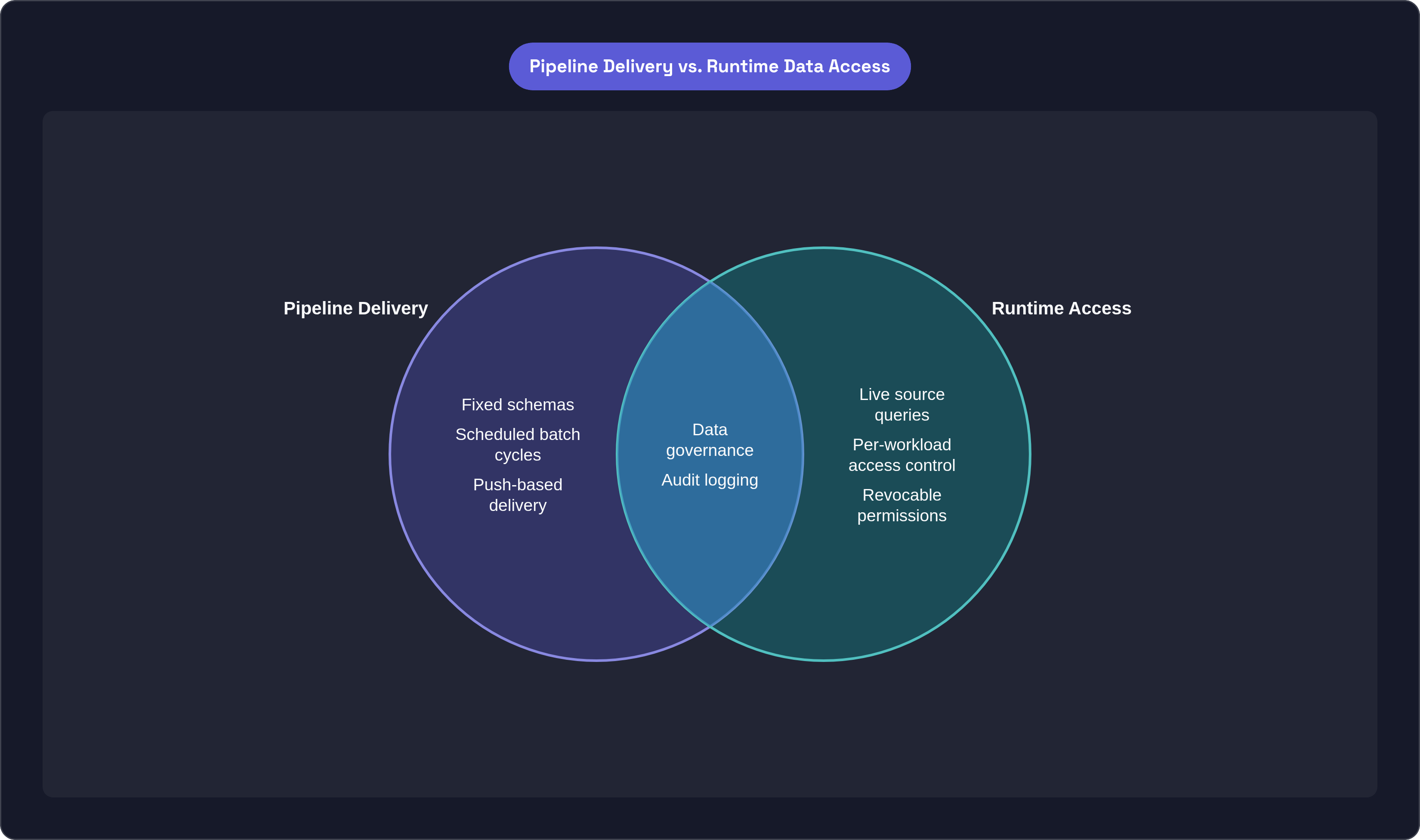
Runtime data access is architecturally distinct from pipeline delivery, not simply a faster version of it. The query goes to the live source at the moment it is issued, not to a snapshot copied into a warehouse on a schedule, not to a materialized view last refreshed thirty minutes ago. To the source, now, with the answer reflecting the state of the world as it exists when the question is asked.
The difference is not only speed. It is a fundamentally different relationship between the consumer and the source: pull instead of push, event-driven instead of scheduled, adaptive instead of fixed. Change Data Capture illustrates one mechanism for achieving this. It reads database transaction logs and publishes changes as they happen, so downstream agents receive current data without waiting for a batch cycle to complete. The contrast with pipeline delivery is structural, not incremental.
Pipeline delivery assumes the consumer will always want the same shape of data, delivered on a schedule the pipeline controls. Runtime access assumes the question is unknown in advance and must be answered at the moment it is asked. That second assumption is precisely what agent queries require. Most agents do not issue the same query twice in the same way. They construct questions dynamically based on task context, and the data layer either accommodates that or it does not.
There is a governance dimension to this that matters independently of freshness. Runtime architecture enables revocable, per-workload access control. A single agent's permissions can be adjusted or revoked without disturbing the shared service accounts that downstream pipelines depend on. Access decisions happen at query time, scoped to the actual identity behind the request, rather than at infrastructure provisioning time, scoped to an account that multiple workflows share. That is the structural prerequisite for governance to function at all in an agent environment, not a minor operational convenience.
Runtime is a different architecture. The difference is not a matter of degree.
Why a semantic layer is what makes runtime access trustworthy rather than just fast
Speed without interpretability solves the wrong problem. An agent querying live data at runtime still fails if it does not know what "netrevenue" means in this schema, how it differs from "grossrevenue" in a joined table, or whether the metric being requested is calculated the same way across two systems that both store it under the same name.
Many AI hallucinations at the data layer occur not because the model is wrong but because the data lacks business meaning. The agent encounters an ambiguous field and fills the gap with plausible inference. The inference is internally coherent and also wrong. Because it is coherent, it passes the kinds of sanity checks that humans apply quickly and move on from. In production environments, an agent returns a number that looks exactly right, the downstream decision gets made, and the error surfaces three weeks later in a reconciliation that nobody wanted to run. It is the data equivalent of getting directions that are confidently delivered but based on a map of the wrong city.
A semantic layer sits between raw sources and the agent. It defines what business terms mean, how metrics are calculated, how entities relate to one another, and who is authorized to see what. It translates raw schema into governed, interpretable meaning. Gartner elevated the semantic layer to essential infrastructure in the 2025 Hype Cycle for BI and Analytics, and roughly 40% of enterprise leaders cite the absence of semantic context as a major blocker for operational AI, according to BigDATAwire reporting.
For agent-to-agent workflows, the stakes compound further. Each agent in a chain must resolve metrics against the same definitions, or sub-agents return results using different logic than the orchestrator expects. The orchestrator assumes agreement on what "conversion rate" means. The sub-agents operate from different underlying calculations. The output is precise, internally consistent, and wrong. Nobody catches it unless someone thought to verify that the definitions aligned before the chain ran.
The semantic layer is what converts a live query into a governed, interpretable answer. Without it, runtime access is just faster access to data the agent can still misread with full confidence.
Where governance must be enforced when agents are querying at machine speed
Roughly 62% of organizations cite lack of data governance as the primary data challenge inhibiting AI initiatives, according to a 2025 study from Drexel University's Center for Applied AI and Business Analytics and Precisely. That figure reflects a structural problem, not a policy problem, and the two require different responses.
A document that prohibits using PII for a particular purpose has no mechanism for preventing an agent from doing exactly that at three in the morning when no human is watching. Intent does not propagate at machine speed unless it is embedded in the architecture. Traditional governance approaches, policy documents and periodic access reviews, do not enforce themselves in a live query pipeline.
Permissions must be evaluated at query time, scoped to the actual end-user identity behind the request. A service account with broad access is a liability structured to look like infrastructure. The agent submits a query under that service account, the warehouse returns everything the account can see, and nobody has verified whether the real user behind that agent was entitled to any of it. In a pipeline world where queries are predictable and scheduled, this was a manageable risk. In an agent world where queries are arbitrary and continuous, it is not.
Sensitivity must also be evaluated at the point where data is combined, not only at the individual field level. Two individually permissible fields can produce a combination that violates access policy. The governance logic must operate on the actual answer, not the constituent parts in isolation.
Audit logs must capture identity, intent, and lineage together. At agent-level query volume, a log that records what was queried but not who authorized it or why becomes operationally unactionable within days. You end up with a complete record of everything that happened and no ability to explain any of it.
Legacy governance was built for static pipelines with known, scheduled consumers. Enforceable runtime governance requires enforcement to be built into the query layer itself: deterministic, verifiable, and evaluated at the moment of retrieval. That is a rebuild of where enforcement happens, not an enhancement to existing policy infrastructure.
What the shift to runtime access requires organizations to stop assuming
Several assumptions that were entirely reasonable in a pipeline-first world become liabilities in an agent-first one.
Freshness requirements are not uniform. A snapshot adequate for a BI dashboard is already stale for an agent making a routing or pricing decision. Freshness must be specified per use case, deliberately, not inherited from whatever the architecture's default batch cadence happens to be.
Schema stability is not a safe default. Runtime architectures must accommodate source changes without requiring manual pipeline intervention. The query layer must absorb variance that pipelines currently handle by breaking. That is a reorientation of where fragility lives in the system, not a minor engineering adjustment.
A service account's access does not equal the end-user's access. Every agent query must resolve under the identity of the real user behind the request, not the infrastructure account that submitted it. This is the minimum condition for governance to mean anything at runtime.
The semantic layer is not a BI convenience that agents can work around. For agents, shared metric definitions and relationship context are correctness requirements. They are the mechanism by which a live query produces a trustworthy answer rather than a coherent fabrication that nobody catches until the damage is done.
None of this requires replacing existing warehouses and pipelines. The practical implication is more specific: it requires adding the layer those systems were never built with. Runtime query access, semantic context, and governance enforced at retrieval, sitting on top of existing infrastructure. The warehouse does not go away. It stops being the only thing the data layer is organized around.
Gartner projects that 40% of enterprise applications will be integrated with task-specific AI agents by the end of 2026, up from less than 5% in 2025. The organizations that close this gap will not do it by building faster pipelines. They will do it by changing what the data layer is designed to serve, and that decision does not get easier the longer it is deferred.