Enterprise Application Architecture Patterns for AI Workloads
Data fragmentation, not model quality, is why most enterprise AI deployments fail.

Most enterprise AI deployments fail not because the model is bad, but because the data the model touches is incoherent. A Teradata and Wakefield Research study of 1,000 senior technology and data leaders found that 77% of executives report only 20% or less of their enterprise data is sufficiently described and contextualized for agents to use. The two barriers named most often: data lacking metadata, context, and relationships, and data fragmented across systems that cannot be connected in real time.
Context fragmentation is what happens when an AI agent encounters your data estate the way an outside auditor encounters a filing system that three different IT teams have touched over ten years. The columns have cryptic abbreviated names. The join logic lives in someone's head, and that someone left in 2021. The metric called "revenue" means four different things depending on which system you pull it from. A human analyst absorbs this over months, accumulates tribal knowledge, and learns who to call when something looks off. An AI agent has none of that. It cannot ask for clarification at runtime in any meaningful way. It has no institutional memory. A stale answer and a correct one look identical in its output.
This is not, strictly speaking, a hallucination problem in the research sense. It is an inference problem driven by absent context. The agent fills the gap with plausible structure, and plausible is not the same as accurate.
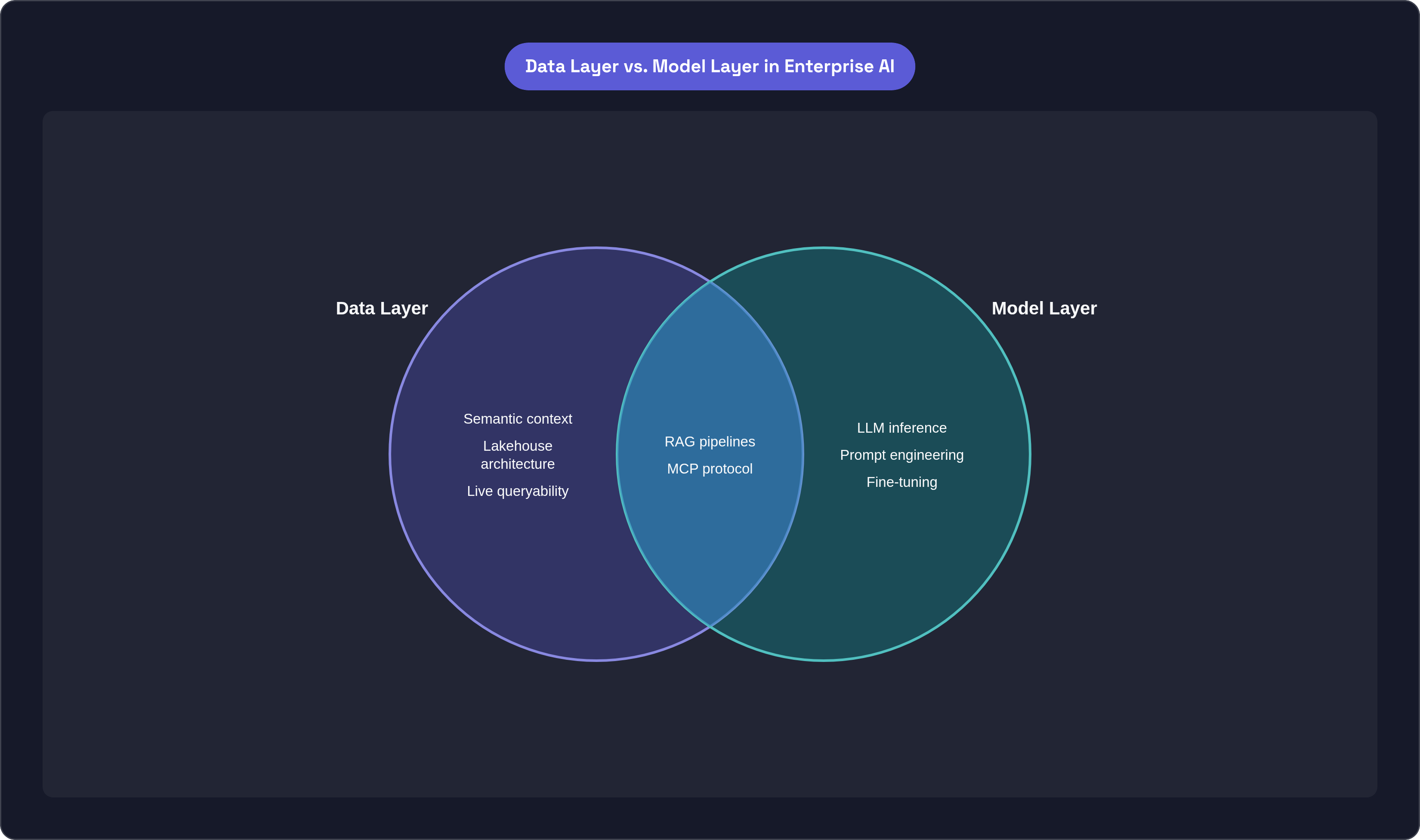
Solving this requires structural intervention at the data layer. Prompt engineering cannot retrieve context that does not exist. Fine-tuning cannot encode business rules that were never written down. The fix is upstream, which means the architecture conversation has to happen before the model conversation, not after the pilot fails.
The Architectural Baseline Enterprise AI Actually Requires
Only 14% of organizations currently have systems ready for agentic AI deployment, with data architecture cited as the primary bottleneck. The problem is not ambition or model capability. It is foundation.
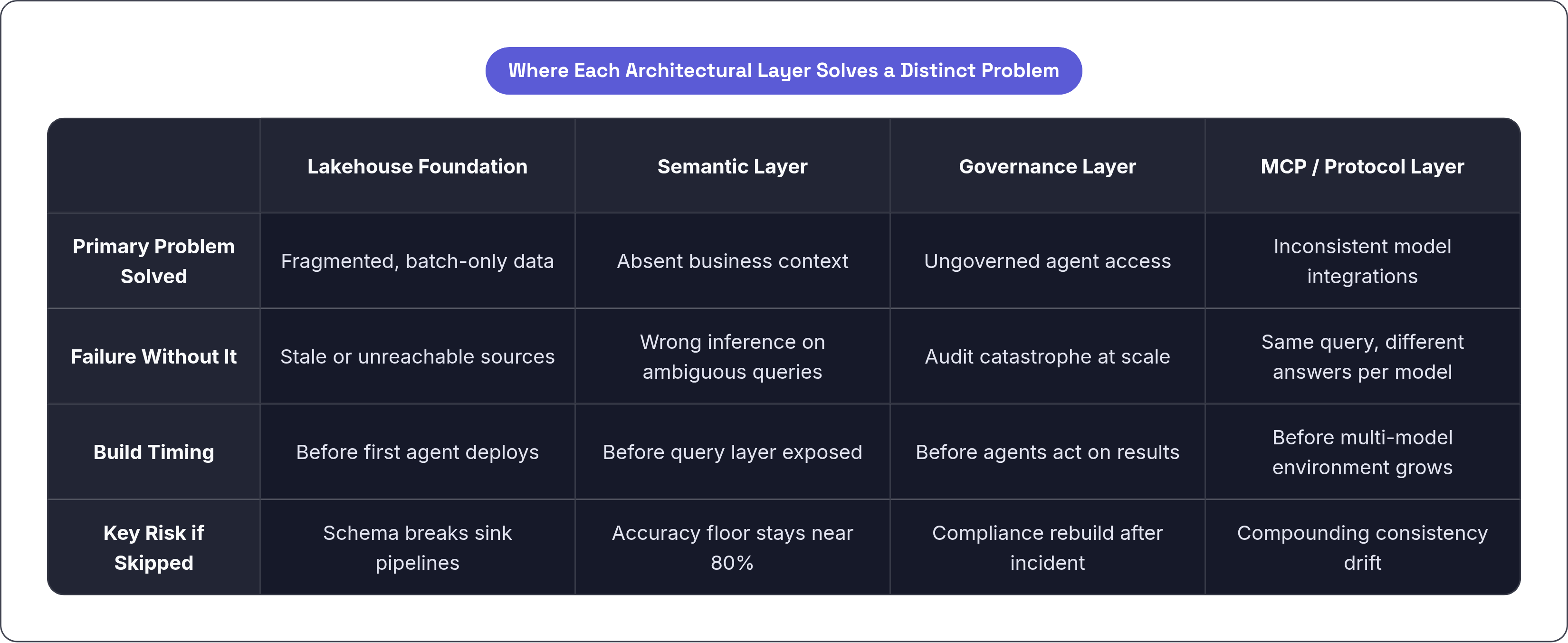
AI-ready data is a specific thing: discoverable, accessible in real time, governed by a unified identity and policy model, high enough quality to trust at inference time, and provisioned in a form agents can actually consume across every system in the estate. Partial implementations produce partial results, and partial results at the agent layer surface as confident wrong answers rather than obvious failures.
Lakehouse architecture has become the dominant unified foundation pattern among organizations that get this to work in production. The critical timing detail: they build it before the first agent is deployed, not after pilots fail. Open formats like Iceberg, Parquet, and Arrow are not optimization details. They represent a strategic commitment to long-term portability and interoperability across the agent layer. Lock-in at the format level becomes a ceiling on architectural flexibility, and that ceiling drops lower with every additional agent you add.
The deepest architectural mismatch is this: most enterprise data systems were built for dashboards and quarterly reports. Batch pipelines. Stable schemas. Scheduled refreshes. Outputs consumed by humans who can contextualize a number that is twelve hours old, because they know the business, they know the season, they know what to discount. AI agents require real-time decision-making against live, governed data. That is not an operational gap you close with better tooling. It is structural, and it requires structural remediation.
The Core Patterns That Structure AI Workloads in Production
Retrieval-Augmented Generation is the dominant pattern for grounding generative outputs in enterprise data, and it is worth understanding as an architecture rather than a product feature. RAG has distinct stages: data ingestion, embedding generation, vector search, context retrieval, and model inference. Each stage carries its own latency profile and failure modes. Each stage is also a governance checkpoint. When the data layer is ungoverned, each stage becomes a place where context degrades silently, and you often do not find out until someone questions a number in a board presentation.
RAG's infrastructure demands are substantial: asynchronous processing across multiple pipeline stages, integration between vector databases and application services, and continuous updates to knowledge sources without disrupting live inference. That last requirement alone disqualifies most static data pipelines. A pipeline designed for batch absorption cannot also serve real-time queries simultaneously without something giving way.
Event-driven and microservices patterns address this by enabling loosely coupled architectures that match what LLM inference latency and dynamic workloads actually require. The decoupling is not a stylistic preference. An agent that fans out across multiple systems in a single reasoning step cannot be served by a synchronous, monolithic pipeline without introducing bottlenecks that compound into reliability problems.
Agentic orchestration is where the stakes escalate quickly. Gartner projects that by 2028, a typical Fortune 500 enterprise will run over 150,000 agents concurrently, up from fewer than 15 today. Governance and routing patterns that work fine for dozens of agents break at that volume in ways that are genuinely difficult to anticipate and painful to fix after the fact.
The patterns built for human-facing business intelligence, request and response cycles, batch pipelines, human review before action, do not translate to agents that query continuously, fan out across systems, and act on results without waiting for anyone. Recognizing that discontinuity early is what separates teams that build durable architecture from teams that rebuild it twice.
Why the Semantic Layer Became Load-Bearing Infrastructure for AI Agents
Gartner elevated the semantic layer to essential infrastructure in its 2025 Hype Cycle for BI and Analytics. About 40% of enterprise leaders now identify the absence of semantic context as a major blocker for operational AI. That elevation reflects a practical reckoning with what actually happens when you deploy an LLM against a raw data estate.
Consider a query that sounds simple: "What were Q3 sales in Canada?" Without semantic context, the LLM must infer which table to query, how the organization defines "sales," which Canadian entities are in scope, and which joins connect them. Every inference is a potential error. Compounded across thousands of queries, the accuracy floor becomes untenable for anything you would actually trust in production.
The ceiling most organizations hit without a semantic layer is around 80% accuracy on complex enterprise queries. A properly implemented semantic layer, built on ontologies and knowledge graphs rather than just a business glossary, pushes that into the mid-90s. An agent that is wrong one in five times is not a productivity tool. It is a liability, and once trust breaks in an organization, it is remarkably hard to rebuild. People remember the wrong answer, not the ninety-nine right ones.
Google has reported that LookML reduces data errors in generative AI natural language queries by roughly two-thirds. That is one company's internal data, not a universal benchmark, and I would be cautious about treating any single vendor's self-reported figure as gospel. But the directional signal is consistent with what practitioners see across deployments: semantic grounding does not marginally improve accuracy. It changes the error rate by an order of magnitude.
BI-oriented semantic layers like dbt MetricFlow and AtScale solve query translation reasonably well but leave unsolved the harder upstream problem of connecting heterogeneous sources with shared meaning across a full enterprise estate. That upstream problem is the one that limits agents working across procurement, finance, and operations simultaneously, not the single-warehouse scenario those tools were designed for.
How MCP Standardizes the Interface Between AI Systems and Governed Enterprise Data
Model Context Protocol defines a standardized layer that lets AI applications access enterprise data as structured, typed information rather than detached text or siloed records.
Without a shared protocol, each model integration rebuilds context from scratch. Claude gets one integration, GPT gets another, an internal model gets a third. Every integration encodes its own assumptions about what a given data entity means, what permissions apply, and how to interpret relationships. In a large enterprise with a heterogeneous model environment, this is not a minor inefficiency. It is a compounding consistency problem, because every assumption that diverges across integrations is a place where the same query returns different answers depending on which model asked it.
MCP closes that gap by giving every AI system the same semantic foundation, the same governance context, the same traceable ownership. Outputs become traceable to governed sources rather than to opportunistic interpretation of whatever context happened to be retrievable at query time. In a regulated industry, in any environment where an audit trail is not optional, that traceability determines whether a deployed agent is usable or legally defensible. Those are different categories, and conflating them is how organizations end up in front of a regulator explaining an architecture decision they made in a hurry.
Where Governance Must Be Enforced, and Why the Model Layer Is the Wrong Place for It
Governance built at the model layer is governance built in the wrong place. It is expensive to maintain, inconsistent across integrations, and invisible to audit processes that care about the data layer. Practitioners who have retrofitted governance after a production failure will tell you this without prompting.
Sixty-two percent of organizations cite lack of data governance as the primary barrier to successful AI initiatives. What makes agentic AI different from prior waves of automation is the nature of the actor. A human analyst working around ambiguous data does so with judgment, institutional knowledge, and personal accountability. They know when something looks wrong. They know when to escalate. An agent capable of making and executing decisions with minimal human oversight acts on what the data says. Ambiguous metadata is not a speed bump for an agent. It is input.
Several specific requirements follow from this. Permissions must be evaluated at query time, scoped to the actual end user's entitlements, not assumed from a service account's broad access. At 150,000 agents querying simultaneously, a permissive service account is an audit catastrophe waiting to surface at the worst possible moment. Sensitivity must be evaluated at the point where data is combined, not only at the individual field level, because agents join across sources and a join can expose combinations neither source alone would surface. Audit logs must capture identity, intent, and lineage together; query text alone becomes meaningless at agentic query volumes.
Write actions taken by agents carry a fundamentally different risk profile than reads. Once an agent can act on query results, the architecture must treat them as categorically distinct. The EU AI Act entered into force in August 2024, with substantive obligations phasing in from February 2025. Architecture built without governance embedded is architecture that will need to be rebuilt for compliance, at greater cost, under worse conditions, and probably after an incident that made the rebuild non-optional.
What Live Queryability Means for AI Workloads and Why Static Pipelines Break Under Agentic Conditions
A dashboard can tolerate a twelve-hour-old snapshot. A human looking at that dashboard brings enough context to discount the staleness appropriately. An agent making a real-time decision cannot discount what it cannot perceive. That single observation drives a significant amount of infrastructure rethinking for teams that take it seriously.
Static pipelines assume stable sources and stable schemas. Agents query dynamically across heterogeneous systems at runtime. When a source changes or a new system gets onboarded, the pipeline assumption breaks, and the agent either queries stale data, fails to reach the new source, or queries successfully but without the semantic context to interpret what it finds. All three of those outcomes happen regularly in organizations that have not addressed the freshness problem architecturally.
There is a tooling mismatch that produces the worst possible failure mode. Structured questions, the kind agents ask constantly, must be answered through structured, queryable data. A vector database optimized for semantic retrieval is the wrong tool for a precise numerical query. Forcing structured questions through semantic retrieval tooling produces confidently wrong answers, rather than graceful failures. The agent does not say "I could not find that." It says something that sounds like it found it.
The architecture anti-pattern to avoid is a proliferation of bespoke pipelines per use case, each working in isolation, none shareable, none governable at the layer required for agentic scale. Each AI initiative solves one problem while creating another, and the collection of disconnected tools that accumulates is itself a form of context fragmentation, just one that the organization built deliberately.
How Enterprises Are Closing the Gap Between Current Architecture and AI-Ready Architecture Without Replacing What They Have
The realistic path for most enterprises is not rip-and-replace. Nobody has the budget or the runway for that, and the disruption risk during the transition is genuinely prohibitive. The practical path is a semantic and governance layer that sits on top of existing infrastructure: warehouses, SaaS tools, operational systems, everything already in place. A layer that governs and contextualizes without requiring migration removes the largest single organizational obstacle to moving from pilot to production.
Instrumentation order matters, and teams that get it wrong pay for it twice. Governance and auditability must be built into the data layer before agents are deployed at scale. Retrofitting governance after the first production failure is substantially more expensive than building it in, and it happens under the worst possible conditions, with stakeholders watching and trust already damaged.
IT budget allocation to data strategy has risen from around 4% in 2022 to roughly 13% in 2025. Budget directed at model experimentation before the data layer is ready produces the failure pattern everyone has seen: impressive demos, fragile production systems, and a post-mortem that identifies data quality as the root cause six months after deployment.
The sequencing is straightforward, even if the execution is not: unify the data foundation first. Embed semantic context and governance into the query layer second. Then expose that layer to agents. Skipping steps in that sequence is precisely why POCs succeed and production fails. The POC worked because someone manually prepared the data context. Production failed because no one built the infrastructure to prepare it continuously, at scale, for every system in the estate. The model was never the problem.