Open Source Data Governance Tools for AI Teams
Four governance layers help AI teams pick the right open source tools.

Sixty-two percent of organizations cite lack of data governance as the primary data challenge blocking their AI initiatives, according to a 2025 Drexel and Precisely study. That number is striking, but the more important question is what those organizations actually mean when they say "data governance." Most of them have governance. They have data dictionaries, access policies, ownership matrices, and audit trails. What they lack is governance built for a consumer that reads at machine speed, chains reasoning across systems, and has no institutional memory to compensate for a vague column name. The practical work ahead isn't building governance from scratch. It's understanding which layer of the governance stack is broken, and which open source tools address that specific layer.
How to think about the governance stack in layers before evaluating any tool
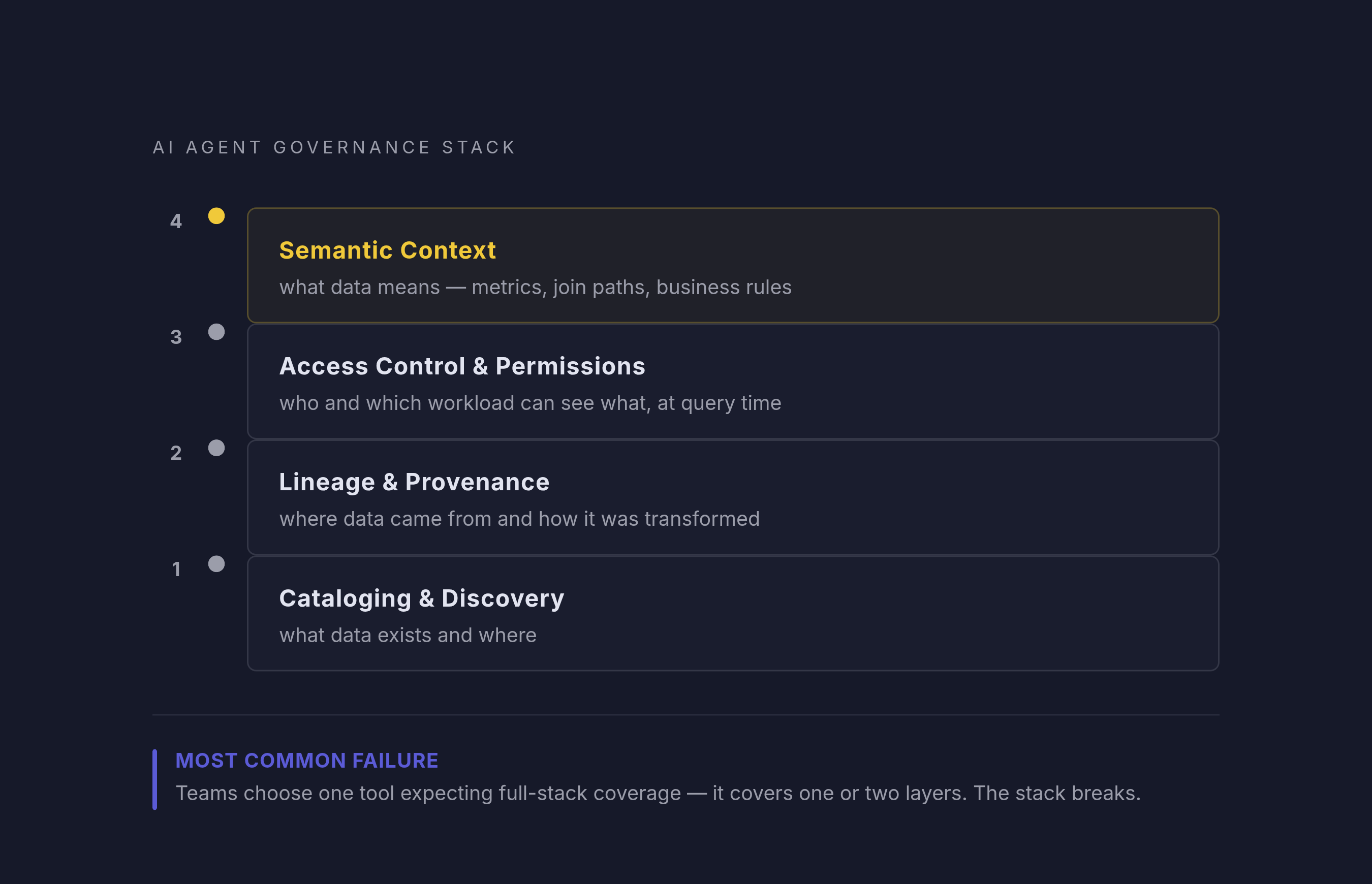
Before evaluating any tool, you need a mental model of what governance actually covers. There are four distinct layers, and each has a different job.
Cataloging and discovery answers the question of what data exists, where it lives, and who owns it. Lineage and provenance answers where data came from, how it was transformed, and what downstream systems consume it. Access control and permissions determines who, and which workload, can see what, enforced at query time rather than at pipeline design time. Semantic context answers what data means: the metric definitions, join paths, business rules, and grain that distinguish a correct answer from a merely syntactically valid one.
These layers are interdependent but not interchangeable. A catalog without a semantic layer tells you a column exists; it fails to tell you what that column means or whether your agent's interpretation of it is defensible. Lineage without access control tells you where data traveled, but not whether it should have. AI agents need all four layers working: they discover data through catalogs, establish trust through lineage, operate under real-user permissions, and interpret data through semantic definitions.
The most common mistake teams make is choosing a single tool expecting it to cover the full stack, then discovering six months in that it only addresses one or two layers. A related blind spot: sensitivity must be evaluated at the point where data is combined, not only at the individual field level. Two individually permissioned datasets can produce a combined result that violates a policy neither source would trigger alone. Most single-layer tools miss this entirely.
The job of this framing is not to overwhelm; it's to prevent the expensive mistake of solving the wrong problem with the right tool.
What drives teams toward open source tools rather than commercial platforms
The honest answer is a combination of cost, control, and ecosystem fit, in roughly that order.
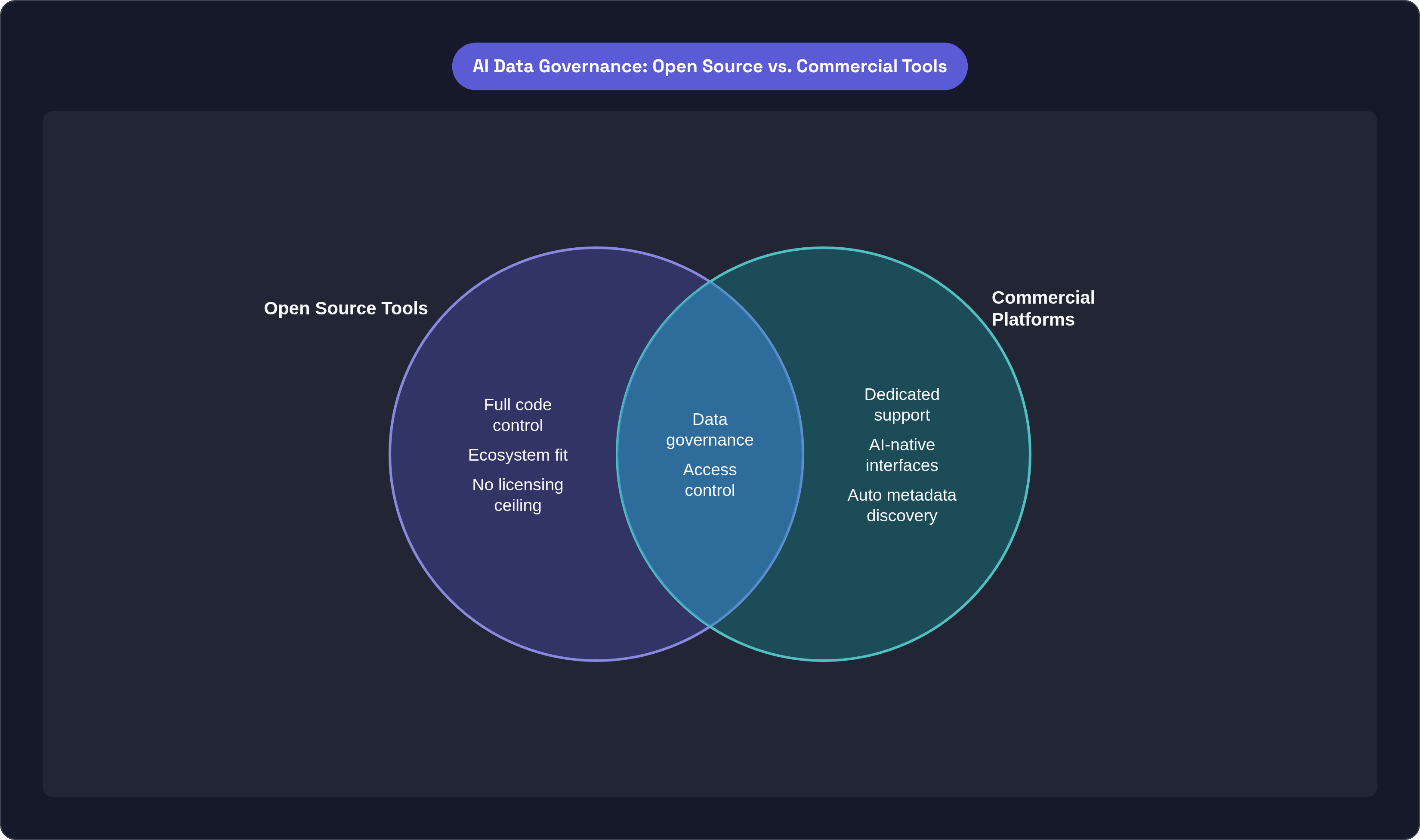
At scale, commercial data governance platforms carry licensing costs that compound with data volume and user count. Open source tools let teams avoid that ceiling. Beyond cost, vendor lock-in is a genuine architectural concern: when a commercial platform owns your metadata, your lineage graph, or your semantic definitions, migrating away becomes a multi-quarter project. Open source tools let teams inspect the code, extend it, and deploy it inside existing infrastructure without a rip-and-replace commitment.
AI teams in particular gravitate toward open source because they already live in open ecosystems. Python, dbt, Spark, Airflow, these aren't just tool preferences; they're the connective tissue of how modern data engineering gets done. Governance tools that integrate natively into that ecosystem generate less friction than standalone SaaS platforms that require a separate authentication model, a separate API surface, and a separate support relationship.
Worth naming clearly: open source does not mean free. The total cost includes integration work, ongoing maintenance, and the engineering time to operate tools that ship without a support contract or a dedicated customer success team. The global data governance market is projected to grow at a compound annual rate of roughly 20 percent through the early 2030s, which means commercial vendors are scaling investment aggressively. Open source tools face real competitive pressure to keep pace on features like automated metadata discovery and AI-native interfaces.
The right framing is not "open source versus commercial." It's which open source tools cover which governance layers, and where the gaps are that might require a commercial supplement.
Cataloging and discovery tools: making data findable before agents misuse it
A data catalog is a registry of data assets, with metadata, ownership, descriptions, and classifications that agents and pipelines can query programmatically. That last word matters. AI workflows don't browse a UI to find the right table; they need an API they can query at runtime.
Without a catalog, AI workflows default to whoever wrote the initial query knowing where data lives. That institutional knowledge disappears when team members leave. The agent has no fallback.
The leading open source options at this layer each have a distinct profile.
Apache Atlas is mature and Hadoop-ecosystem native. It's strong on classification and tagging, and organizations already running Hadoop infrastructure will find it natural. Integration overhead for non-Hadoop stacks is high, and that overhead is real.
OpenMetadata is API-first, built with AI and ML pipelines in mind from the start. It supports automated metadata ingestion from a wide range of connectors and has an active community as of 2025. For teams building greenfield AI infrastructure, it's worth serious consideration.
One graph-based metadata store option, originally developed at LinkedIn, is designed for large-scale, federated environments. It has strong lineage and search capabilities and is widely adopted in engineering-heavy organizations. It scales well and has significant community momentum.
Amundsen, originally from Lyft, is search-first with a strong user experience emphasis. It's better suited to discovery than policy enforcement and lighter on governance features than the graph-based metadata store options.
What to look for in a catalog for AI specifically: programmatic API access, automated ingestion rather than manual tagging, and column-level metadata. Table-level descriptions are insufficient when an agent needs to reason about a specific field.
Cataloging alone doesn't govern access or enforce meaning. It maps the terrain. The other layers do the governing.
Lineage tools: tracing data from source to model output and back
Lineage answers a cascade of questions: what source fed this metric, what transformation touched it, which downstream models or reports consume it, and in AI contexts, which agent query or pipeline run produced which output at what time.
When an AI model returns a wrong answer, lineage is the only mechanism for tracing whether the error originated in the source data, the transformation logic, or the semantic definition. Without it, debugging is archaeology. Audit logs must capture identity, intent, and lineage together. A log that records only "a query ran" is insufficient when agents run thousands of queries per hour.
The key open source options here operate at different levels of the stack.
OpenLineage is an open standard and a set of client libraries for emitting lineage events from pipelines. It works with Spark, Airflow, dbt, Flink, and a growing list of integrations. It isn't a UI or a storage system; it's the data standard that lineage tools consume. It has become, in practical terms, the lingua franca for lineage across the open stack.
Marquez is an open source lineage metadata service that implements the OpenLineage specification. It provides a queryable API and a basic UI, and it's designed to sit alongside orchestration tools rather than replace them.
dbt, used within a dbt project, provides table and model-level lineage across transformation layers natively through its compiled DAG. Column-level lineage requires additional tooling or extensions. Critically, dbt's lineage is only as complete as the dbt project itself; it misses upstream ingestion and downstream consumption that happens outside the dbt layer.
The practical gap across all of these is query-time lineage. Most open source lineage tools track pipeline lineage well. They struggle to capture which end-user query or agent session produced a given result at a given moment, with identity attached. Teams running agentic workloads need lineage at that resolution.
Access control tools: enforcing permissions at query time, not pipeline design time
This is the layer where many AI teams have the most immediate, most underappreciated exposure.
The foundational distinction is this: permissions enforced at pipeline design time, through static access grants, service accounts, and pre-joined exports, are not the same as permissions enforced at query time under the real user's identity. AI agents running under a shared service account inherit that account's full access. That access is almost always broader than any individual user's entitlement. If the account is over-permissioned, or compromised, there is no workload-level revocation without pulling access from everything that account touches. Access must be revocable at the level of a single workload.
The key open source options each address this differently.
Apache Ranger provides policy-based access control for Hadoop-ecosystem services including HDFS, Hive, HBase, and Kafka. It supports row-level and column-level filtering with auditing built in. Outside the Hadoop ecosystem, it's heavy to operate.
Apache Knox acts as an API gateway for Hadoop clusters. It enforces perimeter-level access but doesn't provide column-level or attribute-based control.
Open Policy Agent (OPA) is a general-purpose policy engine with policies written in a declarative language called Rego. It integrates with Kubernetes, APIs, and data planes, and it's increasingly used to enforce data access rules in modern data stacks outside the Hadoop ecosystem. For teams that have moved beyond Hadoop, OPA is currently the most flexible open source option at this layer.
It's also worth naming Immuta and Privacera as leading open-core options for teams that need attribute-based access control at scale. Neither is fully open source, but both occupy important territory at this layer and teams evaluating access control tooling will encounter them.
A fully open source, modern, stack-agnostic access control tool that handles query-time enforcement at the column level remains a genuine gap. Most teams approximate it by combining OPA with a query layer.
One more thing worth stating directly: write actions by agents need stricter governance than reads. Most access control frameworks were designed with read access as the primary concern. As agents gain write-back capability, that assumption needs to be revisited before it becomes a problem rather than after.
Semantic layer tools: giving agents the context to generate correct answers, not just valid queries
A semantic layer defines metrics, dimensions, join paths, grain, and business rules above raw data. It's the layer that ensures when an agent queries "revenue last quarter," it gets the governed, agreed-upon definition, not whatever interpretation the agent infers from column names and table structures.
Enterprises tolerated semantic drift for years. Conflicting metric definitions, undocumented join logic, inconsistent grain across reports: these were organizational friction, annoying but manageable. That tolerance ran out the moment AI agents started consuming data at scale. Per ATScale's 2025 analysis, this was the defining realization of the year for data teams building AI infrastructure. Research from MIT's Center for Information Systems Research reflects growing pressure on leaders to invest in semantic technologies that make data interpretable by both business users and AI agents simultaneously.
The primary open source options at this layer each have meaningful tradeoffs.
dbt Semantic Layer and MetricFlow define metrics in YAML alongside dbt transformation models. Metrics are versioned, tested, and queryable via API. The option is tightly coupled to the dbt transformation layer, which is either a strength or a constraint depending on your stack. For teams already on dbt, it's the strongest available open source option.
Some open source semantic layer tools offer a dedicated API designed for BI and AI consumers, handling caching, pre-aggregations, and multi-tenant access control at the semantic layer. These options require more infrastructure to operate than dbt's semantic layer but are more tool-agnostic, which matters for teams with heterogeneous environments.
LookML, Looker's semantic modeling language, is powerful and expressive but tightly coupled to the Looker platform. It's not portable outside it, which makes it a poor choice as a standalone governance investment.
The Model Context Protocol (MCP), formalized in 2024, created a standardized interface allowing AI agents to query semantic definitions directly from governed models. Teams evaluating semantic layer tools should check MCP compatibility; it's becoming an infrastructure requirement, not a nice-to-have.
The most robust implementations combine a semantic layer tool with a governed catalog. The catalog provides discovery; the semantic layer provides meaning. Relying on either alone leaves a gap the other fills.
McKinsey's 2025 State of AI reports that 88 percent of companies use AI in at least one function, but only roughly one-third have successfully scaled it. Inconsistent business logic is cited consistently as a reason for that gap. The semantic layer is the architectural answer to that problem.
Where open source tools leave gaps that AI teams should plan for
Open source tools, taken individually, cover their respective governance layers reasonably well. The gap is integration: these tools rarely communicate across layers out of the box. The lineage tool doesn't talk to the semantic layer. The catalog fails to enforce the access policy. Teams end up operating a loosely coupled collection of tools and then writing custom glue to make them interoperate, which becomes its own maintenance burden.
Combinatorial sensitivity is the gap that surprises teams most. When data from two individually permissioned sources is joined at query time, the combined result may violate a policy that neither source would trigger in isolation. No widely adopted open source tool handles this automatically. Teams that fail to address this architecturally are carrying risk they may not have inventoried.
Runtime freshness is a related problem. A data snapshot that's perfectly acceptable for a dashboard is already stale for an agent making a real-time decision. Most open source governance tools were designed for batch pipelines and don't model freshness requirements at the use-case level. As agentic workloads grow, this becomes a more significant constraint.
Agent-scale audit volume compounds both of the above. Agents generate query volumes that make human-readable audit logs impractical. Open source logging tools weren't designed to capture identity, intent, and lineage together at that throughput. The audit trail starts to break down precisely when it matters most.
Gartner's 2025 research puts the average annual cost of poor data quality at $12.9 million. That figure belongs here as a consequence of under-governing, not as a market size statistic. The operational cost of these gaps is real and traceable.
MIT's Project NANDA, as of July 2025, found that 95 percent of generative AI pilots delivered zero measurable return. The failed pilots were, in most cases, the result of failures in the data and context layer rather than wrong model choices. Open source tools reduce that risk substantially, but they fail to eliminate it if teams treat tool adoption as a substitute for architectural thinking.
Adding governance tools on top of existing data chaos without first consolidating the underlying stack doesn't produce control. It produces well-documented chaos.
How to sequence tool adoption based on which governance layer is the actual bottleneck
The right question is never "which tool is best." The right question is which governance layer is currently blocking your AI use cases. The answer to that question determines where to start.
The diagnostic signals are reasonably clear. If agents are querying the wrong tables or datasets because no one documented what exists, the catalog layer is the bottleneck. Start with OpenMetadata or a comparable open source catalog tool. If wrong outputs can't be traced back to their source, lineage is the bottleneck; implement OpenLineage instrumentation first. If agents are running under service accounts with unchecked access, or access can't be revoked at the workload level, access control is the priority; OPA or a query-time enforcement layer is the next investment. If the same metric returns different numbers depending on which tool queries it, the semantic layer is the bottleneck; implement dbt Semantic Layer or a comparable open source semantic layer tool before adding more AI consumers.
Most mature teams end up operating tools across all four layers. But starting everywhere at once is how teams produce complexity rather than governance.
The practical sequencing principle is this: catalog and lineage first, then access control, then semantic layer. Visibility before enforcement; enforcement before meaning. You can't enforce policies on assets you haven't cataloged. You can't define meaning on a foundation you haven't secured.
New infrastructure should sit on top of what already exists. Teams that deploy open source governance tools as an overlay on their current warehouses and pipelines ship value faster than teams waiting for a full platform migration to create the ideal conditions.
The test of whether sequencing is working is operational and simple: can a new AI workflow be added to your environment, get the data it needs, operate under the right permissions, and return governed answers, without a senior data engineer manually reviewing every step? If yes, the governance stack is doing its job. If no, that manual review is telling you exactly which layer to address next.