Knowledge Graph Integration for AI Data Retrieval
Knowledge graphs make AI retrieval accurate by encoding what data means, not just how it is stored.
What Knowledge Graphs Actually Are and What They Add to a Data Architecture
A knowledge graph is a structured representation of entities, their attributes, and the typed relationships between them. Simple enough on its face. But "typed" is doing more work than it appears to. The relationships carry meaning. Not just "these two tables join on customer ID," but "this metric is derived from this source table, owned by this business unit, last validated on this date." That is a fundamentally different kind of information than what a relational schema provides, and conflating the two is one of the more expensive mistakes organizations make early in this process.
A schema tells you how data is stored. A knowledge graph tells you what the data means. An organization can have a perfectly normalized relational schema and still have three different definitions of "customer" living in three different systems, none of which the schema surfaces or reconciles. The schema is silent on that conflict. The knowledge graph makes it explicit, which is uncomfortable, and also the point.
For AI retrieval, three components do the heaviest lifting: entity definitions, relationship types, and lineage. Entity definitions establish what a thing is and how it is calculated or identified. Relationship types establish the nature of the connection between entities, not just that a connection exists. Lineage answers the question the schema never could: where did this fact come from, and when was it last confirmed accurate. Without all three, you have a connected dataset. With all three, you have something you can actually build on.
There is also a governance dimension that gets underemphasized in technical conversations, probably because it feels like a policy problem rather than an engineering one. Because relationships in a knowledge graph are explicit and typed, access controls and sensitivity rules can attach to the relationships themselves, not just to individual fields. That distinction becomes critical later, when agents start combining data from multiple sources in ways no one anticipated at design time. Teams cannot bolt that kind of control onto a schema. It has to be native to the structure.
The market signal is not trivial. The enterprise knowledge graph market was valued at $890 million in 2025 and is projected to reach $6.55 billion by 2036. Organizations are spending real capital here, and the ones doing it well are not treating it as a data project. They are treating it as the foundation for everything their AI systems will eventually touch.
How GraphRAG Uses Graph Structure to Retrieve Answers Rather Than Approximations
Standard retrieval-augmented generation, the RAG pattern most teams implemented first, works by converting a query into a vector and finding chunks of text that are semantically similar to it. That is useful for fuzzy recall: summarizing a document corpus, finding relevant support articles, surfacing loosely related content. For schema-bound enterprise questions, the kind where the answer is either correct or it is not, it is structurally unreliable.
The reason is straightforward once you look at it directly. Vector search retrieves semantically similar text. It does not retrieve factually correct answers. Ask a vector-based retrieval system what revenue was for a specific business unit in a specific quarter, and it will find text that looks like an answer. Whether that text reflects the finance team's definition of revenue, whether the data was refreshed this week or six months ago, whether the metric is calculated consistently across the retrieved documents: none of that is verifiable through vector similarity alone.
GraphRAG intervenes at precisely that point. Instead of retrieving similar text, it traverses typed relationships in a knowledge graph to find the specific entities and facts a query requires. Microsoft's open-source GraphRAG release in July 2024 established the pattern at scale; the architecture involves entity extraction, relationship mapping through co-occurrence and semantic similarity, and hierarchical clustering using the Leiden algorithm. The result is a retrieval layer that follows chains of meaning rather than approximating them.
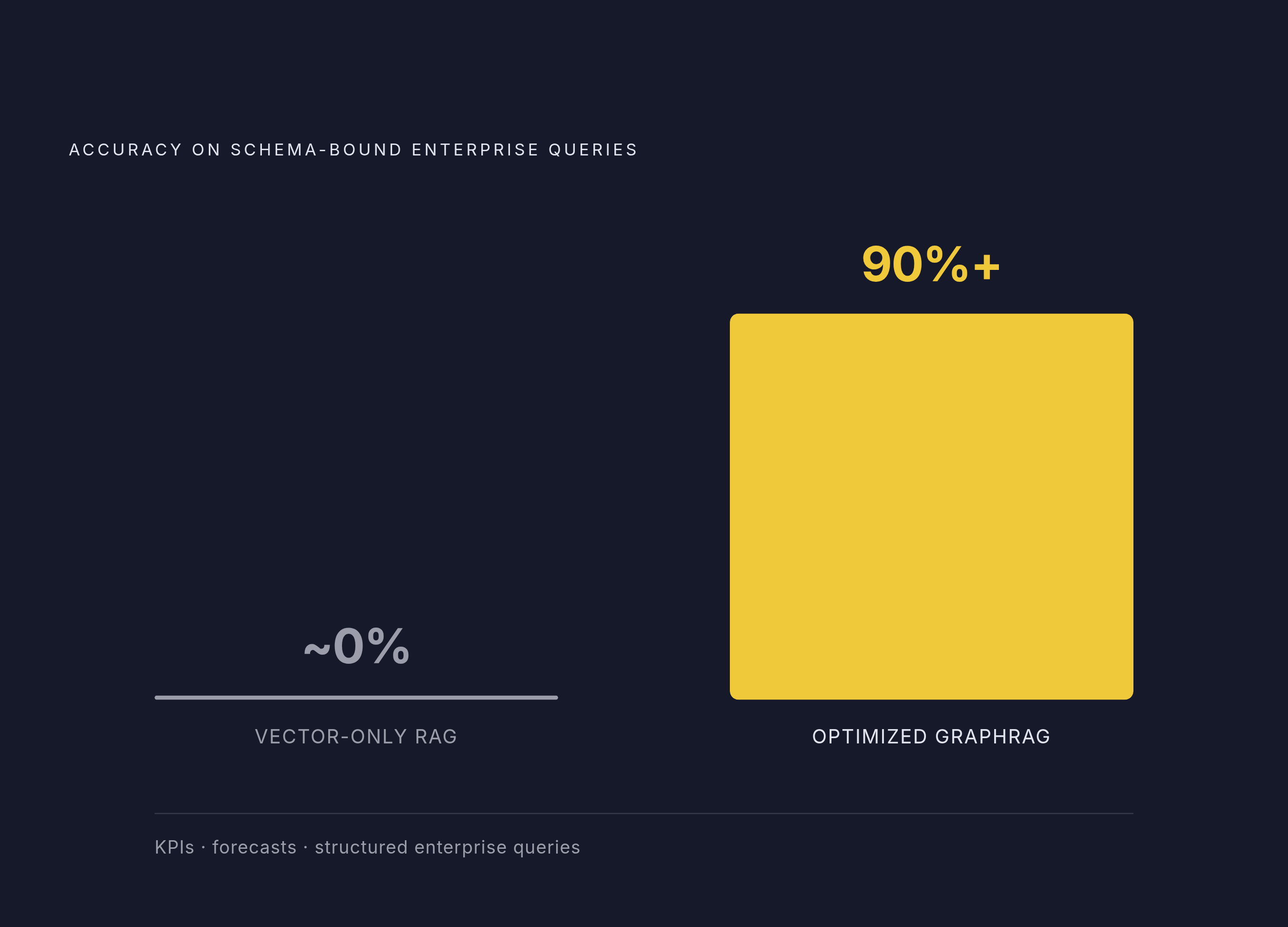
The accuracy difference is not marginal. Benchmarks have shown vector-only RAG achieving effectively zero accuracy on schema-bound queries involving KPIs and forecasts, while optimized GraphRAG implementations reach accuracy in the low 90s or higher on the same queries. That gap is the difference between a system you can use to make decisions and a system that generates confident-sounding noise.
Multi-hop reasoning is where the graph earns its most significant advantage. A query about a forecast metric does not just need the metric value. It needs to follow a chain: metric to definition, definition to source table, source table to refresh schedule, refresh schedule to whether this answer is actually current. Vector search stops at the nearest text match. Graph traversal follows the entire chain because the chain is explicitly encoded in the structure.
Hallucination suppression works through constraint, not through generation-level tuning or prompting the model to be more careful. If a relationship does not exist in the graph, the retrieval layer will not surface it. The graph acts as a factual boundary on what the LLM can claim. That is a meaningful architectural guarantee, and it is qualitatively different from any model-level approach proposed as an alternative.
The pattern is also not settled. Variants like HippoRAG, which applies personalized PageRank for multi-hop retrieval, LightRAG's two-stage pipeline, and GFM-RAG's use of graph neural networks all reflect active engineering effort. The core principle, using graph structure to constrain and direct retrieval rather than relying on semantic proximity alone, is robust. The specific implementations will keep changing.
Why Entity Relationships and Metric Definitions Must Be Explicit Before Retrieval Begins
The upstream problem with knowledge graphs is definitional, not technical. A knowledge graph populated with ambiguous or inconsistent definitions does not solve the enterprise data quality problem. It reproduces it in a new format with a worse failure mode, because now the ambiguity looks structured and authoritative.
What "explicit" actually means in practice is specific, sometimes uncomfortably so. "Revenue" is defined once: calculation logic documented, source systems identified, applicable business unit named, conditions under which it should not be used stated plainly. Not inherited from a column name. Not implied by table placement. Defined deliberately as a formal entity in the graph, with typed relationships to its sources and its consumers. That level of rigor is uncomfortable for organizations accustomed to leaving these definitions as institutional knowledge held by a few senior analysts who have been there long enough to know which number to trust. I have seen entire graph initiatives stall because no one wanted to own the conversation about whose definition of "active customer" was correct.
Gartner's Q3 2024 survey of 248 data management leaders found that 63% of organizations either lack or are unsure whether they have the right data management practices for AI. Most knowledge graphs, if built today without addressing that gap first, would encode existing ambiguity rather than resolve it. Structurally sound, semantically broken.
The CDO Insights 2025 survey is equally blunt: data quality and readiness, and lack of technical maturity, each emerged as top obstacles at 43% of respondents. These are pre-graph problems. No graph architecture resolves them. They must be addressed before the graph is populated, because the graph takes whatever you give it and makes it permanent and load-bearing.
The relationship between ontology and graph matters here. The ontology defines the vocabulary and the rules: what kinds of entities exist, what relationships are valid between them, what attributes are required. The graph instantiates those definitions with actual enterprise data. Skipping the ontology and going straight to connecting data produces something that looks like a knowledge graph and behaves like a connected dataset. A connected dataset does not suppress hallucinations. It gives them better-formatted source material.
Entity resolution and definition standardization are not pre-project cleanup work that can be delegated to a data steward in a parallel workstream. They are the project. Organizations that treat graph integration as a technical deployment and definition work as a prerequisite that someone else already handled tend to discover, six months and considerable budget later, that their graph is internally consistent and externally wrong.
The Semantic Layer as the Operational Interface Between the Graph and the AI Agent
A knowledge graph stores correct relationships. That is necessary and not sufficient. An AI agent querying the graph still needs a governed interface that translates those relationships into consistent, context-aware answers at query time. That interface is the semantic layer, and its role in this architecture is operational, not cosmetic.
The semantic layer provides table descriptions, metric definitions, and relationship context at the moment a query is issued. Gartner elevated it to essential infrastructure in the 2025 Hype Cycle for Business Intelligence and Analytics, and roughly 40% of enterprise leaders cite the absence of semantic context as a significant blocker for operational AI. The bottleneck is not model capability. It is the absence of a governed layer that tells the model what the data actually means.
Traditional BI-style semantic layers solve part of this. They handle query translation: converting a business question into SQL, applying metric definitions, abstracting table joins. What they do not address is heterogeneous sources with conflicting definitions. Knowledge graphs handle unification across sources. Semantic layers operationalize the result. Neither is sufficient without the other; they are solving adjacent parts of the same problem.
The convergence happening in 2025 and 2026 reflects this directly. Semantic layers and knowledge graph architectures are increasingly integrated into unified systems rather than deployed as parallel tools requiring manual synchronization. Organizations choosing infrastructure now should expect these two components to arrive together, not as separate procurement decisions evaluated against separate criteria.
Model Context Protocol (MCP) is the emerging standard for how AI agents access semantic definitions directly from governed models. It allows any LLM, regardless of vendor, to query the same semantic foundation at runtime. Rather than each agent carrying its own interpretation of metric definitions, MCP allows those definitions to be maintained centrally and accessed uniformly. One update propagates to every agent consuming that definition. That is not a minor operational convenience; it is what prevents semantic drift across a fleet of agents running on shared infrastructure.
Research indicates that a semantic layer built on knowledge graphs pushes retrieval accuracy from the high 70s to low 80s that vector RAG achieves into the mid-90s. That improvement comes not from the model reasoning better but from the retrieval infrastructure giving the model less room to reason incorrectly.
Runtime enforcement is where this becomes operational rather than theoretical. Permissions and definitions applied at query time, scoped to the identity of the requesting agent rather than assumed from a shared service account, mean that what one agent can retrieve is not automatically available to every other agent running on the same infrastructure. The graph and the semantic layer together make per-query, per-identity enforcement possible. That is a design requirement that shapes the entire system architecture. Teams cannot add it afterward.
Governance Decisions That Determine Whether Retrieved Answers Are Auditable
Traditional data governance tracks where data lives. AI governance must track something more granular: how data moves through retrieval pipelines, which agent queried it, under whose identity, what path through the graph the answer traversed, and what lineage that answer carries when it surfaces in a downstream decision. Organizations applying the old governance model to the new retrieval architecture will find their audit trails are technically complete and practically useless when something goes wrong.
The volume problem compounds quickly. An AI agent making hundreds of queries per session produces a log that is meaningless without identity, intent, and lineage captured together at the query level. A log entry recording "query executed at 14:32" tells you nothing useful when an answer needs to be investigated. Teams need to know which agent, acting under whose authorization, traversed which graph relationships, to produce which answer, from data last refreshed when. That is the minimum viable audit record, not an aspiration.
The sensitivity challenge also shifts when knowledge graphs are involved. Individual fields are often non-sensitive in isolation. Graphs expose relationships, and a relationship can be sensitive even when its constituent fields are not. Combining an employee ID, a project code, and a budget line constitutes sensitive information even if none of those three fields is individually classified. Sensitivity evaluation must happen at the point of combination, which is the graph traversal, not only at the field level. That requires governance architecture that understands the graph's topology, which is a different kind of governance tooling than most organizations currently have.
The State of AI+BI Analytics Global 2025 Report found that 38.3% of organizations now list governance frameworks and semantic layers as a top investment area. Governance is moving into the data infrastructure itself, because organizations that waited to attach it after deployment found it could not be retrofitted cleanly.
Write actions introduce a distinct risk category that gets underestimated in early integration designs. An agent that can read from the knowledge graph and write back to a source system does not carry the same risk profile as a read-only retrieval agent. The permissions model, the audit requirements, and the revocation procedures are all different. Treating them identically is an architectural error that surfaces at the worst possible moment, usually when a write action has already propagated.
Revocability at the workload level is a specific design requirement organizations frequently discover they did not plan for. When multiple agents share a service account, revoking access for one workload breaks every downstream system attached to that account. Per-workload permissions must be built in from the beginning; retrofitting that granularity into shared-credential infrastructure is expensive, disruptive, and never quite right.
Lineage is what makes the difference between a system that can be trusted and a system that can only be believed. An audit log that captures the query but omits the graph path the answer traversed cannot explain a wrong answer, cannot support a compliance review, and cannot identify which graph relationship needs to be corrected when an error surfaces. That is not a nuance. That is the operational distinction between infrastructure and a prototype with good documentation.
Integration Patterns That Work in Practice and the Tradeoffs Between Them
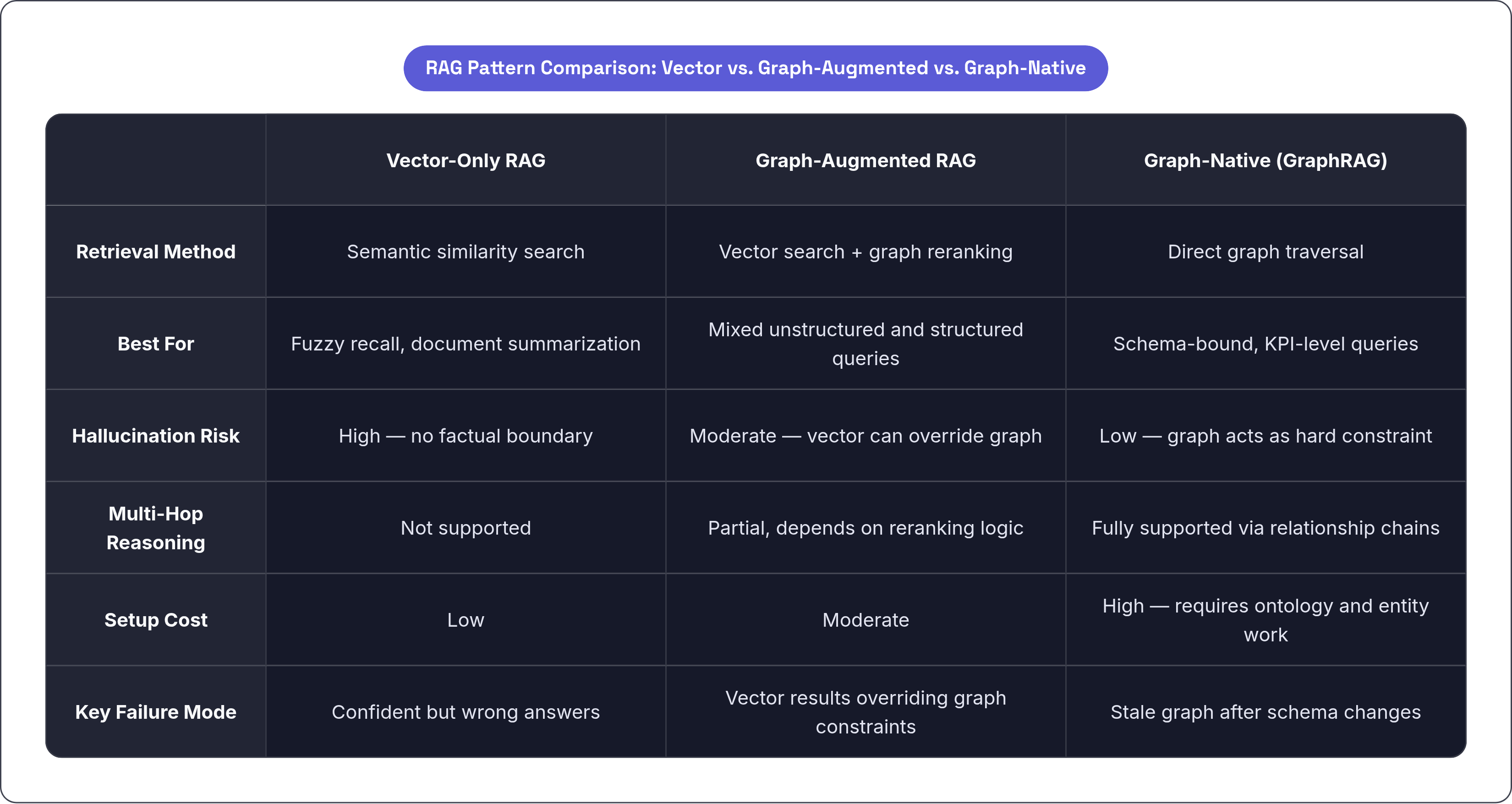
Three patterns are in meaningful production use, and each carries a distinct tradeoff profile worth understanding before choosing.
Graph-native retrieval, GraphRAG running directly over a purpose-built knowledge graph, delivers the highest accuracy on structured enterprise queries. It also carries the highest upfront cost, not in software licensing, but in entity resolution and ontology work. Every entity must be defined. Every relationship must be typed. Every metric must be documented with its calculation logic and source lineage before the graph is useful for retrieval. This pattern is the right choice when query types are predictable and schema-bound, when the organization has genuinely done the definitional work, and when accuracy on specific question types is the primary requirement. If any of those conditions are not yet met, the pattern will underperform expectations and generate the kind of skepticism that is hard to recover from politically.
Graph-augmented RAG is the more common starting point for organizations that cannot yet commit to full graph-native architecture. It uses vector search for unstructured content retrieval and injects graph context to rerank or constrain results. The setup cost is lower, and it preserves semantic search capability for use cases where fuzzy recall is genuinely appropriate. The failure mode is concrete: the vector layer can surface content that overrides graph constraints, and hallucination risk persists as a result. A dual-retrieval strategy requires deliberate design to ensure graph relationships take precedence when there is a conflict. Without that precedence logic built explicitly into the architecture, the graph functions as decoration rather than constraint.
The semantic layer as a unified interface over an existing graph is the pattern most relevant for enterprises that have already built significant knowledge graph infrastructure and need to expose it to AI agents without rebuilding from scratch. This approach treats the semantic layer as the primary query interface and the graph as the authoritative source it draws from. It is the most compatible with the "no rip-and-replace" constraint most enterprises face, because it sits on top of existing infrastructure rather than requiring it to be retired.
Dynamic graph maintenance is a design requirement that separates functional production systems from systems that worked at launch and then drifted. Static graphs that do not reflect schema changes become sources of stale answers, reintroducing the exact problem they were built to solve, with a longer lag time before the failure surfaces. Freshness must be modeled as a variable. A metric definition that is stable for months needs different refresh logic than a relationship reflecting a daily operational state. Applying a single pipeline cadence to all graph content is an efficiency decision that produces correctness problems.
Latency compounds in ways that are easy to underestimate at the design stage. Graph traversal latency, even at the millisecond level that production-grade implementations like Neo4j achieve for multi-degree relationship queries, adds to LLM inference time. At scale, that addition is meaningful. Millisecond-level latency at the graph layer is the practical benchmark for production retrieval; anything slower creates user experience and cost problems that are difficult to justify when inference time is already significant.
What Distinguishes AI Retrieval That Works in Production from Retrieval That Only Worked in the Demo
The demo worked for reasons nobody articulated at the time: clean sample data, a stable schema, no cross-department definition conflicts, no access control edge cases, no agent-level query volume. Those conditions are not present in production. They are almost never present in production. The demo succeeded because the conditions for success were engineered into the demonstration environment, not because the architecture was sound.
Production breaks for the inverse of every condition that made the demo succeed. Fragmented sources replace clean sample data. Ambiguous metrics replace defined ones. Permissions evaluated at the service account level replace per-identity enforcement. Answers arrive with no lineage. The graph was last refreshed before a schema change that now makes its relationship definitions inconsistent with the actual data. I have watched this sequence play out enough times that it no longer surprises me. It still frustrates the teams experiencing it for the first time, and it should, because most of it was preventable.
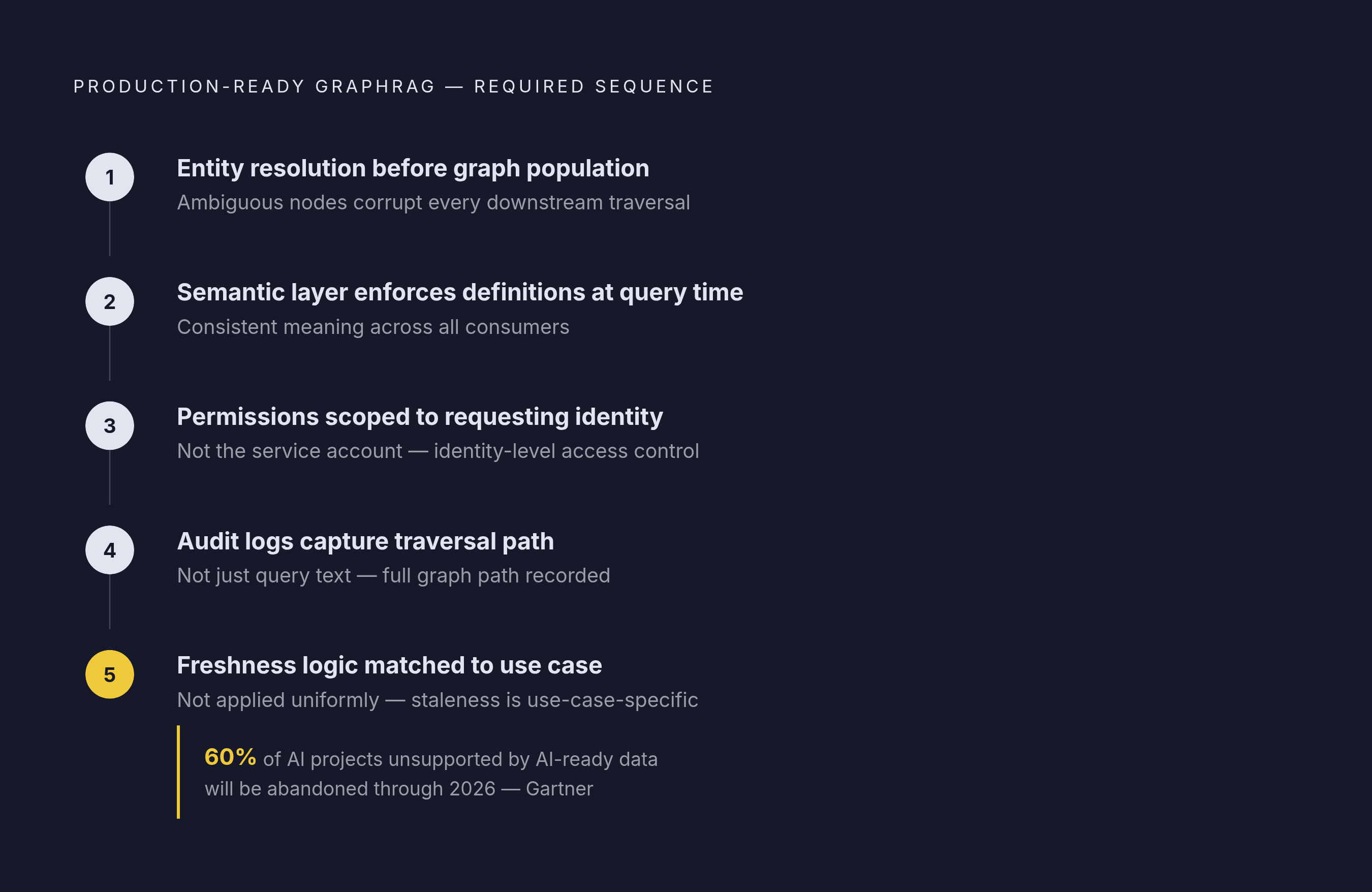
The checklist that separates production-ready retrieval from demo-ready retrieval is architectural, not operational. Entities must be resolved and defined before the graph is populated. The semantic layer must enforce definitions at query time, not assume them from table names. Permissions must be scoped to the requesting identity, not the service account. Audit logs must capture the graph traversal path, not just the query text. Freshness logic must be matched to the use case, not applied uniformly across all content regardless of how frequently it changes.
Gartner forecasts that more than 40% of agentic AI projects will be abandoned by 2027, and separately, that 60% of AI projects unsupported by AI-ready data will be abandoned through 2026. Per Cloudera and Harvard Business Review Analytic Services research from March 2026, only 7% of enterprises say their data is completely ready for AI. The abandonment rate is not a model quality problem. Organizations are abandoning these projects because the retrieval infrastructure cannot support production use, and fixing it after deployment is more expensive than building it correctly the first time.
The distinguishing question for any integration, one worth asking before a single line of integration code is written: can the system explain, at query time, which graph relationships produced the answer, under whose permissions, from data last refreshed when? If the answer is no, the retrieval system is producing output. It is not producing trusted knowledge.
Knowledge graphs do not make AI retrieval foolproof. They make it falsifiable. When a retrieved answer is wrong, a system built on a knowledge graph with a proper semantic layer and lineage-capturing audit logs can tell you exactly why it was wrong: which relationship was stale, which definition was misapplied, which permissions boundary was not enforced. That is what separates infrastructure from a demo. Not that it never fails, but that when it fails, you can actually find out why.