AI Governance Platforms and Tools Comparison

The failure numbers don't leave much room for interpretation. S&P Global's 2025 survey found that 42% of companies had abandoned most of their AI initiatives that year, up from 17% in 2024. The average organization scrapped 46% of AI proof-of-concepts before they reached production. MIT's 2025 GenAI Divide report found that roughly 95% of generative AI pilots delivered zero measurable financial return. Gartner, in June 2025, projected that more than 40% of agentic AI projects will be canceled by end of 2027.
The failure is not happening at the model. The models are, largely, good enough. What falls short is everything underneath them.
Publicis Sapient's research, drawing on a survey of more than 500 industry leaders, identified abandonment as driven primarily by operational and governance failures. McKinsey's 2025 analysis found that organizations achieving significant AI returns were twice as likely to have invested in data workflow redesign before they even selected a model. ModelOp's AI Governance Benchmark Report found that 56% of enterprises report six to eighteen months to move a GenAI project from intake to production, with governance and infrastructure bottlenecks as the primary cause of delay.
Here's the mechanism most organizations miss: in a demo, you run the model against a clean, curated sample dataset. In production, you run it against fragmented data spread across dozens of systems, inconsistently labeled, with no unified definitions. A basic term like "customer" means one thing in the CRM, another in the billing system, a third in the logistics database. The model has no institutional memory to resolve that ambiguity; it infers. Think of it like asking a new employee to write a company-wide report on the first day — they'll produce something that sounds authoritative and gets almost everything wrong. And a model that infers produces wrong answers that look exactly as confident as correct ones. That's not a model problem. That's a data problem.
Which is why the platform selection question matters so much: a governance platform that only operates at the model or application layer cannot fix a failure originating at the data layer. It can document the failure. It cannot prevent it.
The Three Layers Where AI Governance Is Actually Enforced
Most platform comparisons sort by feature checklist or vendor quadrant position. The more useful question is where in the stack control is actually applied, because the layer determines what a platform is physically capable of governing.
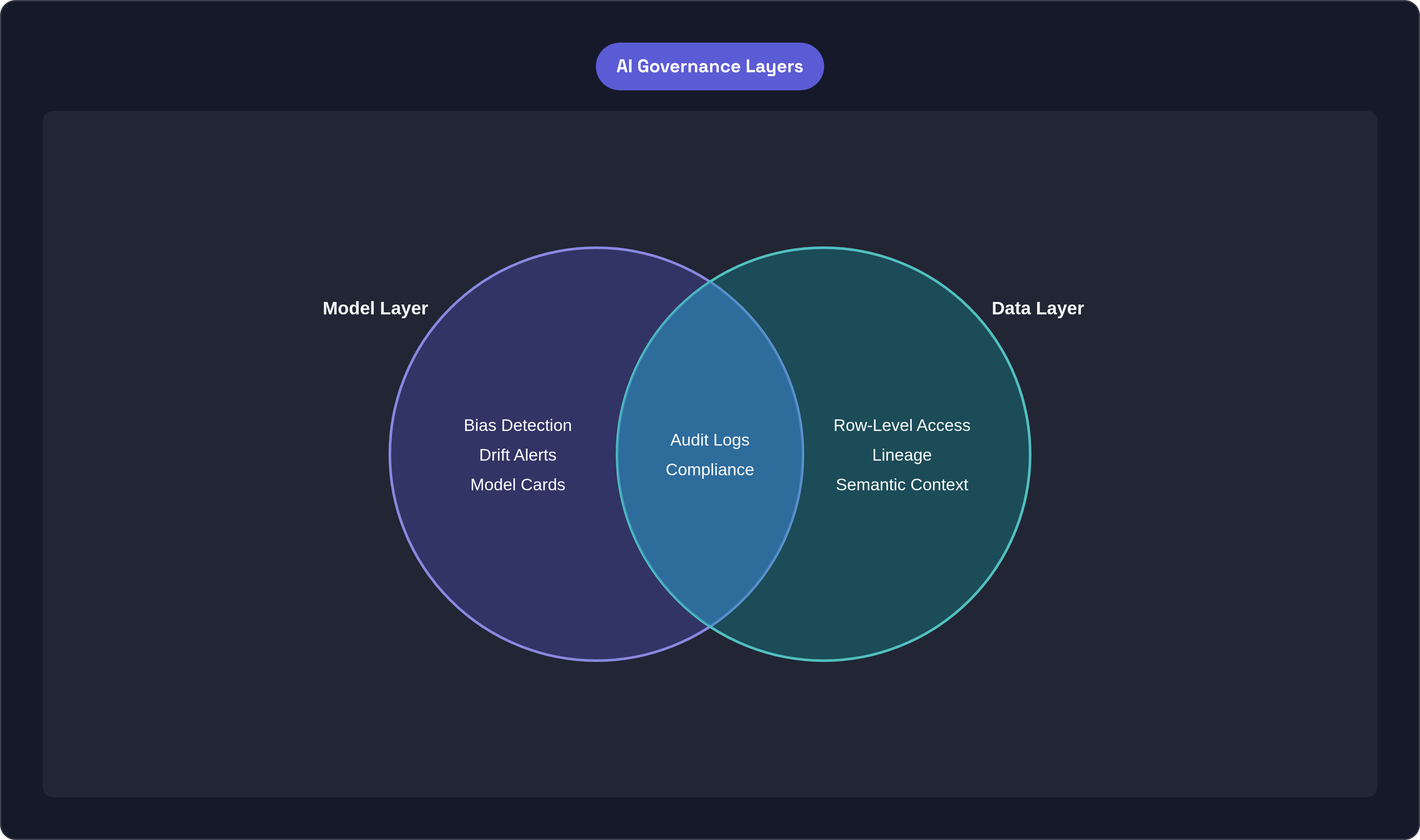
Model-layer governance applies controls during training, fine-tuning, evaluation, and post-deployment monitoring. Bias detection, fairness metrics, explainability outputs, model cards, version tracking. It operates largely before deployment or at the output observation level, which makes it indispensable for regulated industries that must demonstrate model behavior to an auditor. What it cannot do is control which data the model is allowed to access at runtime, or govern what the model does with data it was never trained to distrust.
Application-layer governance applies controls at the interface between the model and the user or downstream system. Prompt filtering, output scanning, rate limiting, content policy enforcement, interaction logging. AI gateways sit here: they intercept requests and responses, enforce content rules, and route traffic across models. These tools deploy fast and require no changes to underlying data infrastructure. The tradeoff is that governance depends entirely on every application routing through the gateway consistently, and the gateway cannot enforce what data the model is allowed to see before the model sees it.
Data-layer governance applies controls at the point where data is accessed, combined, and returned, before it reaches the model at all. Identity-scoped permissions, column-level and row-level access control, semantic context, data lineage, query-level audit logging. This is the only layer that can prevent a sensitive answer from being generated, because it stops the sensitive data from reaching the model before any generation occurs. The tradeoff is integration complexity; retrofitting this onto systems not designed for it takes real work.
Most enterprises need controls at more than one layer. The practical problem is that they buy at the layer easiest to sell internally, which is usually the application layer, rather than the layer where their actual risk lives. Gartner's essential capabilities framework for AI governance platforms, published in late 2025, spans all three: automated policy enforcement at runtime, comprehensive audit trails, and interoperability across systems. Few platforms deliver uniformly across all three, and most vendors aren't eager to tell you where their coverage stops.
Model-Layer Platforms: What They Govern and Where They Stop
Representative platforms here include IBM Watson AI Factsheets, Fiddler AI, Arthur AI, the model monitoring dimensions of Weights & Biases, and Amazon SageMaker Model Monitor. The shared architecture: instrument the model, observe its behavior, produce documentation about that behavior.
The core capabilities are genuinely useful, worth being specific about. Bias and fairness detection across protected attributes, during training and through ongoing drift monitoring, is something regulated industries cannot operate without. Explainability outputs, including feature importance scores and counterfactual explanations, satisfy documentation requirements that regulators increasingly demand. Model cards and AI FactSheets record training data provenance, intended use, and known limitations in formats that survive audits. Drift detection alerts teams when production inputs diverge from the training distribution in ways that degrade output quality.
For specific use cases, model-layer governance is the right primary investment. Credit scoring, insurance underwriting, clinical decision support: these operate in regulatory environments where the regulator explicitly requires documented model behavior. The EU AI Act's Article 10 obligations for high-risk systems, taking force in August 2026, require training data documentation, and model-layer tools are the natural instrument for that obligation.
The scope, though, is real and worth naming plainly. These tools govern what was true at training time and what is observable in outputs. They do not control which data the model queries at runtime. They do not enforce who is allowed to see which results. An enterprise that governs only at the model layer has produced careful documentation of its model while leaving its data access entirely ungoverned. Under regulatory frameworks that care about data handling, not just model behavior, that is a compliance gap, not a governance program.
Application-Layer Platforms and AI Gateways: Fast Deployment, Bounded Authority
This is the fastest-growing category by deployment volume, and the speed is the point. Gartner projects that by 2028, 70% of software engineering teams building multimodel applications will use AI gateways. That number reflects something real about how organizations actually make purchasing decisions: application-layer tools are fast to procure, fast to configure, and require no changes to upstream data infrastructure. In an environment where AI deployment timelines are measured in weeks, not quarters, that operational reality drives purchasing decisions whether or not it aligns with where the risk actually lives.
Representative platforms include AWS Bedrock Guardrails, Azure AI Content Safety, Apigee with AI extensions, Portkey, Kong AI Gateway, and the observability dimensions of LangSmith. Each operates inline between the application and the model.
The core capabilities address legitimate problems. Prompt filtering blocks or modifies inputs containing sensitive content, PII, or off-topic requests before they reach the model. Output scanning catches hallucinated citations, policy violations, or blocked content categories before delivery to the end user. Traffic routing directs requests to different models based on cost, latency, or capability, which matters as multimodel environments become the norm. Interaction logging captures prompt and response pairs for audit and post-hoc review.
Here's the architectural reality, though, and it isn't a vendor failing: a gateway logs that a query was made and what the response was; it does not log which tables were joined, which rows were returned, or whether the combination of two fields created a sensitivity that neither field carried individually. Permissions enforced at the gateway level are typically broad service-account permissions, not the actual end user's entitlements. The gateway sees a request; it does not know who the real requester is or what they are actually authorized to access. And a workload that bypasses the gateway entirely is invisible to the governance layer. That's not an edge case in most enterprise environments. That's Tuesday.
Application-layer governance handles the surface of the interaction. The data underneath that surface remains ungoverned, and in most enterprise environments, that is precisely where the actual exposure lives.
Data-Layer Governance: What It Means to Enforce Control Before the Model Sees the Data
Data-layer governance operates at a different point in time than the other two layers, and that timing is the entire argument for it. Policy is evaluated as the query executes. A result set that would expose restricted data to the wrong user is simply never returned. There is no output to scan because the output was never generated. Prevention, not detection. In other words, it's the difference between a bouncer who checks IDs at the door and a security camera that records who walked in after the fact.
Fine-grained access control is the foundation: role-based and attribute-based controls with row-level and column-level security, evaluated against the actual requesting identity rather than a service account's broad permissions. The enterprise problem this addresses is pervasive. Access policies written per platform, per account, per team produce inconsistency, over-permissioning, and compliance gaps that only surface during audits. By the time an audit surfaces them, the exposure has usually already occurred.
The combination problem deserves its own attention because it is the risk that only data-layer governance is positioned to address. Two fields that are individually non-sensitive can become a privacy violation when joined. Name plus location plus timestamp can constitute identification even if none of the three fields is marked sensitive in isolation. No model-layer or application-layer tool evaluates that risk before the answer is generated, because both layers receive data after the join has already occurred. Data-layer governance is the only architectural position from which the combination itself can be restricted before anything reaches the model.
Semantic context is a governance requirement at this layer, not a nice-to-have. AI agents have no institutional memory. A column named "rev" is ambiguous — it reads as revenue, revision, or review depending on context. Without embedded definitions, the agent infers; and inference at query volume produces plausible-sounding errors that are difficult to detect and expensive to correct. Gartner elevated the semantic layer to essential infrastructure in the 2025 Hype Cycle for Business Intelligence and Analytics. Reporting from BigDATAwire indicates that roughly 40% of enterprise leaders now identify the absence of semantic context as a major blocker for operational AI. Google's internal testing showed that LookML, its semantic modeling layer, reduces data errors in generative AI natural language queries by as much as two-thirds. That's not a theoretical argument about architecture; that's a concrete signal about what semantic context actually does to output quality when it's missing.
The Open Semantic Interchange standard, developed collaboratively by dbt Labs, Snowflake, and Salesforce in 2025, formalizes metric definitions in a vendor-neutral YAML format. The practical value: an organization defines what "revenue" means once, and every connected tool inherits that definition. The proliferation of tool-specific semantic definitions has been one of the more persistent sources of inconsistency in enterprise data environments, and OSI is a direct response to exactly that problem.
Audit logging at the data layer captures what no other layer can: which data was accessed, by which identity, through which query path, producing which result. That lineage matters at agent-level query volume in ways that application-layer logs simply do not, because it traces causation rather than just observation. Only 7% of enterprises claim to have AI-ready data, per Fluree's analysis. Data-layer governance is a near-universal gap, not a solved problem organizations can assume their infrastructure has already addressed.
How Specific Platforms Position Across These Layers in Practice
This is a structured scan by layer emphasis, not a ranking. The point is understanding where each platform enforces control, because that determines what it can and cannot govern.
Model-Layer Primary Platforms
IBM Watson AI Factsheets provides bias monitoring, explainability documentation, and model lifecycle tracking. Strong on auditability of model behavior, designed for regulated industries that need to demonstrate compliance with documentation-based obligations. Runtime data access control is outside its scope by design.
Fiddler AI specializes in production model monitoring, drift detection, and explainability output. Its governance is observational at the output level: it tells you what the model did, not what data it accessed or combined to produce that output.
Application-Layer Primary Platforms
AWS Bedrock Guardrails provides prompt and output filtering, content classification, and PII detection inline. It sits between the model and the application, not between the data and the model. Its governance surface is the interaction layer.
Azure AI Content Safety handles content moderation and harm classification at the API layer, useful for output governance and content policy enforcement; its data provenance visibility is limited by design.
Apigee with AI extensions provides API-level traffic governance, rate limiting, and policy enforcement. Comprehensive at the application interface, absent at the data access level.
Platforms with Meaningful Data-Layer or Semantic-Layer Coverage
Collibra operates as a data catalog with business glossary and policy enforcement tied to metadata. It can auto-generate a semantic layer connecting physical data to business terms and integrates with the OSI standard. Its strongest capabilities are in discovery and classification; policy enforcement depends on integration with the underlying data platforms where access is actually granted.
Alation provides a data catalog with governance workflows and active policy enforcement tied to stewardship assignments. It is metadata-centric and well-suited to organizations that need to operationalize data governance through human stewardship processes rather than automated enforcement.
Atlan positions on a unified policy center with real-time enforcement across the data stack and an open-by-design architecture oriented toward interoperability. It targets the fragmented-policy problem directly, which is the condition most large enterprises actually find themselves in.
Databricks Unity Catalog delivers fine-grained access control at the row, column, and table levels, unified across the lakehouse, with lineage tracking native to the platform. Strong within the Databricks ecosystem; portability to environments outside that ecosystem is more limited. Databricks Metric Views, announced in 2025 and approaching general availability in early 2026, adds a native semantic layer for the lakehouse.
Microsoft Fabric IQ extends Power BI semantic definitions into a broader connected context supporting both analytics and AI workloads. Its semantic coverage is strongest for organizations already operating within the Microsoft stack, and that concentration is both its coherence and its constraint.
AtScale functions as a universal semantic layer engine, providing consistent and reproducible metric definitions across tools regardless of underlying storage. It addresses tool-specific semantic fragmentation directly, without requiring organizations to consolidate onto a single data platform.
The question every organization eventually has to answer is which layer maps to the risk they are actually carrying. Model-layer tools govern what the model was and what it produced. Application-layer tools govern the surface of the interaction. Data-layer tools govern what the model is allowed to see in the first place. All three address real risk. Buying governance at the wrong layer doesn't mean you've invested in safety; it means you've invested in documentation that gives the appearance of safety, which, depending on what goes wrong, can be worse than having no program at all.