Federated Data Access for AI Workloads
Federated queries fail silently when schemas drift unless a semantic layer governs what data means.

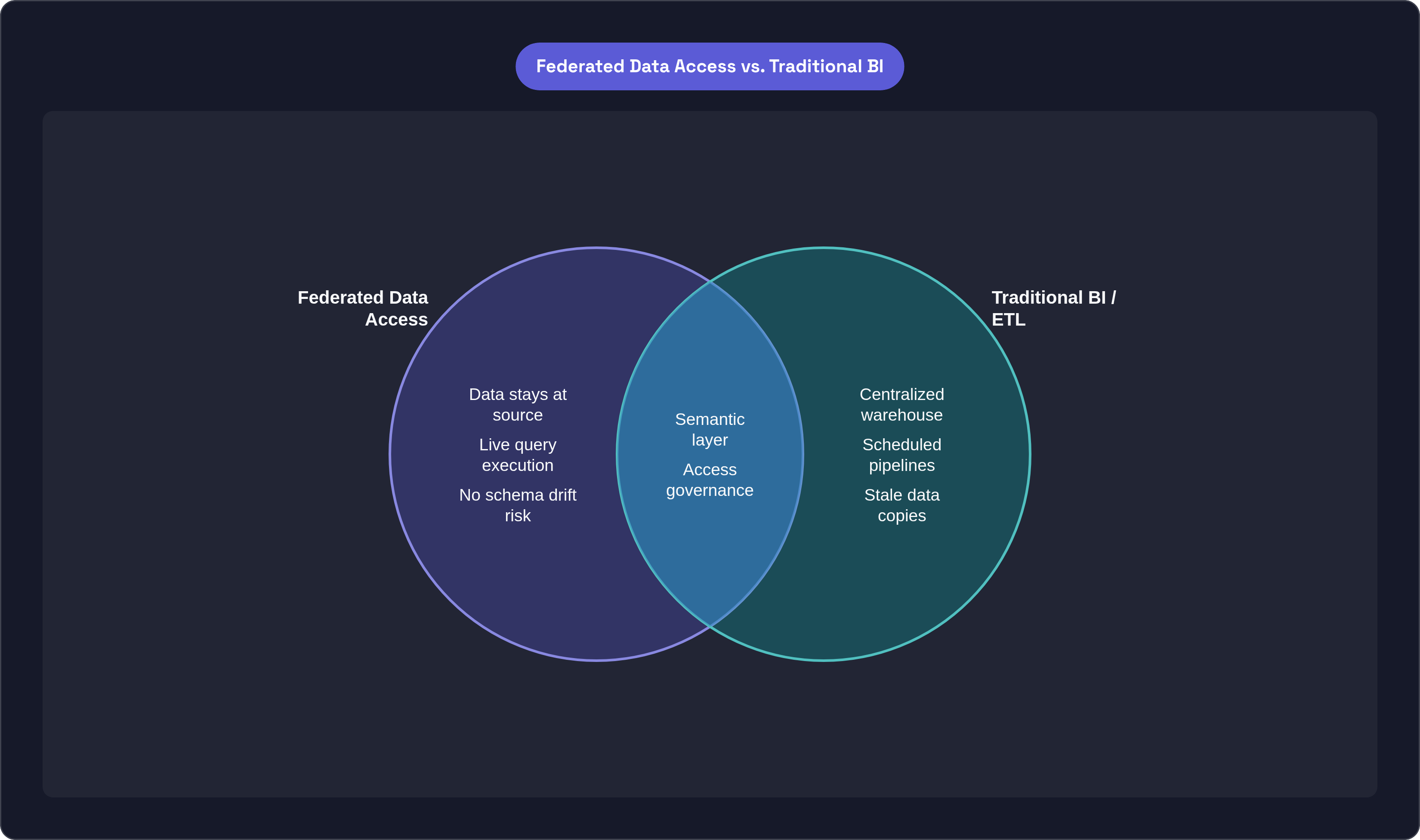
Federated data access means querying data across distributed systems (Salesforce, Snowflake, PostgreSQL, SharePoint) without physically moving any of it into a central repository. The federation layer issues queries to each source simultaneously and returns unified results. The data stays where it lives.
That definition sounds clean. In practice, the term gets stretched to cover at least two other things it has nothing to do with. Federated learning trains models locally on distributed data without centralizing it. That is a model-training architecture with its own distinct constraints, entirely unrelated to querying live data for operational decisions. The two share a word and nothing else, and conflating them in a vendor conversation will waste everyone's time.
It is also not an ETL pipeline. A pipeline moves data from sources into a destination on a schedule. That copy goes stale. Schema changes upstream break it. Federated access has none of those failure modes because there is no copy to drift. Each query hits the source directly.
What federation preserves is data locality and freshness by default: a single source of truth in each originating system. What it demands is a query layer capable of translating requests across heterogeneous schemas and returning results that are semantically consistent, not merely structurally assembled. That second requirement is where most implementations stop short.
For agentic workloads specifically, schema drift stops being a theoretical concern very quickly. Source schemas shift without warning. An agent that ran a query yesterday against one schema receives structurally valid results today against a modified one and never knows the field it relied on was renamed or deprecated. A static pipeline fails loudly in that scenario; you get an error, someone investigates. A live query layer against a drifted schema fails silently, producing answers that are wrong in ways nobody catches until downstream damage surfaces. Graceful handling of that condition requires considerably more than routing.
Why AI Workloads Stress Federated Architectures in Ways Traditional BI Never Did
A human analyst querying a data warehouse knows things that are nowhere in the schema. They know which table actually holds revenue, which date field defines Q3, that "closed won" in the CRM maps to recognized revenue in the finance system after a 30-day lag. That institutional knowledge accumulated over years of frustrating experience: wrong reports, uncomfortable conversations with finance, eventual corrections. It lives entirely in the analyst's head, and it is genuinely valuable precisely because it took that long to acquire.
An AI agent has none of it. An LLM generating SQL against a raw schema infers meaning from column names and table structure, and it infers incorrectly at rates that matter operationally. AtScale's internal testing found LLM query accuracy improved from roughly 40% without a semantic layer to over 83% when models were grounded in governed semantic definitions. I treat that specific figure with some caution since it emerged from a vendor context, but the directional finding matches what you see in practice: the raw schema is not a sufficient interface for an automated consumer. Human analysts compensated for its inadequacy through accumulated expertise that nobody ever had to document, because documenting it was never necessary when the consumer was human.
Agentic workloads introduce two compounding pressures beyond accuracy. The first is volume. A single agent can trigger queries across warehouses, vector stores, and SaaS APIs in seconds, generating a volume of access events that access controls designed for human-paced requests simply were not built to handle. Gartner projects that 40% of enterprise applications will integrate task-specific AI agents by end of 2026, up from under 5% in 2025. That trajectory is steep enough that organizations treating agent governance as a future problem are already behind.
The second pressure is freshness tolerance, which changes entirely for operational AI. A dashboard snapshot 24 hours old is fine for a weekly business review. For an agent making a real-time pricing or routing decision, that same snapshot is already wrong in ways that affect the output. The latency assumptions baked into traditional BI architectures do not transfer. Both pressures converge on the same structural conclusion: the federation layer needs to carry semantic meaning, not just route queries, and governance cannot be retrofitted at the model layer after a query has already executed.
What the Semantic Layer Contributes to Federated Queries (and Why It Can't Be Skipped)
A semantic layer sits above the physical data sources and exposes what a human analyst would otherwise have had to know through years of accumulated experience: table descriptions, metric definitions, entity relationships, business logic. What does "sales" mean in this context, bookings or recognized revenue? Which date field defines Q3? How do these two tables join correctly without producing a Cartesian nightmare? The semantic layer answers those questions so the consuming system does not have to guess.
Without it, an agent answering "What were Q3 sales in Canada?" must independently infer the answer to each of those questions. Each inference is a potential error. Errors compound across a multi-step query in ways that are genuinely difficult to trace after the fact. Gartner elevated the semantic layer to essential infrastructure in the 2025 Hype Cycle for Business Intelligence and Analytics, and roughly 40% of enterprise leaders identify the absence of semantic context as a primary blocker for operational AI.
Google's LookML implementation in Looker demonstrated the concrete effect: grounding generative AI natural language queries in LookML's governed business logic reduced data errors by as much as two-thirds. The semantic layer did not make the AI smarter. It gave the AI something accurate to reason about. This distinction matters because organizations keep trying to solve semantic problems by upgrading models, and the models keep failing for the same structural reason: the problem was never model capability, it was the quality of the interface the model was reasoning against.
The Model Context Protocol, which emerged as a cross-vendor standard in 2025, reflects this same logic applied at ecosystem scale. Large enterprises standardizing MCP across Claude, GPT, and internal models are ensuring every AI system operating across their infrastructure shares a consistent understanding of what the data means, not just where it lives. Shared semantic foundation is infrastructure. Everything built on top of it performs better as a direct consequence.
Why Governance Enforced at Query Time Is Structurally Different from Governance Applied Elsewhere
Sixty-two percent of organizations cite lack of data governance as the primary challenge inhibiting AI initiatives, per 2025 research. The striking part of that figure is not that governance is neglected; most enterprises have governance programs. The problem is that the governance they have was designed for a fundamentally different access model.
Traditional enforcement happens at collection or ingestion. Access controls are set when data enters the warehouse. Permissions attach to service accounts, often with broad grants because the original use case was a batch pipeline that needed to read everything. That model was adequate for the workloads it was built around. Those workloads did not include autonomous agents generating hundreds of queries per minute under a shared credential.
Agentic AI breaks that model at a structural level. An agent operating under a service account can access data the end user behind the request would never be permitted to see directly. Sensitive data surfaces in a model's context window, shaping an answer, without the user ever touching the source file. That exposure is invisible to conventional audit. The log says "query executed." Nobody knows what was actually assembled, what went into the context, or what informed the output the user received.
Gartner projects that by 2028, 50% of organizations will implement a zero-trust posture for data governance specifically in response to AI-generated data proliferation. Zero-trust applied here means permissions are evaluated at the moment of query execution, scoped to the actual end user's identity, not inherited from a shared credential established hours or days earlier. That is the only access model that remains enforceable when agents are generating queries autonomously.
There is a further problem that field-level controls in source systems cannot catch. Individual fields can each be innocuous. Name from one source, diagnosis code from another, employment status from a third: none of those fields alone triggers a governance flag, but the federated join assembles them into a record that is unambiguously sensitive. The federation layer is the only point in the architecture where that combination exists, and therefore the only point where its sensitivity can be evaluated. Delegating that evaluation to the individual source systems is not a governance strategy; it is an assumption that the dangerous combination will never occur. It will occur.
Audit logs at this layer must capture identity, intent, and lineage together. At the query volumes that agentic workloads generate, a log that records only that a query executed is functionally useless for investigation or compliance.
How Federated Governance Has Been Implemented at Scale (and What Those Implementations Reveal)
The German National Emergency Department Data Registry is one of the more instructive examples of federated governance running at real scale. Data from 58 emergency departments, spanning 2017 through 2024, was made accessible across more than 7.9 million records. Seventy-five percent of data access queries were authorized within 15 days. The data never left the individual departments. Policy was defined centrally; execution remained local. Domain teams kept ownership of their data while conforming to shared access and quality standards.
What made it work was not a particular technology choice. It was the design philosophy: centralized policy, distributed execution, no consolidation required. The architecture assumed data would stay where it lived and built governance accordingly, rather than treating centralization as a prerequisite for control.
The Cloud Security Alliance's Agentic Trust Framework, published in early 2026, formalizes a related principle for AI specifically: graduated autonomy. Rather than treating agent access as binary, the framework defines four maturity levels through which agents earn greater autonomy by demonstrating trustworthiness across prior interactions. Governance requirements scale with that progression. This matters because write actions carry a categorically different risk profile than reads. A misconfigured agent reading the wrong data produces a bad answer; annoying, sometimes costly. A misconfigured agent writing back to an operational system causes damage that can propagate for hours before anyone notices it happened.
Every organization that has successfully run federated governance at scale made the same foundational choice early: governance as a structural property of the query layer, not something added to a finished architecture. The organizations that tried to retrofit it discovered, painfully, that retrofitting is not the same thing as building it in. You can retrofit a lock onto a door. You cannot retrofit a load-bearing wall.
Where Most Enterprises Currently Are (and Why the Gap Produces Stalled AI Projects)
Eighty-one percent of enterprises have delayed, scaled back, or abandoned at least one AI initiative in the past 12 months. The average enterprise had three stalled projects in that period, according to a 2026 survey of more than 200 senior IT and business leaders. Ninety-three percent of those respondents reported that data permission or governance issues surfaced at some point during the AI project lifecycle.
The failure pattern is consistent enough to describe without looking at the data. Teams select a use case, begin building, and discover mid-project that the data required is inaccessible, ungoverned, or semantically inconsistent across the sources the use case depends on. The use case was selected before anyone verified that data, governance, and infrastructure requirements were actually in place. By the time the discovery happens, the team has sunk months of effort and is now facing a choice between a long remediation project or a scaled-back scope that no longer justifies the original business case. Only 14% of organizations currently have systems ready for agentic AI deployment, with data architecture cited as the primary bottleneck.
Two responses dominate, and both fail in predictable ways. The first is layering AI tooling on top of existing data chaos, which adds complexity without resolving the underlying access and governance problems. The second is consolidating all data into a central warehouse first, a multi-year infrastructure undertaking that blocks AI deployment in the meantime and is not even feasible where regulatory or contractual data residency requirements apply. Gartner projects that 80% of data and analytics governance initiatives will fail by 2027, not because organizations neglect governance, but because they implement it reactively rather than as a foundational property of the architecture.
Federation avoids the consolidation bottleneck. But federation only works for AI if the layer is built for AI consumption from the start, and that is the condition most current deployments fail to meet. Organizations that already have federated architectures and are still finding their AI projects stalled have usually discovered this firsthand.
What a Federation Layer Built for AI Workloads Needs to Include
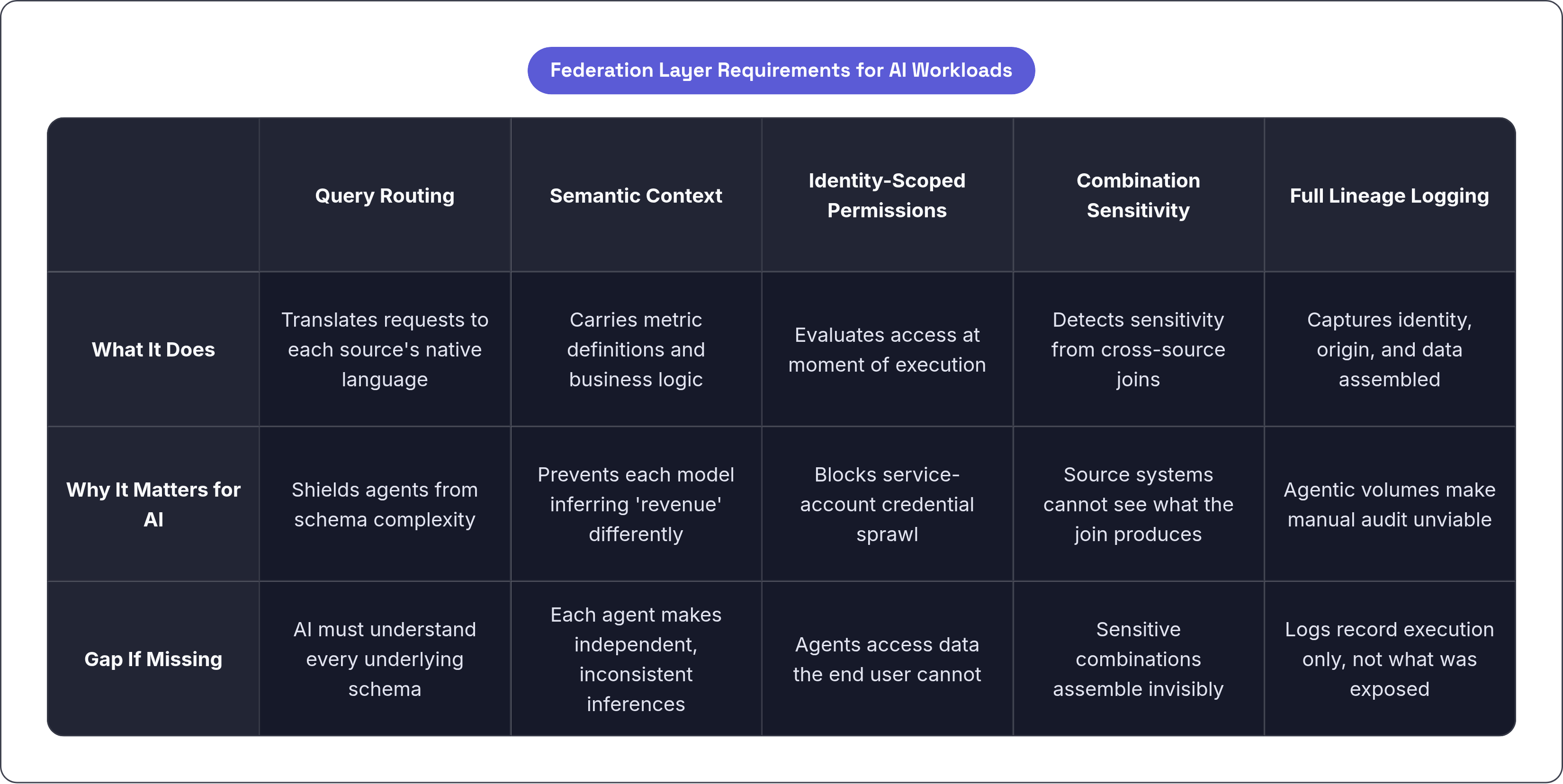
The requirements here are specific, and none of them are speculative. The components exist. The question is whether they are assembled with AI consumption as the actual design objective, or assembled for the BI use cases that preceded AI and then handed to AI teams with the expectation that they will adapt.
Query routing across heterogeneous sources is the baseline: translating requests into the native query language of each source, assembling results without requiring the consuming AI system to understand the underlying schema. Most federation tools do this adequately. It is necessary and, by itself, insufficient.
Semantic context must be carried by the layer itself, not reconstructed independently by each consuming model. Table descriptions, metric definitions, relationships, business logic: all of it travels with the data interface, defined once, available to every AI system querying through the layer. This is what prevents each new model or agent from making its own inferences about what "revenue" means, and then making those inferences differently from the model that ran the same query last week.
Identity-scoped permissions must be evaluated at query time. Every query executes under the real end user's identity. Access is determined at the moment of execution, not inherited from a service account or cached from an earlier authorization check. This is the structural change that makes governance enforceable when agents are generating queries autonomously.
Combination-level sensitivity evaluation must operate at the federation layer, because that is the only point in the architecture where the combination exists. Source systems cannot see what the join produces. Delegating sensitivity evaluation to them is not an alternative.
Full lineage logging must be automated and must capture who asked, what agent or system originated the request, and what data was assembled in response. At agentic query volumes, manual audit is not operationally viable, and a log that records only execution timestamps is not an audit trail in any meaningful sense.
Live query execution is non-negotiable for operational AI. There is no maintained copy to go stale because there is no copy. The freshness requirement is met by design, not by scheduling.
And the architecture must operate without a migration prerequisite. Existing warehouses, SaaS tools, and operational databases stay in place. The federation layer provides the unified, semantically coherent, governed interface they were missing. The data does not move to meet the architecture; the architecture meets the data where it is.
The organizations closing this gap are doing so by treating semantic context and query-time governance as first-order requirements from the beginning, not as problems to solve once the interesting AI work is underway. The ones treating them as later problems are the ones generating the 81% statistic.