Semantic Layer Implementation on Snowflake
A governed, queryable object that replaces scattered definitions with one source of truth.

What a Semantic Layer Actually Is and What It Adds to Snowflake Specifically
The default Snowflake setup is indifferent to what your data means. Schemas, tables, views: all accessible, all queryable, none of it interpretable. A column called "revenue" means something different to finance than it does to sales, and nothing in the raw schema adjudicates that disagreement. The semantic layer is the infrastructure that fixes this. The reason it took the industry so long to treat it as essential rather than optional is that the pain was distributed. Finance blamed sales for using the wrong numbers. Sales blamed finance for moving the goalposts. Nobody blamed the schema.
Inside Snowflake's model, meaning flows through three component types. Metrics are quantifiable measures calculated by aggregating facts: Total Revenue, Profit Margin Percentage, Monthly Active Users, expressed as formulas the layer enforces consistently. Dimensions are categorical attributes that give metrics context, the who, what, where, and when. Purchase date, customer segment, product category: dimensions are how you slice a metric without rewriting it from scratch. Facts are row-level attributes representing specific business events before aggregation happens, an individual sale amount, a quantity purchased.
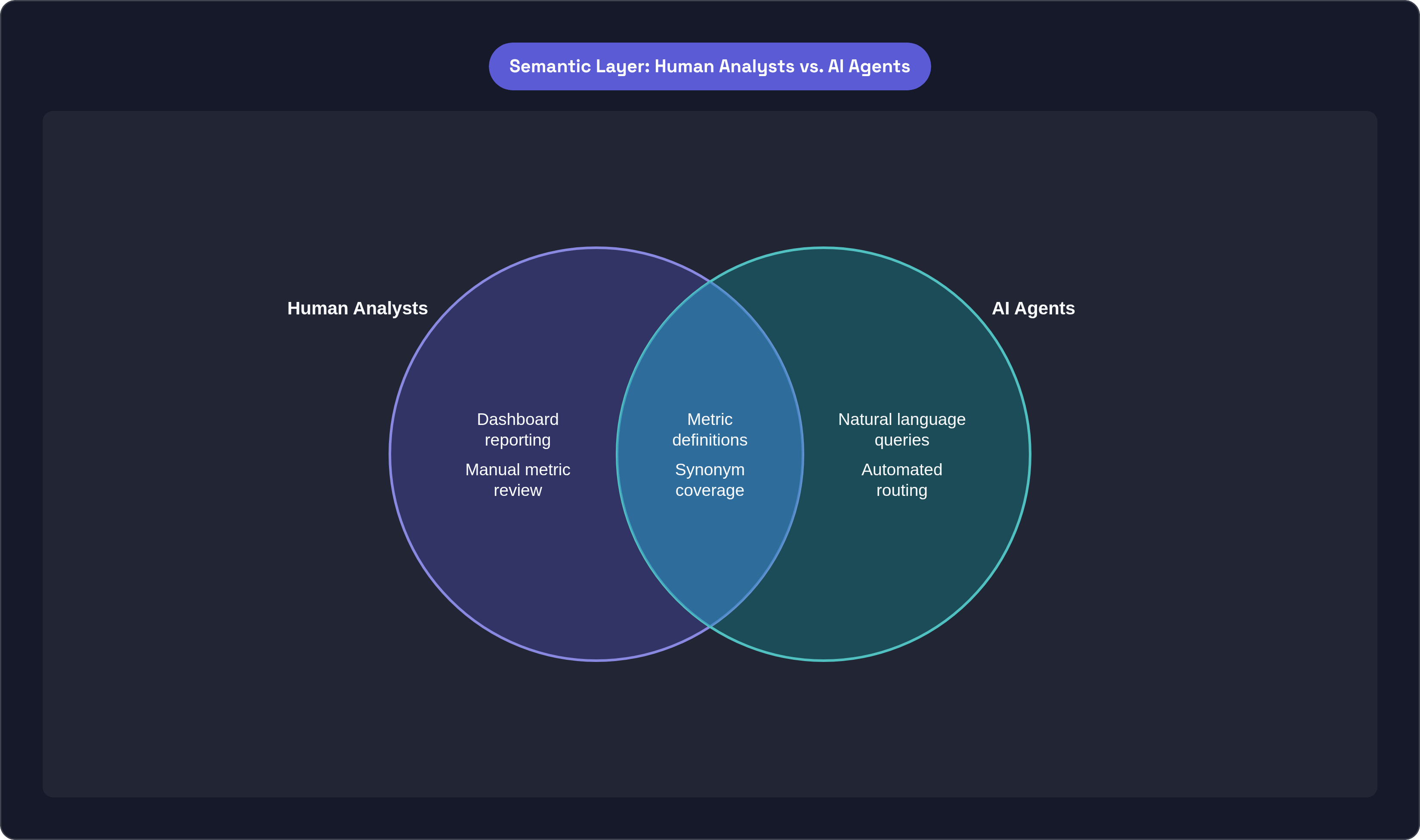
What the semantic layer adds to Snowflake specifically is a location where these definitions live natively in the database, versioned and governed like any other schema object. Not a documentation wiki sitting somewhere adjacent to the warehouse. A queryable, governed object that both human analysts and AI agents consume directly.
GigaOm classified the semantic layer category as mature for the first time in its 2025 Radar for Semantic Layers and Metric Stores. The category moved because the problem it solves became unavoidable, not because the tooling got flashier.
The ambiguity problem plays out in two distinct failure modes. For human analysts: finance calculates ARR one way, sales calculates it another, and both query the same tables, reach different numbers, and trust neither. Dashboards proliferate. Metric definitions drift between reports until nobody can say with confidence which number is right. For AI consumers, the failure is different but more dangerous. An LLM generating SQL against an opaque schema has no way to know what a business term means, and a stale or wrong answer looks identical to a correct one. Atlan's 2026 State of Data and AI report found SQL generation accuracy improved 3x on complex or ambiguous queries when business definitions and schema context were combined. The gap is largest exactly where it hurts most: queries whose correct interpretation depends on knowing what a term means, rather than just what a column is named.
How Snowflake's Native Semantic Views Work and How They Differ from the Earlier YAML Approach
Snowflake has shipped two generations of semantic modeling, and if you built on the first one, the architectural difference matters more than the feature delta.
The first generation arrived with Cortex Analyst in Q3 2024: YAML semantic model files stored in a Snowflake stage. The model lived outside the database. Any role with access to the stage could read the semantic model even without SELECT privileges on the underlying tables. That wasn't a bug anyone filed; it was a structural consequence of a file living outside the database's access control perimeter. A file sitting in a stage is not a schema object, it doesn't inherit role-based access control naturally, and it requires ongoing manual coordination to stay in sync with the tables it describes. Anyone who tried to govern that setup at scale knows what the maintenance load looks like.
Native Semantic Views, generally available at Snowflake Summit 2025, close that gap. A Semantic View is a first-class schema object created with SQL using CREATE SEMANTIC VIEW, or through the Snowsight visual wizard. It stores table relationships, metric definitions, dimension definitions, synonyms, sample values, verified queries, and custom instructions, all in one governed object. Access control reduces to a familiar primitive: GRANT SELECT on the semantic view. The view itself becomes the enforcement boundary.
The consumption surface is broad by design. Semantic Views feed Cortex Analyst natural-language queries, BI clients, Streamlit applications, Workspaces, Notebooks, and custom applications. One definition, many consumers, no parallel models diverging over time.
At Snowflake Summit 2026, the tooling extended further. Semantic Studio, a visual modeling interface, entered private preview. An XMLA Endpoint powered by AtScale, connecting Power BI and Excel to the same governed semantic view definitions, entered private preview. Advanced Semantics, supporting level-of-detail calculations and composable metric definitions, entered private preview as well. Semantic View Autopilot can generate semantic view drafts automatically from existing SQL, Tableau, or Power BI files. That output is a useful starting point. It is not production-ready until someone has reviewed every metric definition against known-correct reference queries, and that review takes longer than most teams budget for it.
Building a Semantic View: The Decisions That Determine Whether It Actually Works
Start by identifying which business concepts actually need definitions. Not every column in your schema needs semantic enrichment. The ones that do: metrics that drive decisions, and dimensions shared across teams where inconsistent definitions have already caused disagreement. If you lack a list of those yet, ask the people who spend the most time in Excel reconciling dashboards. They know exactly which fields are contested.
Define metrics in the right order. Write the business definition first: what does "active customer" mean for this organization? Does it mean anyone who logged in this month, placed an order, or paid an invoice? That question needs a specific answer before you write the SQL expression. Reversing the order, reverse-engineering a definition from a column name, produces a metric that is technically valid and semantically wrong. This is the most common error in semantic layer implementation, and it reproduces the exact ambiguity the layer was meant to eliminate.
Model relationships explicitly. Semantic views capture how tables join, but you must declare those relationships. Undeclared joins force the AI or BI tool to infer the join path, which reintroduces the same hallucination risk the semantic layer exists to prevent. If the join is important enough to query, it is important enough to declare.
Synonyms and sample values are the signals Cortex Analyst uses to match a user's natural-language phrasing to the correct metric. A metric named "net_arr" needs "annual recurring revenue" and "ARR" as synonyms to be reliably found when someone asks a question in plain language. Real users do not phrase questions the way data engineers name columns; this is not a hypothesis, it is the default. Without synonym coverage, the layer fails at exactly the moment an unfamiliar user or an AI agent phrases a question differently than the metric's technical name.
Verified queries are pre-validated SQL examples stored in the semantic view. They anchor AI-generated responses to known-correct patterns. For high-stakes or frequently asked questions, these are the mechanism by which the semantic view delivers consistent, auditable answers rather than plausible-sounding ones. That distinction, between consistent and auditable versus plausible-sounding, is the whole game when you are deploying AI agents against financial data.
Access modifiers, the distinction between public and private facts and metrics, determine which measures are exposed to downstream consumers and which remain internal to the model. Leaving everything public by default exposes intermediate calculation logic that downstream consumers should never see. This decision involves business owners, not just data engineers, and it usually surfaces disagreements that were always present but never formally resolved.
Custom instructions are prose guidance embedded in the semantic view, telling Cortex Analyst how to handle edge cases, business-specific logic, or metric nuances that cannot be captured in a formula. Write those instructions for the hard cases specifically; those are the cases where an agent without guidance will produce a confidently wrong answer.
The maintenance question is the one nobody wants to answer. Semantic views cross the boundary between IT and the business, and responsibility for curation must be assigned explicitly. A semantic view with no designated owner drifts. Within a quarter, its metric definitions may no longer match the business reality they were meant to represent. A drifted semantic layer is more dangerous than no semantic layer: it delivers wrong answers at scale, with confidence.
How Permissions Flow Through a Semantic View and Why the Enforcement Point Matters
Snowflake Semantic Views integrate with role-based access control natively. SQL queries generated by Cortex Analyst execute under the querying user's role, not a service account with broad permissions. This is what makes enterprise deployment safe, and it has a direct implication for how you structure access.
Design RBAC around the semantic view as a schema object from the start. GRANT SELECT on the semantic view at that level. Do not attempt to manage access by restricting the underlying tables after the fact. The enforcement point is the query itself, at runtime, under the real user's identity. A role that should not see regional revenue data will not see it, even if a well-meaning AI agent requests it on that user's behalf.
The YAML-era architecture made this harder than it needed to be. Stage-based models granted implicit read access to anyone who could read the stage file, regardless of their table privileges. The semantic view eliminates this problem by making the view itself the access boundary. That is a meaningfully different security posture, not a marginal improvement.
One area that deserves specific attention: sensitivity at the combination level. A semantic view that joins two tables can expose data combinations that neither table reveals alone. Two columns that are individually innocuous can become a privacy problem when joined and filtered a certain way. Assess sensitivity on the view's output, not on its inputs in isolation.
Practical consequence: RBAC design for semantic views happens before the view is shared with any consumer, and it involves the same stakeholders who own the metric definitions. Access governance and semantic governance are not separate conversations.
Making the Semantic Layer Useful for AI Agents, Not Just BI Tools
Cortex Analyst reads the semantic view definition, then generates SQL against the physical tables directly. The semantic view is the grounding, not the execution target. The quality of the semantic view's definitions determines the quality of the SQL Cortex Analyst produces. A vague metric definition and a precise one can both produce SQL. Only one of them produces the right SQL.
Snowflake Intelligence, generally available as of November 2025, routes structured data questions through Cortex Analyst and semantic models. Unstructured questions route through Cortex Search. The semantic view determines which path a query takes. If the semantic view is incomplete or ambiguous, the routing degrades, and questions that should produce a precise metric calculation instead wander into unstructured search territory.
What an AI agent cannot infer from schema alone: which of two date columns is the reporting date versus the transaction date; what "churn" means for this organization specifically; which revenue line to use for executive reporting versus operational review. These distinctions must be encoded in the semantic view. Agents do not ask clarifying questions. They make a choice and return an answer, and if the semantic view does not specify, the agent will infer, and inference on ambiguous business logic is where the confident wrong answer lives.
The Atlan 2026 finding, a 3x accuracy improvement with embedded definitions on complex or ambiguous queries, is a direct argument for investing in synonym coverage and metric documentation, not just metric formulas. The formula is necessary. The surrounding context is what determines whether an agent finds the right metric when the question is phrased the way humans actually phrase questions.
On data residency: Cortex Analyst's default model boundary means Snowflake-hosted LLMs process queries, so no data, metadata, or prompts leave Snowflake's governance perimeter. For organizations with strict data residency requirements, this is a meaningful architectural property, not a footnote.
The XMLA endpoint announced at Summit 2026 extends the same principle to Power BI and Excel. One governed definition serves the analyst building a pivot table and the agent answering a natural-language question. Without this, parallel models accumulate, one in Power BI, one in the semantic view, one implied by the AI's behavior. They diverge. The metric inconsistency the semantic layer was supposed to solve reappears somewhere new.
Connecting the Semantic Layer to Snowflake's Broader Governance Infrastructure
A semantic view is only as trustworthy as the governance infrastructure around it. Snowflake Horizon Catalog, announced at Summit 2026, operates as the universal AI catalog: every person, tool, and AI agent operates from the same trusted business context via Horizon Context.
Horizon adds capabilities the semantic view itself does not provide. End-to-end lineage traces AI-generated answers back to their source tables, through the metric definition, to the underlying rows that produced the result. For AI consumers, this lineage is the difference between an auditable answer and a liability. When an agent produces a number and a finance leader asks where it came from, the answer needs to be traceable, not reconstructed from memory or rerun from scratch.
Data quality monitoring and AI guardrails detect and block sensitive data before it reaches users. PII detection functions where data surfaces, reducing the probability that a semantic view inadvertently exposes sensitive fields to unauthorized consumers, particularly through metric combinations that would not be flagged if each field were assessed in isolation. This is the combination-sensitivity problem showing up in a different part of the stack.
Classify data sensitivity before publishing any semantic view, and verify that Horizon's AI guardrails cover the field combinations the view exposes. Individual column classification is necessary; it is not sufficient.
Common Implementation Mistakes and How to Avoid Them
The most consequential mistake is building the semantic view to match the schema rather than the business. If metric definitions are reverse-engineered from column names, the layer reproduces the same ambiguity it was meant to eliminate, with more infrastructure overhead and considerably more misplaced confidence in the output. That misplaced confidence is what makes this mistake worse than having no semantic layer at all.
Skipping synonyms and verified queries because they feel like documentation overhead is the second most common failure. A semantic view without adequate synonym coverage fails on natural-language queries the moment phrasing deviates from the metric's technical name, which happens almost immediately once real users or agents start asking questions. The 3x accuracy improvement in the Atlan research comes from coverage, not better formulas. Synonyms and verified queries are that coverage.
Assigning ownership to data engineering alone, without involving business stakeholders, produces metric definitions the business doesn't recognize. Untrusted definitions don't get adopted, and they drift the moment the underlying business process changes because no one owns the reconciliation. The technical layer is fine; the organizational layer around it isn't. This pattern repeats across nearly every first implementation.
Treating Autopilot-generated or Semantic Studio-generated drafts as production-ready is a related problem. Those outputs are starting points. Validate every metric definition against known-correct reference queries before promoting anything to production consumers. The volume and confidence of AI-generated answers makes a validation gap much more damaging than it would be in a traditional BI context, where at least a human has to read the wrong number before acting on it.
Conflating the semantic layer with the BI tool's internal model defeats the purpose. Maintaining separate definitions in Tableau, Power BI, and a Snowflake Semantic View recreates the metric inconsistency the semantic layer was built to solve. The XMLA endpoint exists specifically to close that gap.
Leaving access modifiers at their defaults, public for everything, exposes internal calculation logic and intermediate measures to consumers who should only see finished metrics. This is a business decision that requires business owner input, and it should happen before the view is shared with anyone.
Finally, and most practically: failing to update the semantic view when business definitions change. A semantic view whose metric definitions no longer match current business reality delivers wrong answers confidently, at the scale and speed of an AI agent, to every consumer connected to the layer. The maintenance cadence must be defined, assigned, and enforced before the view reaches production. That is not a technical requirement. It is an organizational one, and it is the one most teams skip.