AI Readiness Assessment for Enterprise Data
AI systems need data structured for agents, not analysts—and they're fundamentally different.

What "AI-Ready Data" Actually Means, and Why It Differs From Clean Data
Clean data and AI-ready data are not the same thing. This is the first confusion most enterprise teams run into, and it costs them months they never recover.
The distinction most people miss is between BI-ready and AI-ready. Think of a well-maintained warehouse built for analysts and dashboards as a good map of a city — useful, but drawn for someone who already knows which streets are one-way. That analyst knows the "revenue" column in one system reflects gross figures, while in another it's net, after adjustments living in a spreadsheet nobody formally ingests. She learned that in her third week. An AI agent arrives with none of it, ever, and the gaps she quietly papers over become systematic errors that propagate at scale, invisibly and confidently.
A stale or semantically wrong answer from an AI system looks exactly as confident as a correct one. There is no hedge. It simply responds.
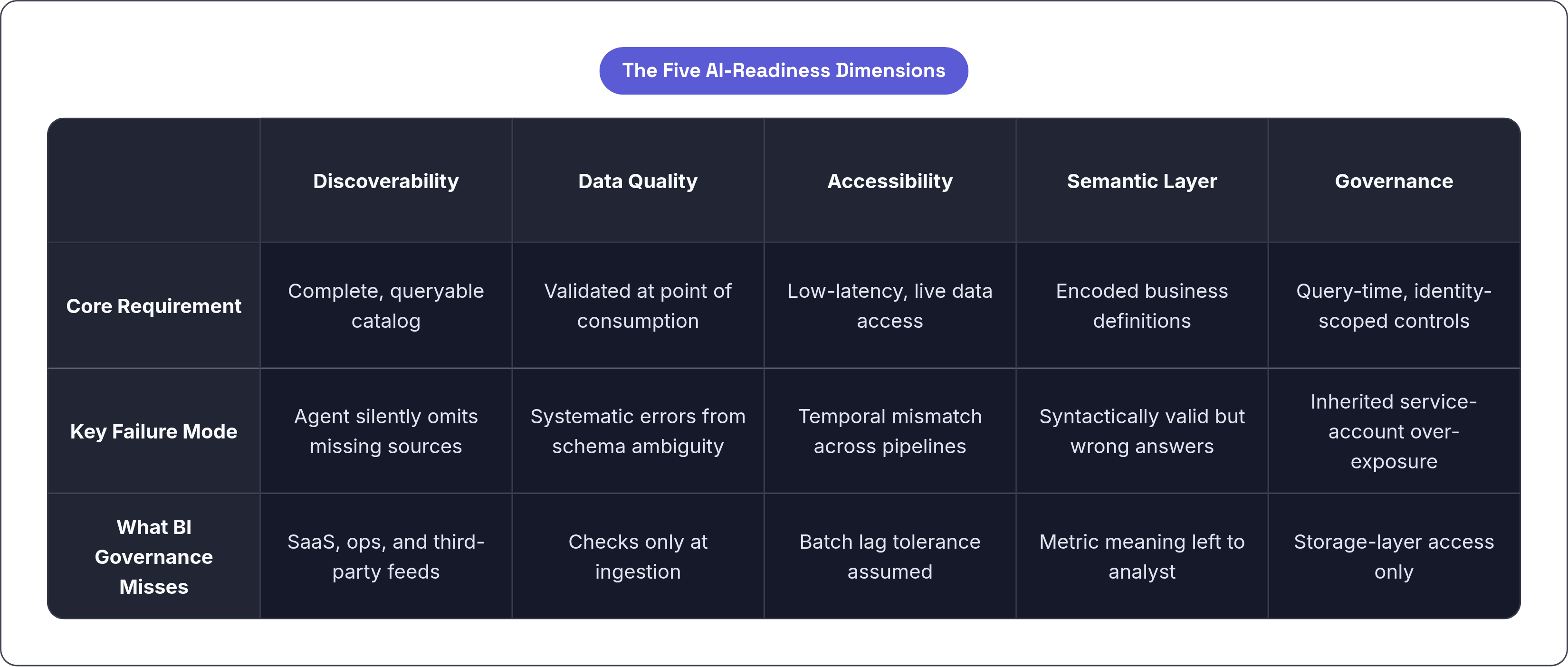
For data to genuinely support AI consumption, five conditions must hold simultaneously: discoverability, real-time accessibility, end-to-end governance, quality calibrated for AI rather than for ingestion, and a semantic layer so an agent can interpret what it retrieves the way the business actually intends. You cannot make data AI-ready in the abstract or in advance. You make it ready for something particular, for a specific workload touching specific sources asking specific questions. That framing alone dismantles the idea that a one-time hygiene project is adequate preparation. Each of the five conditions maps onto a distinct audit dimension, and any one of them can independently derail an initiative regardless of how solid the others look.
Data Discoverability and Catalog Completeness as the First Gate
The most straightforward way to surface a discoverability gap is to ask a single question: can an AI agent enumerate every data source relevant to a given business question without relying on what an engineer already hard-coded into its context window? If the answer is no, the catalog is not complete enough for AI workloads, regardless of how well it serves human analysts.
Discoverability failure is invisible right up until an agent actually needs a dataset. At that point, one of two things happens: the system either hallucinates an answer from whatever context it does have, or it silently omits an entire source without flagging the absence. Neither failure is obvious to the person receiving the output. Both erode trust in ways that are difficult to trace back to their root cause, because the output looks complete.
Catalog completeness means considerably more than a list of table names. Each registered entry needs a description of what the data actually represents, who owns it, what its known limitations are, and how it relates to adjacent datasets. The relationship mappings matter especially for AI workloads, which frequently need to join across multiple sources to answer a single question. A catalog that covers the warehouse but not SaaS tools, operational databases, or third-party feeds is, for agentic purposes, an incomplete map of the world. Agents, unlike analysts, do not go looking for what is missing. They work with what they can see.
Data Quality Dimensions That Matter for AI and How to Measure Them
Completeness, accuracy, consistency, and timeliness: these still matter. But they were conceived with human analysts in mind, and human analysts compensate for a great deal of data imperfection without realizing they're doing it. AI agents compensate for nothing.
Schema ambiguity is the canonical example. A column labeled "revenue" that means gross in one system and net in another, depending on which system generated the row, is a problem a skilled analyst navigates intuitively after a few weeks on the job. An AI agent running thousands of queries treats both values as equivalent and produces internally consistent answers that are factually wrong. The error is systematic rather than sporadic, which is precisely what makes it so difficult to catch: there is no obvious anomaly, no spike, no alert. Just quietly wrong outputs that look authoritative.
Quality must be measured at the point of AI consumption, not only at ingestion. A field that passes ingestion validation can still fail when joined with another source in a context the original validation never anticipated. Validating once at the front door and assuming validity persists through every downstream use is a structural limitation that compounds over time.
The checks worth running include null rates, duplicate key rates, referential integrity across joined sources, and distribution drift over time. That last one is underappreciated. If a feature distribution shifts, a model trained on earlier data is operating on assumptions that no longer hold, and nothing in most pipelines flags that drift as a problem.
Data contracts address this structurally: formal, programmatically enforced agreements specifying schema, expected distributions, allowable null rates, and what happens when the contract is violated. Most enterprises have rudimentary versions in the form of ingestion tests. What remains underdeveloped, almost universally, is treating those contracts as binding agreements between producers and consumers rather than as internal engineering guardrails that nobody enforces downstream. The producer ships data. The consumer assumes it matches what was agreed. It often does not.
One quality dimension that receives almost no attention in traditional governance is the sensitivity combination problem. Fields that are individually innocuous can become sensitive when joined across sources. A name in one table and a diagnosis code in another are each unremarkable in isolation; combined, they constitute protected health information. Quality governance must evaluate data at the point of combination, not only at the individual field level, which is a meaningfully different architectural requirement than most teams have built for.
Accessibility at Query Time: Why Batch Pipelines Fall Apart for AI Workloads
A data snapshot adequate for a morning dashboard is already stale for an agent making a decision right now. The acceptable lag between data generation and data availability differs enormously by use case, and batch pipelines were designed around a lag tolerance that most agentic workloads simply cannot accommodate.
The structural problem with static pipelines is that they assume stable schemas and predictable sources. AI agents operate against live, heterogeneous environments where schemas change and sources multiply without notice. A pipeline that ran correctly last week feeds an agent data reflecting a schema that no longer matches the source system, with nothing attached to signal the discrepancy.
Change Data Capture and streaming pipelines are the architectural answer for high-freshness requirements, propagating changes as they occur rather than on a schedule. But most enterprises have streaming infrastructure for only a subset of their systems, typically their highest-volume transactional sources, and fall back on batch for everything else. An AI workload joining across both categories is working with a temporal mismatch baked directly into its inputs. The agent does not know. The user does not know. The output still looks current.
There is also a permissions dimension to the access layer that organizations consistently underestimate. A service account with broad standing access to multiple systems effectively extends that access to any AI agent running against it — like handing a master key to every contractor who walks through the door. Permissions should be enforced at query time, scoped to the actual identity of the end user whose request triggered the query. Inheriting access from a service account that sees everything by design is not a governance posture; it is an exposure waiting to be discovered.
The Semantic Layer: Giving AI the Business Context It Cannot Infer From Schemas Alone
Without a semantic layer, AI agents produce syntactically valid answers to the wrong questions, and neither the agent nor the user can detect the error. A semantic layer gives an AI agent table and column descriptions, metric definitions, business rules, escalation logic, and relationship mappings. It encodes the institutional knowledge a human analyst has internalized over years, the knowledge an agent cannot infer from column names and data types alone. Without it, an agent generates syntactically valid SQL against the wrong definition of "revenue," "churn," or "active user." The query runs. The result looks plausible. The answer is wrong, and the wrongness is invisible to anyone who does not already know the correct answer.
The shortcut worth naming explicitly is skipping the semantic layer in favor of vector search, usually in the interest of moving faster. Vector search works well for demos. It breaks for enterprise queries requiring multi-hop reasoning or precise terminology, because vector similarity is not definitional precision. What looks like a time-saving decision in the pilot phase becomes a forced rebuild when the limitations surface in production, typically at the worst possible moment, typically when someone is relying on the output for something that matters.
The industry has begun converging on standards here. dbt Labs open-sourced MetricFlow as a way to define metrics once and apply them across tools. Snowflake formalized Open Semantic Interchange to allow metric definitions to move between platforms. The Model Context Protocol gives language models access to governed business logic rather than raw data, introducing traceability and consistency into workflows that previously had neither. These convergences reflect a shared diagnosis: metric definitions must be defined once, governed centrally, and applied everywhere. The organizations still defining "revenue" differently in three systems are building on sand.
The gap that persists is not a tooling shortage. Building and sustaining taxonomies and ontologies that categorize data elements and document their relationships remains underdeveloped in most enterprises, not because the tools are absent, but because it requires sustained investment and discipline that most organizations have not prioritized.
Governance: What It Must Cover That Traditional Controls Do Not
Traditional data governance enforced access rights at the storage layer. You could read a table or you could not. That model is insufficient for AI workloads because the critical control decisions do not arise only at storage. They arise at the point where content is retrieved, assembled, and generated, and most governance frameworks were never designed to operate there.
The questions worth asking in an audit are specific. Are permissions evaluated at query time, scoped to the actual end user, or inherited from a service account? Are those permissions revocable at the level of a single workload without disrupting shared infrastructure? Is every query logged with identity, intent, and lineage together, not just the query text in isolation?
Write actions taken by AI agents require stricter governance than read actions, and most current frameworks do not distinguish between the two. An agent that can update records, trigger downstream workflows, or initiate communications carries a fundamentally different risk profile than one that only retrieves information.
Audit logs that capture only what was queried, without capturing who queried it, under what permission scope, and as part of what business action, become functionally useless at agentic query volume. The volume is too high and too fast for manual review to function as a genuine control. Logs must be structured to support automated monitoring and anomaly detection from the start. Retrofitting that structure later, after an incident surfaces the gap, is an expensive way to learn an avoidable lesson.
Lineage must be end-to-end. An AI output is only as auditable as the chain from source data through transformation through model inference. Any break in that chain makes the output untraceable when an investigation requires accountability for a specific answer. Investigations will happen. The question is whether the infrastructure exists to support them when they do.
How to Run the Assessment: A Practical Sequence Across the Five Dimensions
The five dimensions are not a checklist you complete once and file away. They are ongoing conditions, any one of which can degrade independently as data sources change, schemas evolve, or new AI workloads get added. The assessment is a starting point for instrumentation, not a certification.
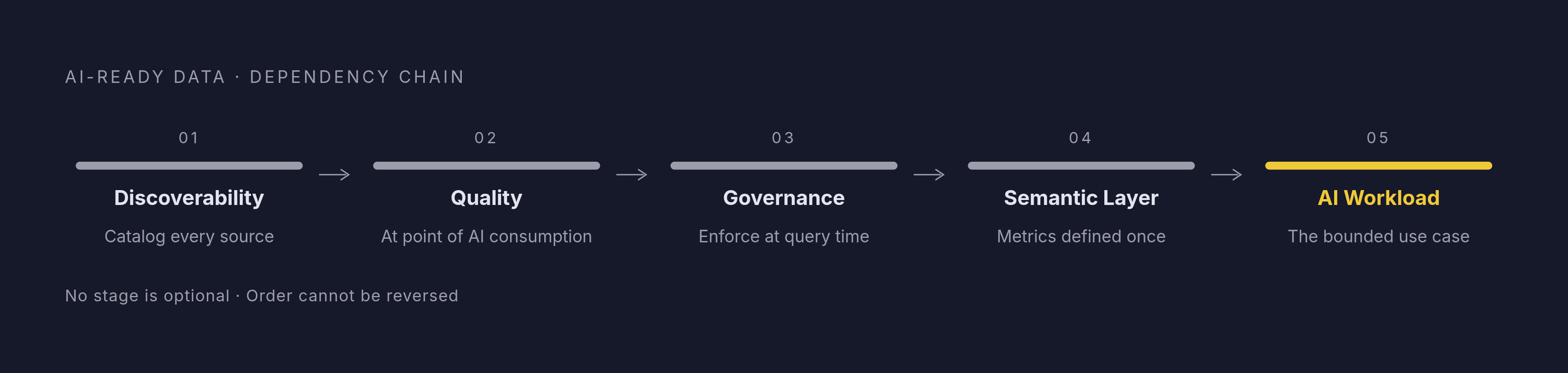
Sequence matters more than most teams expect. Discoverability must be established before quality can be measured comprehensively, because teams cannot assess the quality of data they do not know exists. Quality must be established before governance can be meaningfully enforced, because teams cannot govern data whose semantics and provenance are ambiguous. All of this must be in place before semantic enrichment delivers its full value, because a semantic layer built on top of undiscovered, inconsistent, or ungoverned data inherits every one of those problems directly.
Start with a bounded use case rather than the full enterprise data estate. Assess all five dimensions for the specific sources the first AI workload will actually touch. This keeps the assessment tractable and produces findings that are immediately actionable, rather than a landscape survey too broad to prioritize.
The finding that shows up most often is that organizations pass quality checks but fail on semantics. The data is clean by traditional measures; its meaning is simply undocumented. Agents produce answers that are internally consistent but wrong relative to how the business defines the underlying concepts. There is no error message, no confidence interval, no asterisk. That is precisely what makes this failure mode so persistent.
The assessment should produce a dimension-by-dimension gap map, not a single composite score. A composite score obscures which dimension is the actual blocker. If the semantic layer is missing but discoverability and quality are strong, the remediation path is specific and bounded. Averaging across all five dimensions masks that specificity and leads to remediation efforts that feel productive without being targeted.
The realistic implementation path is to build on top of existing infrastructure rather than replace it. The goal is a layer that exposes a unified, governed, semantically enriched interface over what already exists: the warehouses, pipelines, SaaS connectors, and operational databases that took years to build. Replacing that foundation to achieve AI readiness would take years more and introduce migration risks that compound at every stage. The organizations making the fastest progress are augmenting what they have, systematically, one dimension at a time.