Data Discovery Tools for AI Data Pipelines
Traditional catalogs built for humans don't serve AI pipelines at runtime.

A data catalog discovers, documents, and organizes data assets: tables, dashboards, pipelines, ML models, pulled from connected systems into a searchable inventory. It tracks schema, ownership, lineage, quality scores, business definitions. The data catalog market is projected to exceed three billion dollars in 2026, expanding at nearly 22% annually through 2033, per Coherent Market Insights. That growth reflects real demand for real work that these tools do well.
But every feature in a traditional catalog was designed around one assumption: a human analyst is on the other end.
Search returns candidates for a person to evaluate. Descriptions are written in prose for a reader to interpret. Lineage renders as a visual graph for someone to trace with their eyes. Quality scores surface warnings that a person decides whether to act on. None of that is a design flaw. It accurately reflects who these tools were built to serve.
The consumer changed. The hands doing the work are now made of code — and a hammer built for a carpenter does not automatically fit a robot's grip.
What discovery tooling does well remains valuable: asset registration across heterogeneous sources, ownership assignment, lineage capture, policy tagging. But a catalog was never designed to serve metadata to a runtime query in milliseconds, express metric definitions in a form a query engine can consume, enforce access scoped to the actual end user rather than a service account, or signal freshness in a way that stops a pipeline from ingesting stale data without a human in the loop. These tools are not broken. They are answering a question that no longer gets asked.
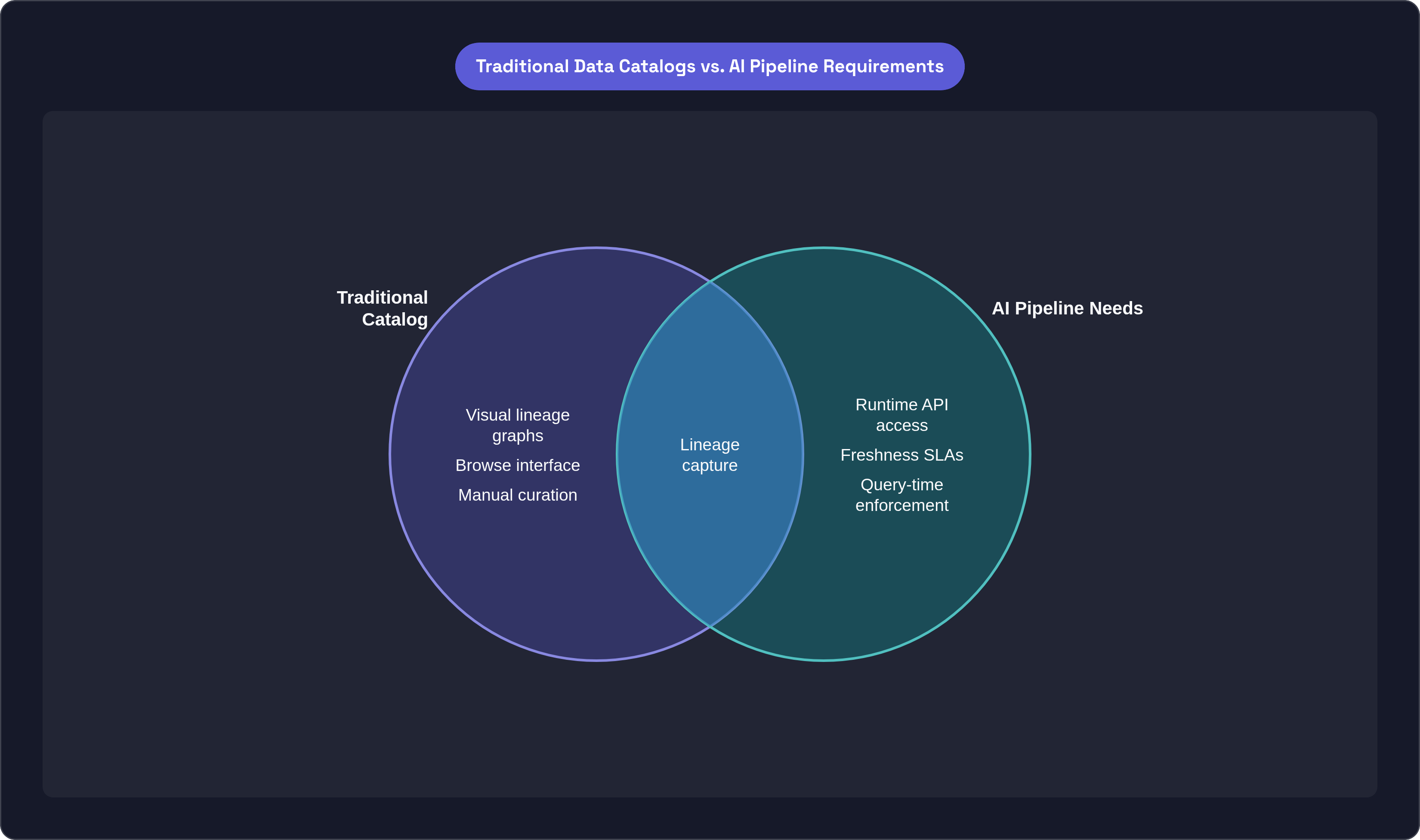
How an AI Pipeline Actually Consumes Data and Where It Needs to Ask for Help
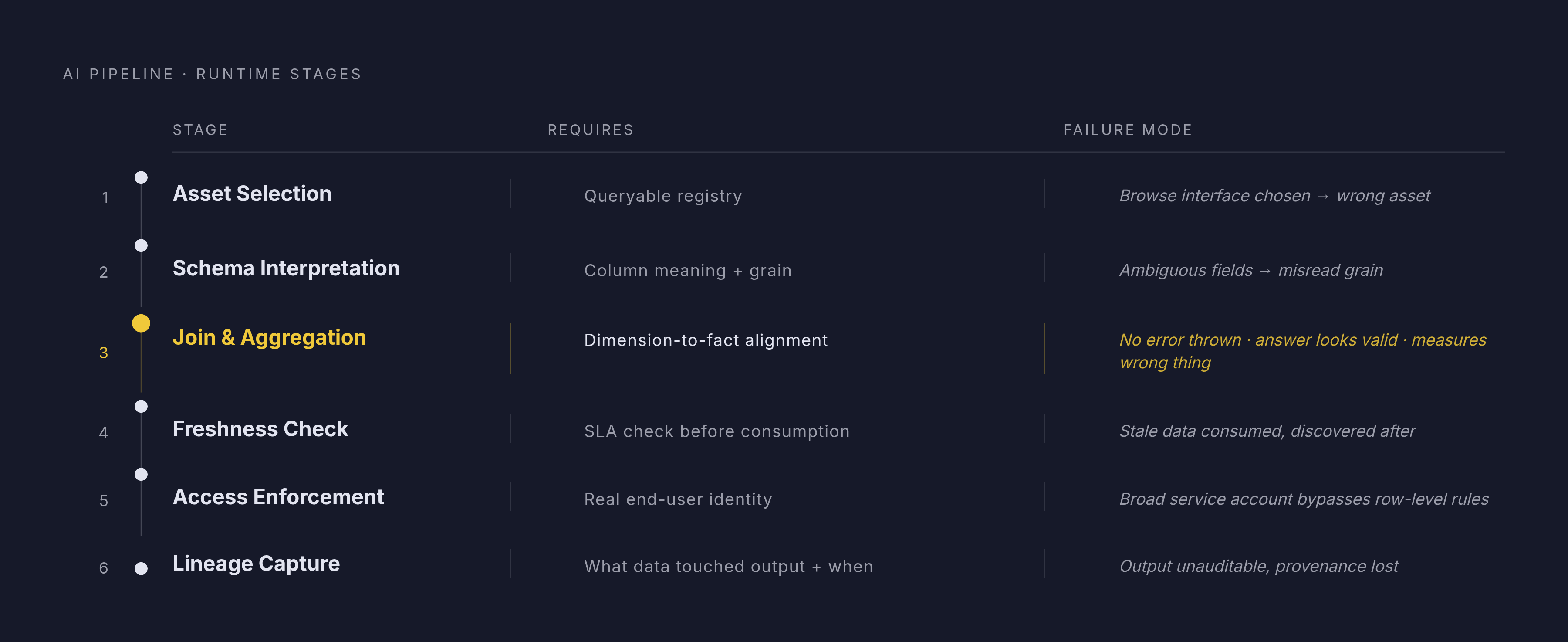
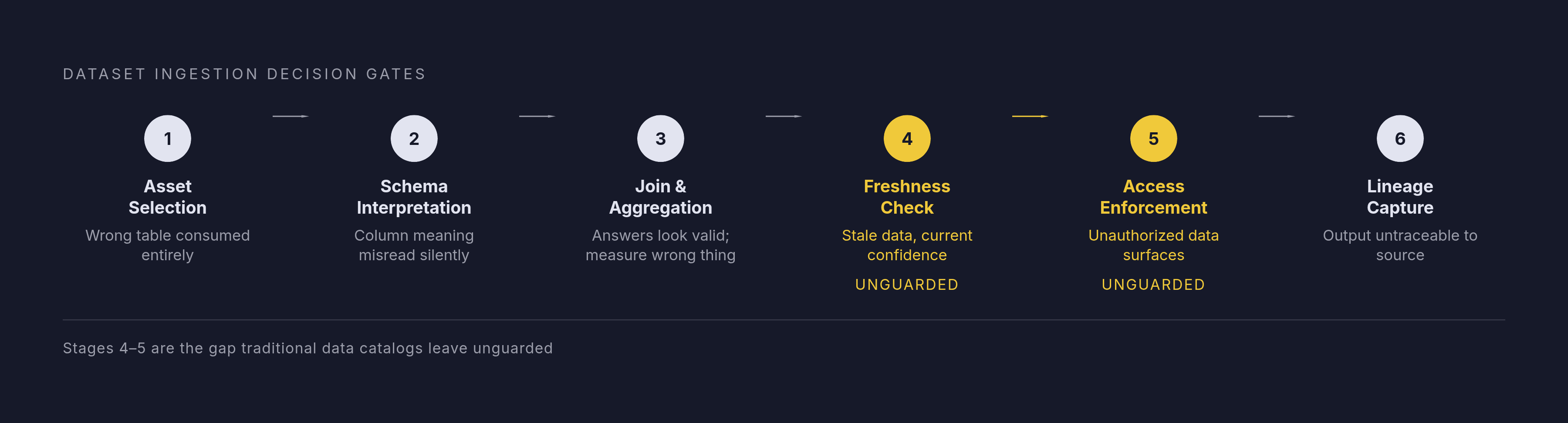
Work through what a pipeline actually does, and the discovery dependency becomes visible fast.
Asset selection first: the pipeline needs to identify which table or API endpoint answers the question at hand. That requires a queryable registry, not a browse interface designed for a person with time to explore. Then schema interpretation: what does a column actually mean, what is the grain of the table, what does "active" signify in this specific context. Then join and aggregation logic: which dimension aligns with which fact table. Wrong choices here do not throw errors. They produce answers that look valid and measure the wrong thing entirely, and nobody knows until something embarrassing surfaces in a board presentation.
Freshness comes next. The pipeline needs a signal it can evaluate before consuming a dataset, not a dashboard someone pulls up afterward. Access enforcement follows: does the identity behind this query have rights to this data, evaluated right now, not assumed from a broad service account configured at design time. And lineage capture closes the loop, recording what data touched an output and when, for audit purposes and for diagnosing when outputs shift unexpectedly.
The unifying problem across all of these is what the industry has started calling the silent-failure problem. A pipeline that lacks discovery-layer support does not error out. It proceeds on a bad assumption, produces an answer that clears every technical validation, and is quietly wrong — like a GPS that confidently navigates you into a lake.
Omni's 2025 analysis named this pattern "modeling failure": wrong table selected, join at the wrong grain, aggregation at the wrong level. These are not hallucinations in any meaningful sense. They are catalog failures wearing model failures as a disguise. The real evaluation question for any discovery tool is not "can a person find the right dataset using this" but "can a pipeline find and correctly interpret the right dataset without human intervention at runtime." Most tools were built to answer the first question. The second is what matters now.
Semantic Context: The Requirement Discovery Tools Most Often Leave Unmet
An analyst encounters two tables both containing a column called "revenue," defined differently, and asks a colleague which one to use. That conversation takes thirty seconds. A pipeline makes a silent choice and propagates it downstream at machine speed. I have watched this asymmetry cause more production pain than any other single failure mode in data organizations, and it is fundamentally a semantic context problem.
Semantic context, in a pipeline context, means something specific. Metric definitions expressed in a form a query engine can consume, not prose a human reads. Entity resolution: knowing that "customer" in the CRM and "account" in the ERP refer to the same concept without being told at runtime. Disambiguation: "active" in a sales table and "active" in an engineering table carry different meanings, and agents have no institutional memory to sort that out. Permissions encoded at the metric level, not just the table level.
Gartner elevated the semantic layer to essential infrastructure in its 2025 Hype Cycle for Business Intelligence and Analytics. That is not an ambiguous signal.
When semantic context is absent, the failure modes are depressingly predictable. Five teams maintain five definitions of "churn." The pipeline selects one. Nobody knows which. An agent generates syntactically valid SQL that answers the wrong question and clears all validation. The inconsistency surfaces only when two pipelines contradict each other in a board presentation, at which point the conversation about which number is right is both awkward and entirely unresolvable without a forensic process nobody budgeted time for.
What a discovery tool must provide: metric definitions, dimension relationships, and join logic exposed through a machine-readable interface queryable at runtime. Not housed in documentation that an agent cannot consume. The interface needs to carry business context at the column and metric level, not just at the dataset level.
Several tools have moved in this direction. Looker's LookML encodes business logic in a governed semantic model that agents query in place of raw tables; Google's internal testing found it reduced data errors in generative AI natural language queries by as much as two-thirds. Databricks Metric Views reached general availability in early 2026 with similar intent. Snowflake Semantic Views extends the pattern to Snowflake-native workloads. Some tools situate a semantic layer above existing infrastructure rather than requiring schema rewrites, embedding metric definitions, table relationships, and join logic into every query the pipeline executes.
Lineage That a Pipeline Can Read, Not Just a Person Can Trace
Lineage serves two entirely different purposes depending on who consumes it, and most catalog tools have built for only one of them.
For a governance team, lineage is retrospective: visualize data flow, demonstrate compliance, satisfy an auditor. The output is a graph someone traces. For a pipeline, lineage is operational. At runtime, the pipeline needs to determine whether a source has changed, whether an upstream transformation is trustworthy, whether an output is tainted by a known-bad input. The output needs to be a signal a machine can act on, not a diagram a human admires.
The granularity a pipeline actually requires is more specific than most catalogs provide. Column-level lineage means not just "this table feeds that table" but "this output column is derived from these three source columns via this transformation." Transformation provenance means recording what logic was applied, by which process, at what time. Impact propagation means knowing which downstream pipelines are affected when an upstream source changes schema or quality, proactively, before the failure cascades.
Table-level lineage is something most catalog tools handle reasonably well. Column-level lineage and runtime-accessible lineage APIs are where the gap opens. McKinsey's 2025 research found that organizations achieving significant AI returns were twice as likely to have invested in data workflow redesign before model selection. Lineage infrastructure is a core component of that redesign.
The requirement: lineage queryable via API at runtime, at column-level granularity, logged with identity and intent rather than just asset names. Audit trails that record only which assets were touched become uninterpretable noise at the query volume that agent workloads generate.
Freshness Signals That Match What the Pipeline Is Actually Deciding
A dataset perfectly adequate for a weekly dashboard can be wrong for an agent making a pricing or routing decision in near-real time. This is not a data quality problem in the traditional sense. The data is accurate as of its last refresh. The problem is that the pipeline has no mechanism to evaluate whether "as of its last refresh" is acceptable for the specific decision it is about to make.
Freshness is not a universal property. It is relative to the use case, and conflating the two creates production failures that are genuinely difficult to diagnose after the fact. Fraud detection requires near-real-time state; a one-hour-old batch export is the wrong input regardless of its internal accuracy. Churn prediction runs correctly on a daily refresh. Inventory routing depends on operational system latency, not warehouse refresh cadence. The same dataset can be fresh enough for one pipeline and dangerously stale for another running twenty minutes later — like yesterday's weather forecast handed to a pilot mid-flight.
What discovery tools currently provide is a "last updated" timestamp on a dataset card, readable by a person who makes a contextual judgment. What pipelines need is a freshness SLA expressed as metadata the pipeline can compare against its own requirements before consuming a source. They also need a signal that distinguishes "this dataset has not updated because nothing changed" from "this pipeline is broken and the data is silently stale." Those are operationally different situations that a timestamp cannot differentiate.
Discovery tools must expose freshness SLAs and last-refresh metadata as queryable properties, not display fields, and surface breach signals proactively to pipelines rather than only to dashboard monitors that humans check on a schedule.
Access Governance Enforced at Query Time, Not Assumed at Pipeline Design Time
Here is the failure pattern that plays out repeatedly in production. A pipeline is built and tested against a service account with broad read access. Everything works in development. In production, the pipeline executes on behalf of a user with narrower rights. The discovery tool registered the dataset as accessible. The pipeline consumed it. The actual user was never authorized to see that data.
The access metadata in the catalog was accurate. The enforcement was absent. That distinction is the whole problem.
Research from Drexel University and Precisely found that 62% of organizations cite lack of data governance as the primary barrier to successful AI initiatives. The catalog is the system that knows which users and roles can access which assets. If that information is not queryable at runtime and enforcement is absent at the point of query, it is decorative — it documents a policy without implementing one, which is worse than having no policy at all, because it creates the appearance of compliance without the substance.
The complication compounds when pipelines join data across sources. Two fields individually permissioned for a given user can be joined to produce output that neither field's access control list anticipated. Sensitivity must be evaluated at the point of combination, not at the individual field level. That requires the catalog to function as an active enforcement layer, not a passive registry that assumes someone else is handling the hard part.
The requirement: permissions enforced at query time under the real end user's identity, not a shared service account; access policies revocable at the level of a single workload; audit logs that capture identity, intent, and lineage together. Agent-level query volumes will otherwise generate trails that are voluminous and entirely uninterpretable.
How the Leading Discovery and Catalog Tools Address These Requirements Today
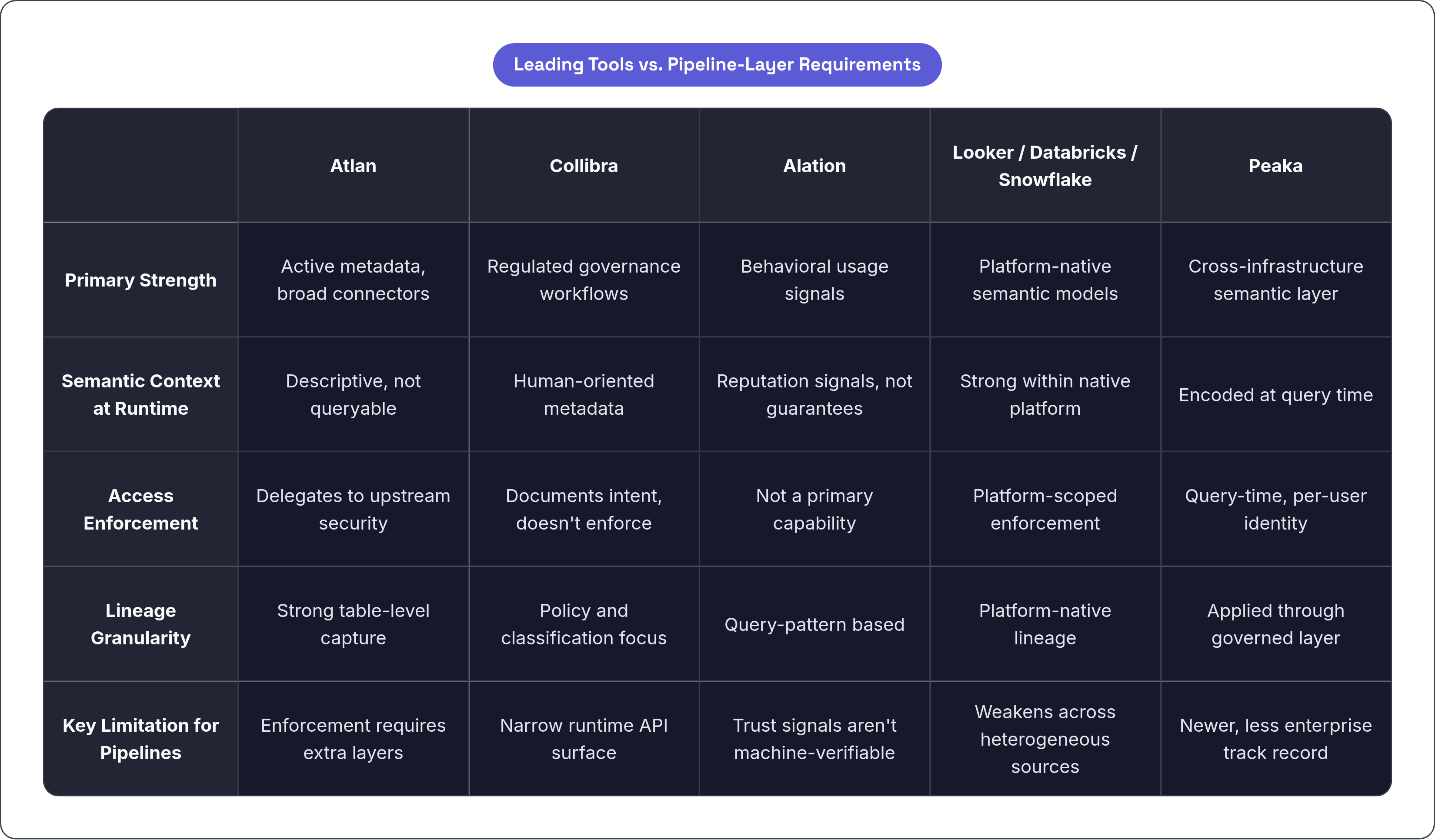
Evaluated against pipeline-layer requirements rather than analyst-facing UX features, the leading tools look different than their category positioning suggests. Some of that gap is architectural and some of it is a matter of where each vendor has chosen to focus. Neither is a moral failing, but both have real consequences for what you can build on top of them.
Atlan
Atlan holds a leader position in both the Gartner Magic Quadrant and the Forrester Wave for data catalogs as of 2025. Its active metadata architecture is genuinely useful for organizations where schemas and pipelines evolve constantly: the catalog keeps itself current rather than requiring manual curation to stay relevant. Connector coverage is broad. Lineage capture is strong. AI-assisted metadata enrichment reduces the documentation burden that quietly kills most governance initiatives before they get traction.
The pipeline-layer limitations are real. Semantic metric definitions in Atlan are descriptive rather than queryable by a runtime engine. Access enforcement depends on integration with upstream security layers rather than being enforced at the catalog query layer itself. For organizations that need an authoritative, well-maintained catalog, Atlan delivers. For organizations that need the catalog to be the enforcement point, not just the record, the architecture requires additional layers, and the responsibility for building those falls on you.
Collibra
Collibra's domain is regulated enterprises where formal governance workflows and audit documentation are non-negotiable. Its depth in policy workflow, classification and sensitivity tagging, and stewardship assignment is extensive. If an organization needs to demonstrate to an auditor exactly who approved what classification and when, Collibra handles that rigorously and has the enterprise track record to prove it.
The pipeline-layer limitation is structural rather than incidental. The catalog metadata is oriented toward human consumption. The runtime API surface for direct pipeline integration is narrower than purpose-built semantic layers. Collibra functions as an authoritative record of governance intent, which is genuinely valuable; it is not the system that enforces that intent at query time. In compliance-intensive environments, that gap requires explicit architectural decisions about where enforcement actually lives, and making those decisions after a production incident is a bad way to make them.
Alation
Alation's genuinely distinctive capability is behavioral metadata: surfacing which datasets analysts actually use, trust, and return to, based on observed query patterns rather than manually curated documentation. For analytics-first organizations where curation at scale is the primary challenge, this signal has practical value that manual tagging cannot replicate.
The pipeline-layer gap here is conceptual rather than technical. Usage signals are human-generated. The trust metadata Alation surfaces reflects analyst judgment, which is meaningful social proof but not a machine-verifiable property. A pipeline selecting a dataset based on Alation's trust signals is consuming a reputation mechanism — useful context, not a technical guarantee, and the distinction matters considerably when the pipeline is operating autonomously at scale with no one checking its work.
Looker, Databricks Metric Views, and Snowflake Semantic Views
These three are not data catalogs in the traditional sense. Grouping them with catalog tools obscures what they actually do. They are semantic layers integrated into query and compute platforms, and their approach to pipeline-layer requirements is architecturally distinct from the catalog tools above.
Looker's LookML model defines metrics, dimensions, and join logic in a form that a query engine consumes directly. Databricks Metric Views and Snowflake Semantic Views extend the same pattern within their respective platform ecosystems. The practical tradeoff is scope: each is most effective within its native platform. Organizations running heterogeneous infrastructure need to think carefully about how far semantic consistency actually extends across source systems, because a semantic layer that covers most of your data estate is only partially solving the problem, and the portion it misses tends to be exactly where the interesting joins happen.
Peaka
Peaka's approach is to position the semantic layer above existing infrastructure rather than inside a specific compute platform. Metric definitions, join logic, and table relationships are encoded in the layer and applied at query time, so a pipeline querying through Peaka resolves schema interpretation and join decisions against governed definitions rather than raw schemas. Access is enforced at query time scoped to the actual end user's identity rather than a service account, which addresses the governance enforcement gap directly rather than delegating it upstream.
What This Means for Tool Selection
No single tool in the current market fully satisfies all four pipeline-layer requirements. The catalog and the semantic layer solve different problems: the catalog manages inventory, lineage, and governance intent; the semantic layer makes that intent enforceable and queryable at runtime. Treating them as alternatives means governance policies exist on paper while pipelines operate without them. The organizations building durable AI data infrastructure are investing in both, with clear ownership of what each layer is responsible for enforcing, established before the first pipeline goes to production rather than after it fails.