OLTP vs OLAP for AI Agent Data Sources
AI agents need fresh transactional data and historical patterns simultaneously.

Application code is predictable. A developer writes a query against a schema they understand, ships it, and it runs exactly that way forever. The query doesn't mutate at runtime. The system knows precisely what it's asking for.
Analysts are a different animal, but still manageable. They write ad hoc queries, sure. But they carry institutional memory. They know that "revenue" in the finance schema excludes refunds, or that "customer" in the CRM counts subsidiaries separately. When something is ambiguous, they can turn to a colleague.
AI agents have neither of those safety nets. They generate queries dynamically, at runtime, against schemas they've never been trained on. No institutional memory. No ability to pause mid-workflow and ask what an ambiguous column name actually means. And here's what keeps infrastructure engineers up at night: a misreading agent produces an answer that looks exactly as confident as a correct one. No hedged phrasing, no uncertainty flag, nothing to indicate something went sideways. The error is invisible until something downstream breaks in a way nobody can immediately explain.
Agents also don't respect the traditional separation between workload types. A single agentic workflow reads a customer's live order from a transactional database, reasons over six months of purchasing patterns from an analytical warehouse, and writes a decision back to the system of record, all in one chain. Two systems, two consistency models, one consequential action. No human analyst ever had to do all three simultaneously in a single pass.
Then there's scale. Enterprises aren't deploying one agent running one report. They're running thousands of concurrent agent instances, each switching between systems, each issuing queries no developer pre-wrote. Gartner projects that 40% of enterprise applications will include task-specific AI agents by the end of 2026, up from less than 5% in 2025. The overhead cost of keeping OLTP and OLAP separate, tolerable when a human analyst bore it once per query, now multiplies across every concurrent instance in the fleet.
What each system gives an AI agent — and what it costs
OLTP databases were built for high-frequency, low-latency writes and point reads. One order. One balance update. Thousands of times per second. Row-based storage means all the fields for a given record live together on disk, which makes reading and writing a complete record fast.
For agents, that delivers something genuinely critical: the current state of a record, with strong consistency guarantees, immediately after a write. Fraud detection, inventory reservation, credit approval. Any agent action that must reflect the world as it is right now belongs in a transactional system. Read-after-write correctness isn't a nice-to-have in those workflows; it's the entire point.
The costs are real, though. OLTP schemas are normalized for application logic, not for the semantic clarity an agent needs. Column names that made perfect sense to the developers who built the system are opaque to an agent operating without context. Aggregation queries, the kind that scan millions of rows to compute a trend, aren't what row stores optimize for. And when thousands of agent instances issue broad analytical scans against a transactional database simultaneously, write throughput degrades. Works fine in development. Collapses in production.
OLAP systems were designed for the opposite workload: wide scans across many rows, few columns, aggregating fields like revenue or units sold across millions of records. Columnar storage keeps each field's values physically together on disk, which makes reading one column across fifty million rows fast, with favorable compression ratios on top of that. Per benchmarks published by datapace.ai, a column store ran a filtered aggregation 46 times faster than a row store on the same dataset. Not a rounding error.
What OLAP surrenders is freshness. The data in an analytical warehouse is a copy, reflecting the world as of the last load. For a human analyst running a quarterly revenue report, that's entirely acceptable. For an agent making a fulfillment decision or evaluating available inventory, a warehouse refreshed hours ago is a quiet liability. The agent reasons confidently over a number that's already wrong. Human analysts developed intuition about when freshness matters over years of getting burned by it. Agents lack that intuition, and there's no graceful way to install it without addressing the architecture underneath.
Why stitching OLTP and OLAP together doesn't solve the agent problem
The intuitive response is to query both systems: hit OLTP for fresh state, hit OLAP for historical context, merge results in the agent's context window. It sounds reasonable. It doesn't hold up.
Consistency guarantees don't compose across a network boundary. Two systems with separate transaction models and separate refresh cycles return contradictory answers about the same entity. When the agent reconciles those answers inside the prompt, it does so without any guarantee of correctness and without a shared audit trail tying the result back to a reliable source. Lineage disappears. Permissions are managed separately in each system, which means a user who shouldn't see a field in one system can reach it through the other path without triggering any access control. That's a compliance failure waiting to be discovered, not a theoretical vulnerability.
Then there's the pipeline problem. ETL processes adequate for refreshing dashboards become bottlenecks when thousands of agent instances are waiting on a sync. That's not a latency footnote; it's a system design failure.
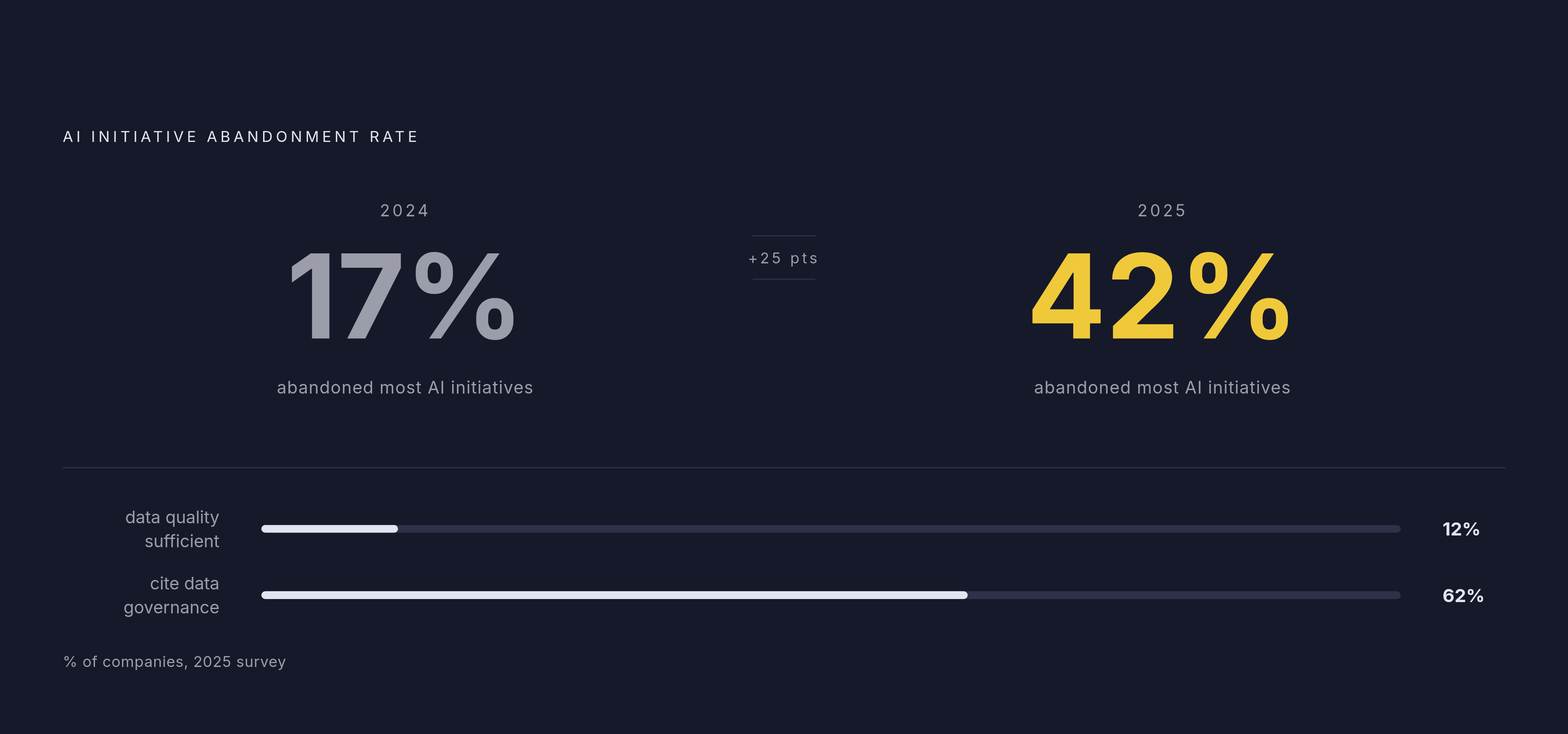
The numbers make the scale of the problem concrete. Only 12% of organizations reported data of sufficient quality and accessibility for AI, per Precisely's 2025 planning insights. 62% cited data governance as the top challenge inhibiting AI progress. S&P Global's 2025 survey found that 42% of companies abandoned most AI initiatives that year, up from 17% in 2024. The stitched-together approach is a meaningful part of why pilots don't survive contact with production data.
The convergence architectures the industry built in response
The market sent a clear architectural signal in mid-2025. Databricks acquired Neon for roughly one billion dollars. Snowflake acquired Crunchy Data for roughly hundreds of millions of dollars. Two dominant analytical platforms buying transactional capability at the same time. IDC research director Devin Pratt described these moves as reflecting how vendors are aligning with HTAP convergence as a prerequisite for agentic AI.
HTAP, Hybrid Transactional and Analytical Processing, is the bet that you can run both workloads in a single engine against the same storage, with committed transactions immediately visible to analytical queries. The hard problem it doesn't eliminate is workload isolation. Transactional and analytical workloads contend for the same resources, and calibrating that balance is genuinely non-trivial. Anyone who's tried to tune it in a production environment with real query variance knows how fast the tradeoffs get uncomfortable.
Databricks LTAP, launched in June 2026, takes a different path. It consolidates data into Delta and Apache Iceberg open formats and delivers sub-100ms query latency at 12,000 queries per second running directly on those tables. Writes commit to Lakebase, a Postgres-compatible OLTP layer, and a background process replicates into Iceberg with a reported sync lag of over a minute. That's not true single-engine HTAP; it's a tightly integrated CDC bridge with strong tooling around it. Worth naming clearly. Separately, Databricks' own Genie agent answered 84.5% of real-world enterprise questions correctly on first attempt, versus 52.4% for the strongest general-purpose coding agent and as low as 25% for the weakest. That gap traces back to semantic grounding as much as to storage architecture.
Neo4j Infinigraph, released in September 2025, approaches convergence from a graph-native direction, distributing OLTP and OLAP workloads across cluster members via sharding while preserving relationship structure across both workload types.
For teams not ready to replace existing infrastructure, change data capture has matured considerably as a pragmatic bridge. Amazon Aurora's zero-ETL integration replicates into Redshift within seconds of the transactional write, with general availability for Aurora PostgreSQL since 2023. Single-digit second latency from a well-configured CDC pipeline is achievable, which is sufficient for many agent workloads even where true real-time consistency isn't.
Practitioner behavior confirms the direction. Per VB Pulse's Q1 2026 survey, hybrid retrieval intent tripled from 10.3% to 33.3% across the quarter while standalone vector database adoption declined across every tracked vendor. That's not a trend line; that's a verdict.
What convergence doesn't fix: the semantic gap agents still fall into
Convergence solves the plumbing. One system, fresh data, no ETL delay. What it doesn't solve is what the data says about itself.
"Customer" means something different in the sales system than in the finance system. "Revenue" in one department's definition includes refunds; in another, it doesn't. "Order" refers to a placed order in one table and a shipped order in another. These ambiguities break human analysts too, but a human can ask a colleague and get a real answer. An agent generates a confident wrong answer with no signal that anything went sideways. A perfectly unified storage architecture changes none of that.
A semantic layer, a governed translation layer that maps raw fields and schemas to actual business concepts, is the mechanism that closes this gap. By the end of 2025, most serious data teams had some form of semantic layer in place. The problem is that those layers were built to enforce query consistency for humans, not to serve the full context an agent needs at query time.
An agent-ready semantic layer has to go further: table and column descriptions the agent can consume dynamically, not documentation sitting in a wiki somewhere. Metric definitions that hold across systems, not just within one warehouse's SQL dialect. Relationship maps between entities so the agent can navigate joins without guessing. Lineage and provenance so every answer traces back to a source. Quality signals so the agent knows when a field is unreliable.
In agent-to-agent workflows, the problem compounds. Sub-agents returning results built on different metric logic than the orchestrator expects, silently, at scale, is a failure mode that no amount of storage architecture improvement prevents. The A2A protocol Google published in April 2025 defines how agents communicate; it does not supply semantic grounding. Those are different problems, and conflating them is an easy way to discover the distinction the hard way.
Governance remains similarly unresolved. Sensitivity has to be evaluated at the point where data is combined across sources, not only at the individual field level. Permissions must be enforced at query time under the actual user's identity, not assumed from a service account with broader access than any individual user should have.
Matching the right source architecture to what a given agent workload actually requires
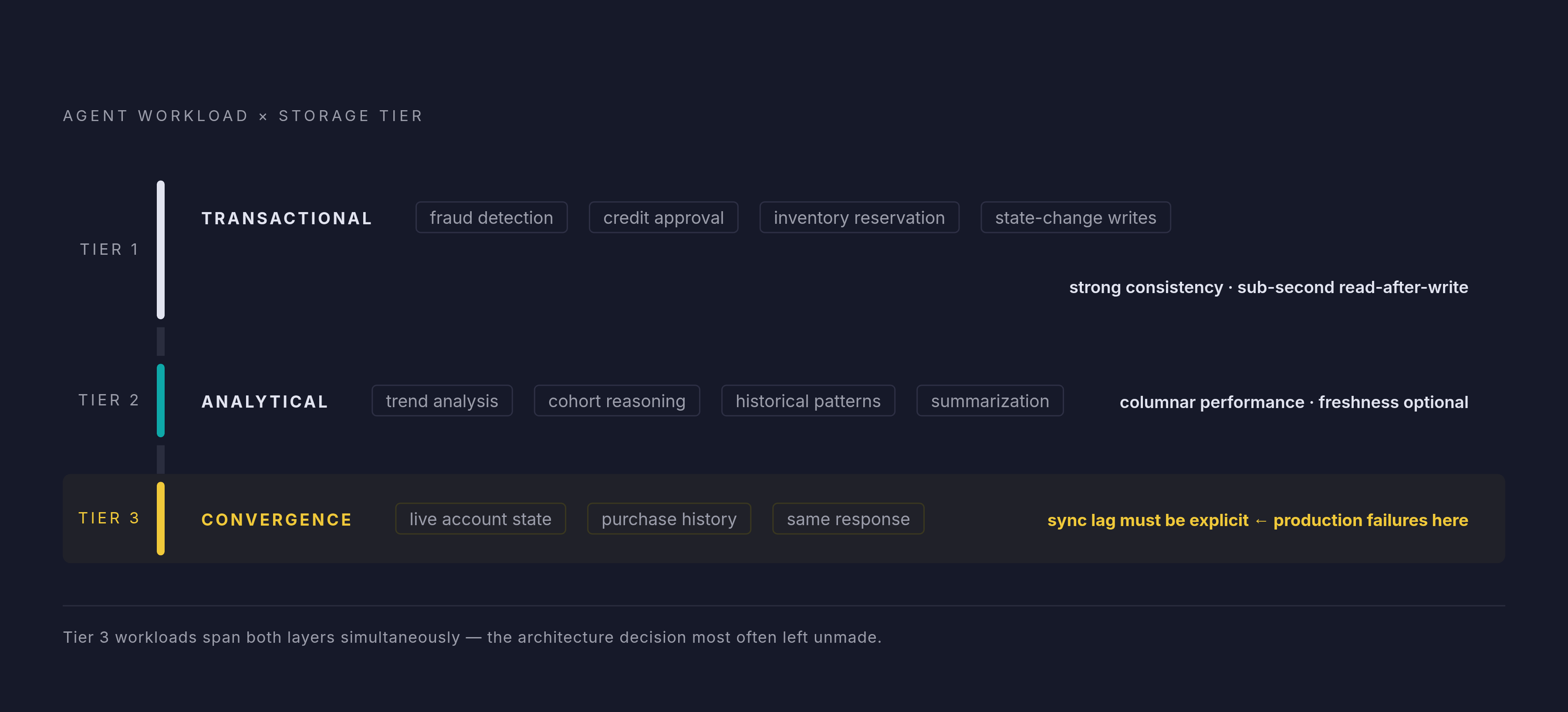
The core matching question is this: what does this agent need to be correct, and on what time horizon?
Workloads where staleness is the error belong on a transactional layer. Fraud detection. Credit approval. Inventory reservation. Any agent action that writes a state change back to a system of record. These workloads require strong consistency, sub-second read-after-write, and row-level permissions enforced at query time. The write must go to the system of record, not to a copy.
Workloads that belong on an analytical layer are the ones where the question itself spans a long time horizon: trend analysis, cohort reasoning, historical pattern detection, summarization over large datasets. Columnar performance advantages matter more than freshness to the second here. Reporting agents, recommendation engines working from historical signals, and summarization agents all fit this profile.
The genuinely difficult workloads are the ones that need both at once. A customer-facing agent that must display live account state and reason over purchase history in the same response. Convergence architectures reduce the gap, but where replication is involved, the sync lag has to be explicit and deliberate. A lag of over a minute is acceptable in some contexts; a true unified engine or live query layer is required in others. That decision has to be made consciously, before the agent is built, not diagnosed afterward when something starts returning nonsense.
McKinsey's 2025 research found that organizations achieving significant AI returns were twice as likely to have invested in data workflow redesign before model selection. The architecture decisions made before an agent is built determine whether it works in production. That sequencing isn't incidental; it's causal.
The semantic layer is not optional in either path. An agent querying a perfectly fresh transactional database still fails if the schema is opaque. Peaka, a zero-copy data integration platform with 300+ pre-built connectors to SaaS tools, databases, and APIs, addresses the case where replacing existing OLTP and OLAP infrastructure is unrealistic; it queries across both without copying data into a separate store, enforces permissions at query time under the actual user's identity, and surfaces semantic context including table descriptions, metric definitions, and relationship maps through its semantic layer, so that the agent's queries are grounded in what the data actually means rather than what the column names literally say.
The right architecture is always the one that matches the agent's actual workload requirements to the systems that can serve them. Freshness tolerances, consistency guarantees, semantic grounding: every one of those has to be a deliberate choice. Leaving any of them implicit is how production failures happen.